My Lai remembered
MY LAI, Vietnam - Forty years after rampaging American soldiers slaughtered her family, Do Thi Tuyet returned to the place where her childhood was shattered.
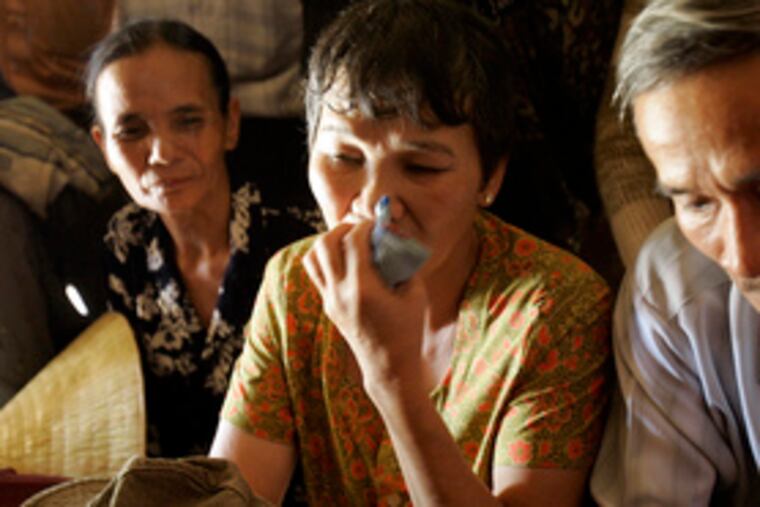
MY LAI, Vietnam - Forty years after rampaging American soldiers slaughtered her family, Do Thi Tuyet returned to the place where her childhood was shattered.
"Everyone in my family was killed in the My Lai massacre - my mother, my father, my brother and three sisters," said Tuyet, who was 8 at the time. "They threw me into a ditch full of dead bodies. I was covered with blood and brains."
More than a thousand people turned out yesterday to remember the victims of one of the most notorious chapters of the Vietnam War. On March 16, 1968, members of Charlie Company killed as many as 504 villagers, nearly all were unarmed children, women and elderly.
When the unprovoked attack was uncovered, it horrified Americans, prompted military investigations, and badly undermined support for the war.
Lt. William Calley was convicted of murder in the massacre and sentenced to life in prison. His sentence was reduced on appeal, and he was released in 1974.
Yesterday's memorial drew the families of the victims, returning U.S. war veterans, peace activists, and a delegation of atomic-bomb survivors from Hiroshima and Nagasaki.
"We are not harboring hatred," said Nguyen Hoang Son, vice governor of Quang Ngai, the central Vietnamese province where the incident occurred. "We are calling for solidarity to defend peace, to defend life, and to remind the world that it must never forget the massacre at My Lai."
Although the occasion was somber, many visitors said they drew hope from it.
"So much positive energy has come from such a negative event," said Richard Chamberlin, 63, a returning veteran from Madison, Wis. "The people here have amazing resilience. I'm grateful that they've treated us as friends, not enemies."
Chamberlin was part of a delegation called the Madison Quakers, a Wisconsin group that has built a peace park and three schools in My Lai, including one that was dedicated yesterday. The group's leader, war veteran Mike Boehm, honored the dead by playing a mournful fiddle tune.
Boehm also arranged for a group of atomic-bomb survivors from Japan to join his delegation. Among them was Fujio Shimoharu, who was playing in a Nagasaki schoolyard on Aug. 9, 1945, when the earth shook, a strong wind howled, and the sky went dark as a mushroom cloud rose over the city.
"I'm very angry about the indiscriminate killing both here in My Lai and in Hiroshima and Nagasaki," Shimoharu, 74, said. "I came here to send a message of peace to the world."
Shimoharu feels connected to My Lai survivors such as Tuyet, who returned to a replica of her home and wept after yesterday's service ended. U.S. troops torched the original thatch-roofed house; the new one is part of a museum dedicated to the victims.
On that morning 40 years ago, Tuyet and her family were getting ready to go to work in the fields when members of Charlie Company burst into their house and herded them outside at gunpoint. They were pushed into a ditch where more than 100 people were sprayed with bullets, one of which hit Tuyet in the back, paralyzing the right side of her body.
Four decades later, she is still overcome by grief. But Tuyet has managed to build a life for herself. She became a pharmacist, married, and had two children.
When they arrived in the hamlet 40 years ago, the frustrated and angry members of Charlie Company were on a "search-and-destroy" mission, trying to track down elusive Viet Cong guerrillas whose tactics had depleted the company's ranks. The soldiers began shooting that day even though they hadn't come under attack. The violence quickly escalated into an orgy of killing.
The young troops had found themselves in a bewildering war in which it was impossible to distinguish friend from foe, said Stanley Karnow, an American historian who wrote
Vietnam: A History.
Their actions shocked the American public, who had preferred to think of U.S. troops as heroes making the world safe for democracy, Karnow said.
Boehm, whose Wisconsin group helped plan yesterday's ceremony, takes solace from stories of the survivors.
"If hope can rise from the ashes of My Lai," he said, "it can rise from anywhere."