Liberia, scarred by war, takes first count since '84.
SELEGA, Liberia - The deep distrust of government created by years of war is evident in Liberian villages like this one, where people don't understand why census workers have been chalking numbers on every house, lean-to and shack.
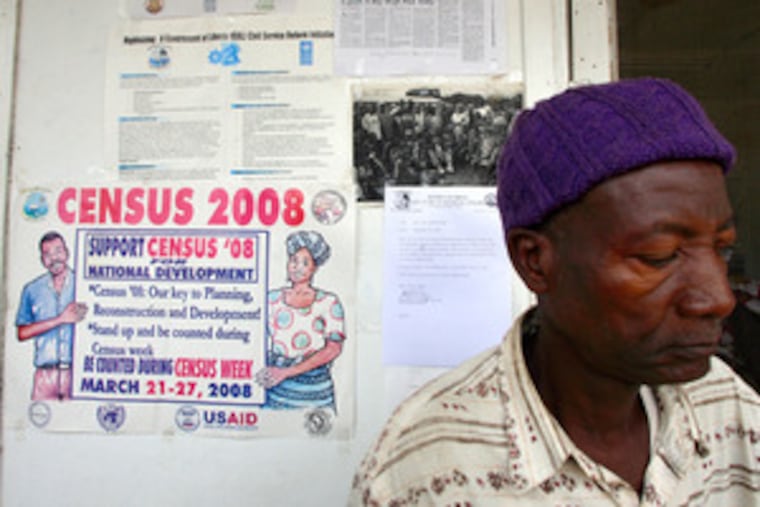
SELEGA, Liberia - The deep distrust of government created by years of war is evident in Liberian villages like this one, where people don't understand why census workers have been chalking numbers on every house, lean-to and shack.
"What do you think they want with my house?" said Monogo Kebeh, 70, outside her mud hut.
The census is an exercise as old as the Roman Empire, but in a country that has not had one for a quarter-century, it's anything but ordinary.
For more than a year, more than 9,000 census-takers have combed the densely forested nation mapping every structure. For three days starting today, they will revisit each dwelling and count the inhabitants.
The preparations, including the marking of dwellings, have given birth to rumors. Some wonder if the census is part of a military-recruitment drive, a potent fear in a country where boys as young as 5 were handed machine guns and forced to fight. Others believe it's in preparation for new taxes.
To try to dispel these and other rumors, the government commissioned a pop star to compose a catchy tune about the census. It has been translated into Liberia's 16 languages and is playing daily on the radio, urging Liberians to "stand up and be counted."
Throughout the country's interior, billboards have been erected reminding villagers to stay home for three days starting today to be counted properly. Schools are closed through the end of the census.
The last census took place in 1984, and in the 24 years since, Liberia spiraled into a civil war that left it dotted with mass graves.
In 2003, warlord-turned-president Charles Taylor was forced into exile, paving the way for elections and a return to peace.
In a country where Liberians struggle to earn, on average, $1.37 a day and die before 41, spending millions on a census might seem frivolous. But officials say their efforts to alleviate poverty and create a modern Liberia are useless without it.
"Without data, there is no way to target your resources properly," said Edward Liberty, who heads the Liberia Institute of Statistics & Geo-Information Services, the agency responsible for carrying out the census.
How can you know, he asked, where to build a hospital if you lack a clear grasp of where people live?
Census workers have already found that many villages that existed on the 1984 map are deserted, the result of massacres.
Counting citizens is an exercise that is at least 5,000 years old, dating to the ancient Babylonians, whose census tallied people, as well as the amount of honey, milk, wool and butter each had amassed.
The Romans gave the census its modern form, performing the count every five years. Today, censuses create a detailed snapshot of a country's citizens, including their age, gender, education and economic status.
In most developed countries, census-takers can simply ask a set of questions. In Liberia, they must phrase them in imaginative ways or face not getting correct information.
Many Liberians are illiterate and do not know their age. So, for example, if a woman appears to be in her 60s, a census-taker could ask if she was born before or after President William Tubman took office in 1943.
To determine economic status, census-takers ask villagers if they have a TV - but that could backfire, as a pilot census revealed last year.
"You ask 'Do you have a TV?' in order to be able to classify the person's economic situation, but they think that if they say they don't have one, you might give them a TV," said Rose Gakuba, the U.N. Population Fund's representative in Liberia and a lead organizer of the census. "So they hide the TV and the fridge and the generator and say they don't have a job and that their kids are not in school, thinking you'll pay their school fees."