New Yorker cartoon raises stir
So much for trying to point out the dangers of fear-mongering, artist Barry Blitt must be saying today. Yesterday, the man who drew the controversial New Yorker magazine cover featuring Barack and Michelle Obama was defending his use of irony.
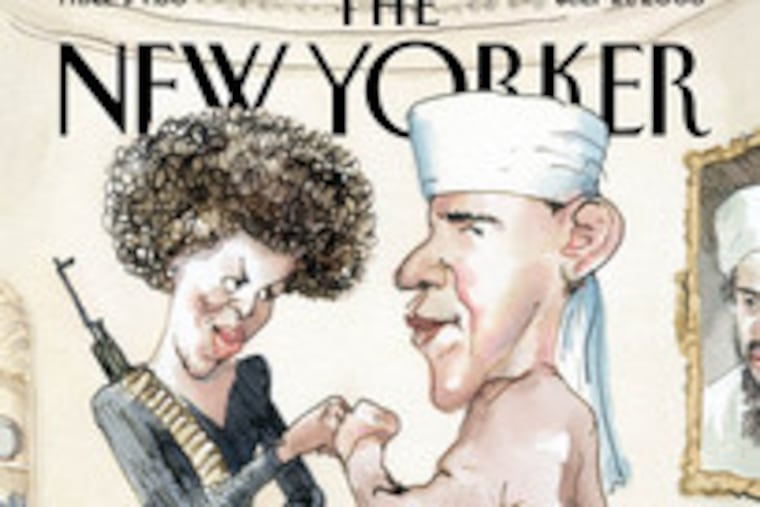
So much for trying to point out the dangers of fear-mongering, artist Barry Blitt must be saying today. Yesterday, the man who drew the controversial New Yorker magazine cover featuring Barack and Michelle Obama was defending his use of irony.
How literary. How New Yorker. How fast the criticism came after the issue hit newsstands.
"I view everyone involved as being ludicrous," said syndicated cartoonist Ted Rall, who thinks elitists, anti-elitists, the left and the right all are "a little hysterical."
In comments to the Huffington Post, Blitt wrote: "I think the idea that the Obamas are branded as unpatriotic (let alone as terrorists) in certain sectors is preposterous. It seemed to me that depicting the concept would show it as the fear-mongering ridiculousness that it is."
Attempts to reach Blitt for an interview were unsuccessful.
The illustration is titled "The Politics of Fear," though that appears only inside the magazine; there is no cover caption. The drawing shows Obama dressed in garb meant to make him look like a traditional Muslim, and his wife sporting a full afro and wearing camouflage, an AK-47, an ammo bandolier, and army boots.
The two are giving each other that now-famous fist bump - the affectionate greeting they exchanged the night he claimed the Democratic presidential nomination. The Obamas are shown standing in the Oval Office, a U.S. flag in the fireplace and a portrait of Osama bin Laden on the wall.
The Associated Press reported that the magazine, in a statement, said the cover combines "fantastical images about the Obamas and shows them for the obvious distortions they are."
"The burning flag, the nationalist-radical and Islamic outfits, the fist-bump, the portrait on the wall? All of them echo one attack or another," the statement said.
Obama, a Christian, has fought rumors claiming he secretly is a Muslim, a shadowy campaign that persists on the Internet and in e-mail.
His wife has endured her own attacks, including one claiming that a videotape showed her criticizing "whitey" from a church pulpit. The Obama campaign says there is no such tape.
A political cartoon that causes a furor certainly isn't anything new. Illustrated political-humor magazines, including the legendary Puck, date to the late 19th century, said Lucy Shelton Caswell, curator of Ohio State University's Cartoon Research Library.
Still, the 21st century is a vastly different environment. Faster than you could google "Obama" and "New Yorker," the cartoon had flared into controversy on cable news and the Internet.
Politicians and left-leaning Web sites decried the cover as insensitive and reinforcing lies promulgated by the right. Conservative writer Michelle Malkin's blog reaction was headlined, "Grow a pair, Obama," in response to his campaign's criticism of the cover, and showed cartoons that took aim at Bush administration officials.
Cartoonists and those who study political art were concerned this cartoon's lessons were being lost.
"This is what political cartooning should be all about," said Stephen Hess, co-author of
Drawn and Quartered: The History of American Political Cartoons
and a senior fellow emeritus with the Brookings Institution. "It's outrageous and it's controversial, and people are mad about it and arguing about it and thinking about it - and isn't that terrific."
"This country has lost its ability to have a sense of humor when it comes to satire and pointed commentary like this," said Bob Gorrell, a syndicated cartoonist who usually has conservative views.
Art Spiegelman, author of the graphic novel
Maus
and a frequent New Yorker artist, said the Obama cover isn't "anything other than a necessary inoculation and vaccination against what has been traveling below the surface and needs to be stared at right before the eye.. . ."
Spiegelman knows about outcries over New Yorker covers. He drew one in 1993 referring to the Crown Heights racial violence in New York between blacks and Orthodox Jews, showing a Hasidic Jewish man kissing an African American woman.
It took a few days for indignation, from all sides, to reach him. "The response now is more instant and more visible," he said.
That the Obama cover is on the New Yorker, an influential liberal magazine, makes the debate even more visible.
"If you are a subscriber to the New Yorker . . . you are going to read this cartoon the way it was intended," said Robert Thompson, professor of popular culture at Syracuse University. "However, when you yank this cover out of the context of the New Yorker reader . . . you're going to get people who don't read that picture as satire."