Hunting tips help Marines avoid being prey
A program hones their ability - crucial in Iraq - to notice and track what's around them.
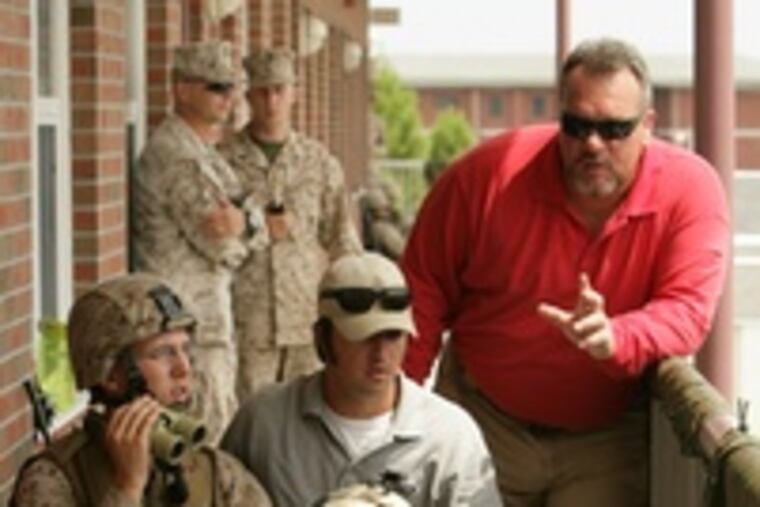
CAMP LEJEUNE, N.C. - The enemy hides among civilians on the urban battlefield in Iraq, walking the same dusty streets and in the same crowded markets where Cpl. Derrick Terrell found himself during a yearlong deployment.
The Marine rifleman said he had been oblivious to his surroundings, a wartime environment where basic infantry skills of shooting straight and heading out onto patrol were no longer enough. It's a potential weakness that has led Terrell and hundreds of other Marines to spend time Stateside with big-game hunters and police, learning to "hunt" for targets among the human landscape.
"I wish I had this training when I was there before," Terrell said of his time last year in Iraq. "It helps take away the enemy's advantage on us. I know what I am looking for now."
Called Combat Hunter, a two-week program at Camp Lejeune and Camp Pendleton, Calif., is designed to teach Marines how to observe, profile and track potentially dangerous individuals.
The program, which started in April 2007, grew out of a concept by Gen. James Mattis, who saw the need for hunting skills while overseeing combat forces at Pendleton.
Instructors teach Marines how to pay attention to small details and problem-solving. Marines are taught to pick out irregularities in the behavior of a village and track people who may be insurgents.
"All terrorists and criminals follow the same patterns," said Greg Williams, a police officer and big-game hunter who teaches the profiling portion of the program to the Marines. "We give them the ability to think like the enemy."
In the first week, Marines learn profiling techniques, including how to detect a criminal or a leader of a group based solely on behavioral patterns such as how he dresses, how the villagers respond to him, and where he goes in the village.
The second week focuses on tracking, as Marines learn to see "the unnatural," said Randy Merriman, a Camp Lejeune civilian instructor. They're taught to notice even minor disturbances, such as a broken branch, trampled grass, or litter that may indicate someone has passed through.
"We are giving them the gift of situational awareness," Williams said.
The final exam requires a six-man sniper team to track two instructors with a half-hour head start for several miles through thick pine forest and swampy terrain near Lejeune, the Marine Corps' main base on the East Coast.
A recent chase began when a trainee, Cpl. Charles Flaisher, noticed a branch was freshly broken. The undersides of the leaves were showing, and because there was no fading or brittleness from baking in the sun, they must have been turned over recently.
"We can now see if anybody has been there and if we are being tracked," said Flaisher, 25, a rifleman from Detroit.
For the next several miles, the team tracked the instructors through heavy brush, over a bourbon-colored creek, and through a thicket so dense the Marines had to crawl. The mission was familiar for Marine snipers, who must often sneak in and out of remote hiding spots.
Meanwhile, perched on a barracks several football fields away from the action, more than a dozen four-man teams of Marines faced a different test, scouring a mock village complete with an open-air market, a mosque, and a police station for the enemy.
Peering through binoculars and using infrared sensors, the Marines watched and catalogued every detail. Terrell alternated between the scope on his rifle and his binoculars as he watched townspeople mingle in the market, kick a soccer ball in a field, and rake up debris along a ditch.
The team observed the natural patterns of the villagers, and everything appeared normal. But over time, Terrell noticed a man dressed in jogging pants marking distances by counting his paces and dropping a small cup to mark the distance. A few moments later, a policeman was shot, and the village erupted in panic as a sniper opened fire. Terrell quickly called in the location of the sniper, but it was too late: The police officer was "dead."
After the training, Williams praised the Marines for communicating, but stressed they had failed to identify the sniper in time. Still, he acknowledged they hadn't performed badly their first time out.
Sgt. Chris Johnson, 22, of Taunton, Mass., said the training had made him more alert to changes in the normal pattern of life, which can be the difference between life and death in a war zone. "You are never going to see the world the same," Johnson said.