Sex for secrets? Decades later, truth emerges
SEOUL, South Korea - She was "the Korean seductress who betrayed America," a Seoul socialite said to have charmed secret information out of one lover, an American colonel, and passed it to another, a top Communist in North Korea.
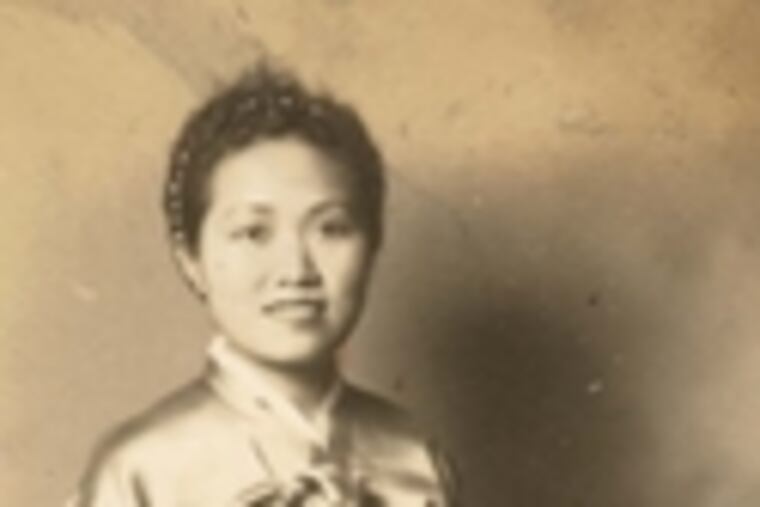
SEOUL, South Korea - She was "the Korean seductress who betrayed America," a Seoul socialite said to have charmed secret information out of one lover, an American colonel, and passed it to another, a top Communist in North Korea.
In late June 1950, as North Korean invaders closed in on this panicked city, Kim Soo-im was executed by the South Korean military, shot as a "very malicious international spy."
Her deeds, thereafter, only grew in infamy.
In 1950s America, gripped by anticommunist fever, one TV drama told viewers Kim's "womanly wiles" had been the Communists' "deadliest weapon." Another teleplay, introduced by host Ronald Reagan, depicted her as Asia's Mata Hari. Coronet magazine, under the "seductress" headline, reviled her as the Oriental queen of a vast Soviet "Operation Sex."
Kim Soo-im and her love triangle are gone, buried in separate corners of a turbulent past. But in yellowing U.S. military files stamped "SECRET," hibernating through a long winter of Cold War, the truth survived. Now it has emerged, a half-century too late to save her.
The record of a confidential 1950 U.S. inquiry and other declassified files, obtained by the Associated Press at the U.S. National Archives, tell a different Kim Soo-im story:
Col. John E. Baird had no access to the supposed sensitive information. Kim had no secrets to pass on. And her Korean lover, Lee Gang-kook, later executed by North Korea, may actually have been an American agent.
The espionage case, from what can be pieced together today, looks like little more than a frame-up.
Her colonel could have defended her, but instead Baird was rushed out of Korea to "avoid further embarrassment," the record shows. She was left to her fate - almost certainly, the Americans concluded, to be tortured by South Korean police into confessing to things she hadn't done.
Historians now believe the Seoul regime secretively executed at least 100,000 leftists and supposed sympathizers in 1950. This one death, for one American, remains a living, deeply personal story.
Wonil Kim - son of Kim Soo-im and Baird - is on a quest to bury the myths about his mother, a woman, he says, "with a passion for life, a strong woman caught up in the torrent of historical turmoil and drowned."
The son, a theology professor at California's La Sierra University, was the first to discover the declassified U.S. documents. Now he has also found an ally, Seoul director Cho Myung-hwa, who plans a feature film on Kim Soo-im.
"He betrayed her," Cho said of Baird. "He could have testified. But he just flew back Stateside to his American family."
The soft-spoken theologian, 59, and the moviemaker, 63, say that to grasp the Kim Soo-im story one must understand that young, educated Koreans of the 1930s and 1940s largely favored recasting their feudal country in a leftist mold once rid of their Japanese colonial rulers.
Kim Soo-im, born in 1911, was among the educated elite. An orphan, she was schooled by American missionaries, eventually graduating from Seoul's prestigious Ewha women's college.
Smart and fashionable, with a circle of sophisticated, politicized friends, she later met an older married man, Lee Gang-kook, a German-educated intellectual active in Seoul's leftist movement.
She became his lover, and Lee rose to political prominence after Japan's defeat. But within a year of the U.S. takeover, he faced arrest as an alleged security risk and fled to Communist-run northern Korea.
Kim Soo-im's fluent English, meanwhile, had made her valuable to the U.S. occupation. She was hired as an assistant by Baird, the Americans' 56-year-old, Irish-born military police chief. Baird secured a house for her and took to spending nights there, according to Korean and American witnesses in the declassified record.
"She had a baby by Col. Baird," Kim's friend Nancy Kim would later tell U.S. interrogators. "We all knew. He slept in the house many times. The baby looks like the father."
When the U.S. occupation army withdrew in 1949, succeeded by an advisory corps, Baird shifted to assisting the national police, and his American wife joined him in Korea.
Finally, on March 1, 1950, Kim, no longer U.S.-employed, was arrested by South Korean police, joining thousands of others ensnared in President Syngman Rhee's roundups of leftists.
"It was witch-hunting," said historian Jung Byung-joon, who has studied the case. "The South Korean police and prosecutors hated her because she was the lover of Lee Gang-kook, and then of Col. Baird, and nobody could touch her. They waited for their chance."
On June 14, 1950, nine days after Baird sailed from Korea, Kim Soo-im faced a five-judge South Korean military court and a long list of alleged crimes, including obtaining vehicles from the colonel that she lent or sold to "Communist" friends, and transporting Lee Gang-kook to the northern border in 1946 with a U.S. Army jeep.
The most serious charge accused her of eliciting the classified 1949 U.S. withdrawal plans from Baird, and relaying them to the Communists.
As her court-appointed lawyer noted, the government presented neither material evidence nor witnesses to back up the charges. But on the trial's third day, according to a summary in the declassified U.S. file, Kim Soo-im confessed and was sentenced to death.
Just weeks after her execution, however, and across the Pacific, U.S. military investigators reviewing Baird's role were hearing confidential testimony from Army officers indicating Kim's conviction was a contrivance of the Seoul authorities.
On the espionage count, officers up to Gen. Hodge himself testified Baird had no access to classified details of the troop withdrawal. Besides, the withdrawal's outlines had been reported in Stars and Stripes, the military newspaper available to all.