Russians continue to send mixed signals on a pullout
TBILISI, Georgia - Russian troops returned yesterday to the Georgian port city of Poti, taking 20 Georgian soldiers prisoner, towing away several American humvees, and blowing up a missile ship, reporters and Georgian officials said.
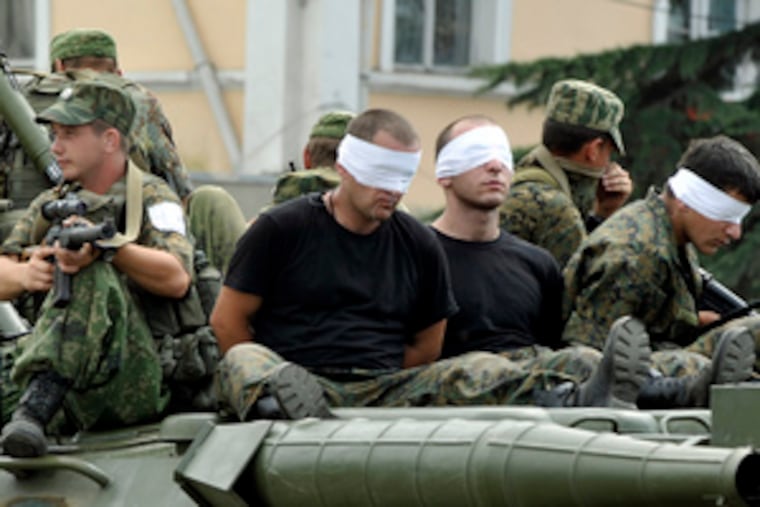
TBILISI, Georgia - Russian troops returned yesterday to the Georgian port city of Poti, taking 20 Georgian soldiers prisoner, towing away several American humvees, and blowing up a missile ship, reporters and Georgian officials said.
A column of Russian armored vehicles was seen leaving the area of Gori in the direction of North Ossetia, the pro-Russian separatist zone, a day after Russian officials said that a general withdrawal had begun.
Reporters in Gori said that the departure made no discernible difference in the Russian presence in the town and that Russian troops remained camped in fields north of it.
In a rare sign of cooperation, the two sides exchanged prisoners: 15 Georgians for five Russians. The Georgians, appearing on local television, said they had been tortured; several had broken arms or fingers. They said at least two Georgian soldiers were still being held in South Ossetia.
As U.S. and Western European governments continued to demand a rapid pullout, Russian intentions remained unclear. French officials said Russian President Dmitry A. Medvedev told French President Nicolas Sarkozy that the Russian withdrawal would be completed by tomorrow or Friday but that 500 troops would continue to implement "additional security measures" as allowed under an Aug. 12 cease-fire accord, Reuters news service reported.
Russia has used that wording to justify the presence of its soldiers in towns and along roads in many parts of Georgia outside of South Ossetia and another separatist zone, Abkhazia.
The Russian return to Poti came 11 days after an initial bombardment of the port, which is a main point of transit for goods crossing into and out of Georgia by sea.
Although the port had reopened, the flow of goods had stopped after Russians closed off Georgia's main east-west highway and destroyed part of its railway. Also, Georgian officials said, the presence of Russian vessels offshore is intimidating ships from calling at Poti and other Georgian ports on the Black Sea.
Georgian officials said the soldiers seized at Poti by the Russians had been sent to the port to guard it after an earlier Russian raid there. The Associated Press photographed the soldiers in Russian custody, blindfolded and handcuffed. It also photographed U.S.-made humvees being driven or towed away under Russian control. According to Georgian officials, the humvees belong to the U.S. Army.
The Georgian government said yesterday that 215 Georgians, 69 of them civilians, had been killed in the conflict so far and that 70 soldiers were missing.
British Foreign Secretary David Miliband arrived in Tbilisi last night. At a news conference with Georgian President Mikheil Saakashvili, he said an emergency meeting in Brussels of NATO foreign ministers yesterday had been marked by "above all, unity in the face of continuing Russian refusal" to leave Georgia as promised.
Earlier in the day, a large group of young Georgians marched from Tbilisi along the main road to Igoeti village, where Russian soldiers are positioned. The marchers carried signs calling for an end to the occupation and sang the Georgian national anthem. Some posed, grinning, for pictures beside Russian soldiers.
"I have an order to stop them here, to not let anyone go past," a Russian soldier said to a Georgian television crew filming the march. "I hope these boys and girls will understand us."
Many Georgians shrug at Russian promises to leave. Georgian Interior Ministry spokesman Shota Utiashvili said the Russian column that left Gori yesterday was part of a hoax. "They just call these foreign journalists, move the column in front of them, and then when they are gone, they put them back," Utiashvili said.
Nana Berekashvili, a Tbilisi resident, was busy at home last night, slicing bread and drying it in her oven, then putting it into a cloth bag - in case food becomes scarce.
"I just remembered my great-aunt always had this, and she was in Leningrad" during the siege of World War II, she said. "Even later, when she had plenty of money and food, she always had this. Now we have to think about these things again."