Now there's more to a Capitol visit
An overdue and overbudget visitor center is preparing to open its doors - finally.
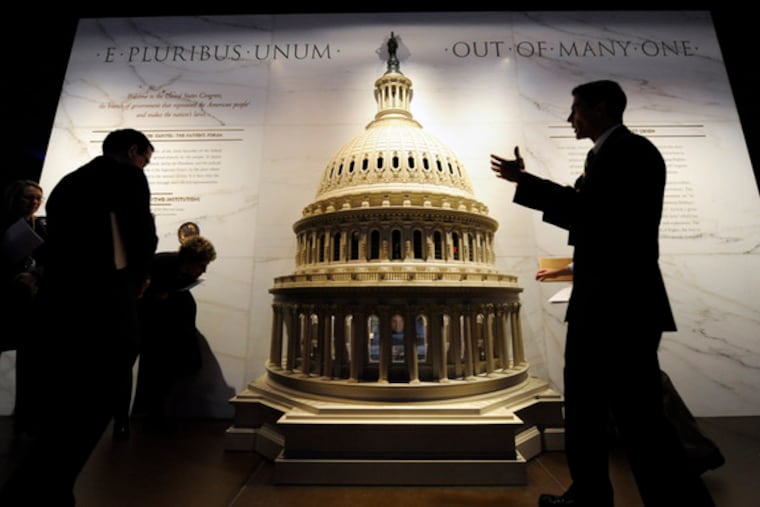
WASHINGTON - Three years behind schedule and almost $360 million above budget, the Capitol Visitor Center is preparing to open its doors to millions of tourists who now endure long lines without food, restrooms or shelter to catch a glimpse of the halls of Congress.
The underground center, the largest single construction project in the Capitol's two-century history in terms of size and expense, is to open to the public on Dec. 2.
The final cost of the project is put at $621 million, more than double the $265 million estimated cost had the center been completed on schedule in December, 2005. The escalating cost has invited criticism it is a boondoggle.
Rep. Robert A. Brady (D., Pa.) provides oversight for the project as chairman of the Committee on House Administration.
"I can make sure that it's done right from now on in," he told The Inquirer in an interview in August last year, months after gaining the congressional post.
For the 3 million tourists who visit the Capitol every year, the facility is long overdue. People now form lines at the bottom of Capitol Hill and wait in the heat, the cold and the rain to sign up for tours. They then must trek up the hill to enter the building.
With the Capitol Visitor Center, located below ground between the Capitol and the Supreme Court, visits will begin in the vast Emancipation Hall, which is filled with statues moved from the Capitol and a model of the Statue of Freedom that is perched above the Rotunda.
Before beginning tours of the Capitol itself, people can stroll through an exhibition hall with historic documents, artifacts and interactive computers, see shows in two theaters, and eat at a 530-seat restaurant area.
Among the artifacts on display are a letter from George Washington to the Continental Congress reporting the defeat of the British at Yorktown; Franklin D. Roosevelt's "infamy" speech; and John F. Kennedy's message to Congress proposing travel to the moon.
Also on view is the catafalque, the raised bier first built to support the casket of Abraham Lincoln and since used when presidents and military leaders, including JFK, Douglas MacArthur and Ronald Reagan, have lain in state in the Rotunda.
Visitors will also be able to book tours of the Capitol in advance at
» READ MORE: www.visitthecapitol.gov
, a Web site to open on Nov. 14, or by phone, 202-226-8000.
Momentum for the project began to build in 1998, when a mentally unstable man burst through the doors of the Capitol, killing two police officers before being subdued in the office of then-Republican Whip Tom DeLay.
That impressed on lawmakers the need to move security stations for visitors away from the main building. Groundbreaking was in 2000.
Security was also a key factor in the cost overruns. After the Sept. 11 attacks, Congress decided to add two tunnels, one for truck deliveries and one linking the Capitol with the Library of Congress, that could also serve as emergency evacuation routes.
There were also the usual overruns associated with a project in which 9,000 workers set 400,000 pieces of stone, some weighing 500 pounds. Excavation required the removal of 65,000 truckloads of dirt.
The acting architect of the Capitol, Stephen Ayers, at a news conference yesterday, defended the center, "a treasure in itself," saying it would both enhance security and contribute to the experience of visiting the Capitol.
"I don't think it's extravagant," he said. "We have built a building that's here to last another 215 years."