Film about founder upsets many in Turkey
Documentary shows weaknesses of the revered Ataturk.
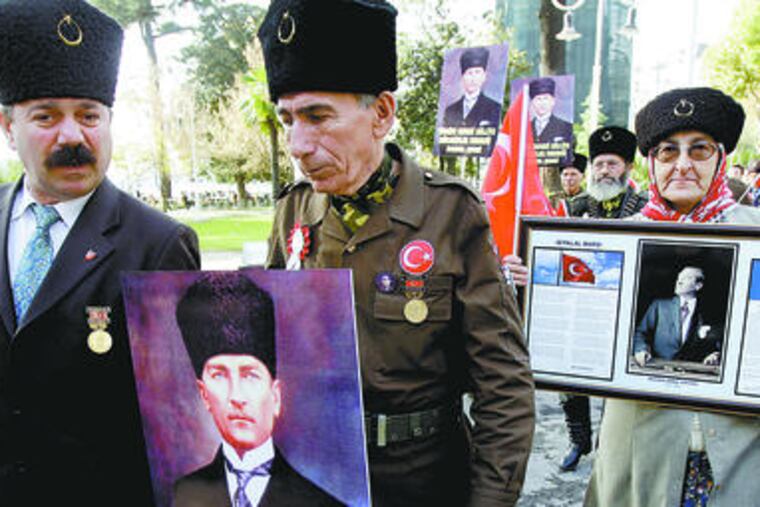
ANKARA, Turkey - A documentary that portrays the revered founder of modern Turkey as a lonely womanizer with a weakness for alcohol and cigarettes is drawing large crowds but outraging hard-line followers of Mustafa Kemal Ataturk's secular tradition.
More than a half-million people have watched
Mustafa
since its premiere Oct. 29 on the 85th anniversary of the Turkish republic, making it one of the most-seen films in Turkey in recent years.
Hard-line secularists are livid over its portrait of Ataturk as an authoritarian leader who was detached from the people and spent his final days smoking and drinking alone.
Turkey's top mobile-telephone operator, Turkcell, withdrew its sponsorship after company officials watched portions of the documentary before its release.
Two university professors filed a complaint with a court in Istanbul on Monday demanding an investigation into the film's director, journalist Can Dundar, for "eroding Ataturk's respectability."
Insulting Ataturk is a crime in Turkey.
'The glue'
"Ataturk is the glue that holds the Turkish people together, he is its leader, a model personality," professors Ahmet Ercan and Orhan Kural wrote.
Ataturk became a hero for his fearless leadership against Britain and its allies in the World War I battle of Gallipoli and went on to lead his demoralized, occupied nation to independence in 1922.
He embarked on a series of radical reforms aimed at turning the mainly Muslim Turkey into a Western European-style democracy - abolishing the Ottoman caliphate, giving the vote to women, restricting Islamic dress, and replacing the Arabic script with the Roman alphabet.
Admirers say he created a model nation that shows democracy and Islam can blend.
Ataturk is idolized as the personification of that tradition 70 years after his death at age 58 of cirrhosis of the liver. His portrait is ubiquitous - on home, school and office walls, currency, and even jewelry such as tie pins and shirt buttons.
'Freaky'
But Islamists dislike Ataturk for changes that reduced religion's role and banned religious orders such as the Sufis.
Critics say the movie devotes too much time to Ataturk's weaknesses.
It depicts him as afraid of the dark and terrified by a distant cloud of dust he thinks is kicked up by soldiers loyal to the Ottoman sultan who are trying to get him. It turns out to be a herd of animals in the distance.
The two-hour documentary narrated by Dundar shows Ataturk often alone, melancholic, and spending his days in the palace in Ankara, the capital he founded, drinking a bottle of the traditional Turkish spirit raki and smoking three packs a day.
Critics say that Ataturk was rarely alone and that his dinners were lively occasions where state affairs and reforms were discussed.
Yigit Bulut, a popular columnist for the Vatan newspaper, called the film "freaky" and the "latest attempt of an effort to belittle Ataturk in the eyes of the people."
Dundar defends his work as a realistic depiction of a man seen too long as beyond criticism.
"I wanted to present Ataturk to the new generation through cinema," Dundar told the Associated Press. "I wanted to present a warmer, a more human side to Ataturk."