Slovakia adopts the euro
It is 16th to join eurozone - and on currency's 10th anniversary.
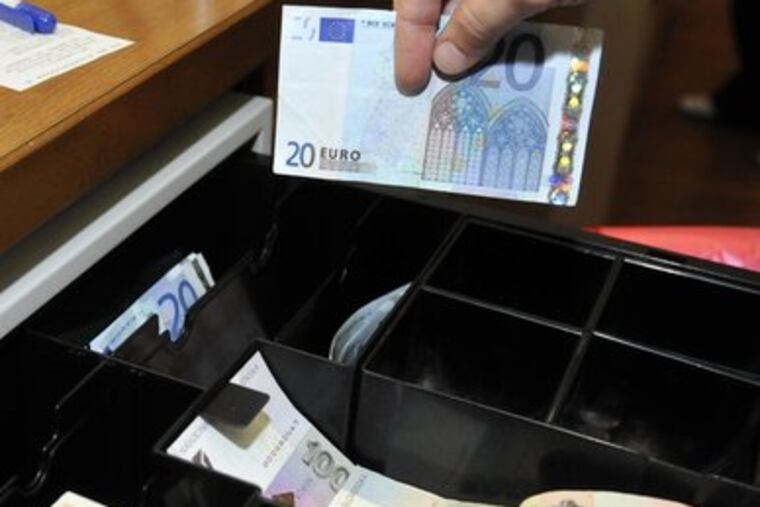
BRATISLAVA, Slovakia - Slovak banks did brisk business as they opened on New Year's Day for a very special occasion - issuing euros to citizens eager to get their hands on the country's new currency.
The small alpine nation yesterday became the 16th country to adopt the European Union's euro - a currency that also celebrated its 10th birthday yesterday. With the addition of Slovakia, the euro currency will be used by 330 million people with an annual gross domestic product of more than $5.6 trillion.
The decision by this country of 5.4 million people to join the eurozone and abandon the Slovak koruna appears even wiser now amid the global financial crisis, as other European countries have seen their currencies severely buffeted.
"I congratulate Slovakia and warmly welcome all its citizens to the euro area," EU Commission President Jose Manuel Barroso said. "The euro will help Slovakia to take part in, and benefit from, Europe's collective effort to recover from the current economic crisis."
He said the development showed Slovakia to be "a powerful symbol of economic and political progress and of European integration."
Slovak Prime Minister Robert Fico's comments were tinged with nostalgia.
"We're saying goodbye to the Slovak currency that meant so much to us," he said. "Part of us, the Slovak identity, is leaving."
Still, Fico was among the first Slovaks to slip the new bills into his wallet, pulling five crisp 20-euro notes out of an automated teller machine set up at the Slovak parliament shortly after midnight.
Slovakia is adapting as some people in EU members Denmark and Sweden are rethinking their countries' refusal to sign up for the euro. Czech Prime Minister Mirek Topolanek said yesterday that his government would set a target date in November for the euro's adoption.
Other countries have seen their currencies hit badly. EU member Hungary, once the beacon of economic success in postcommunist Eastern Europe, was forced last year to accept a bailout from the International Monetary Fund to avert economic collapse, as has non-EU member Ukraine.
Iceland, neither an EU nor a euro member, has suffered badly as an outsider, affected by a combination of a plunging currency and the popularity of high-interest foreign-currency loans. That means that monthly loan repayments for cars and homes have doubled this year, jolting Icelanders as the economy teeters and jobs are slashed.
Katinka Barysch, an analyst at the London-based Centre for European Reform think tank, said recent currency swings had underlined the benefits of the euro to Eastern European states.
"The very stark experience of being in the middle of a global economic storm means they have felt very cold and uncomfortable," she said.
Slovakia is also the first nation formerly in the Soviet orbit to join the eurozone - while Slovenia also was communist-ruled, it was part of Yugoslavia, which kept its distance from Moscow.
The euro was introduced on financial markets Jan. 1, 1999, and notes and coins first came into circulation in 2002. The zone widened to 15 nations in January 2008 when Cyprus and Malta joined; the other members are Belgium, Germany, Ireland, Greece, Spain, France, Italy, Luxembourg, the Netherlands, Austria, Portugal, Slovenia and Finland.
Slovakia's old currency will circulate alongside the euro until Jan. 16. Banks also plan to open over the weekend to aid the transition.