Dramatic details of splash-landing
Believing his plane was "too low" and "too slow," the pilot saw no option but the river.
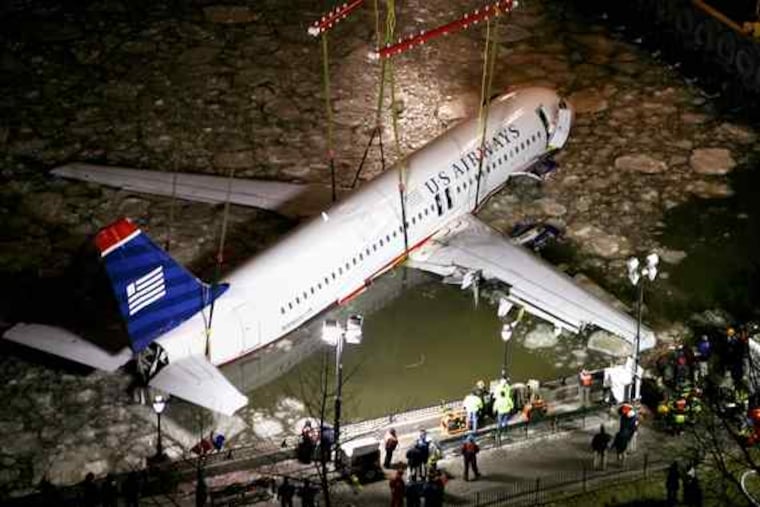
NEW YORK - The pilot of a crippled US Airways jetliner made a split-second decision to put down in the Hudson River because trying to return to the airport after birds knocked out both engines could have led to a "catastrophic" crash in a populated neighborhood, he told investigators yesterday.
Capt. Chesley B. "Sully" Sullenberger said that in the few minutes he had to decide where to set down the plane Thursday afternoon, he felt it was "too low, too slow," and near too many buildings to go anywhere else, according to the National Transportation Safety Board account of his testimony.
The pilot and his first officer provided their first account to NTSB investigators yesterday of what unfolded inside the cockpit of US Airways Flight 1549 after it slammed into a flock of birds and lost both engines.
Copilot Jeff Skiles, who was flying the plane at takeoff, saw the birds coming in perfect formation and made note of it. Sullenberger looked up, and in an instant his windscreen was filled with big, dark-brown birds.
"His instinct was to duck," said NTSB board member Kitty Higgins, recounting their interview. Then there was a thump, the smell of burning birds, and silence as both aircraft engines cut out.
The account illustrated how quickly things deteriorated after the bump at 3,000 feet, and the pilots' swift realization that returning to LaGuardia or getting to another airport was impossible.
With both engines out, Higgins said, flight attendants described complete silence in the cabin, "like being in a library." A smoky haze and the odor of burning metal or electronics filled the plane.
The blow had come out of nowhere. The NTSB said radar data confirmed that the aircraft intersected a group of "primary targets," almost certainly birds, as the jet climbed over the Bronx.
After the bird impact, Sullenberger told investigators that he immediately took over flying from his copilot.
Returning to LaGuardia, he quickly realized, was out. So was nearby Teterboro Airport, where he had never flown before, and which would require him to take the jet over densely populated northern New Jersey.
"We can't do it," he told air traffic controllers. "We're going to be in the Hudson."
The copilot kept trying to restart the engines, while checking off emergency landing procedures.
Sullenberger guided the gliding jet over the George Washington Bridge and looked for a place to land.
Sullenberger picked a stretch of water near Manhattan's commuter-ferry terminals. Rescuers arrived within minutes.
It all happened so fast, the crew never threw the aircraft's "ditch switch," which seals off the fuselage to make it more seaworthy.
After the hard landing, the crew's third flight attendant - the only one in the rear of the aircraft - made the decision not to open the back exits, she told NTSB investigators yesterday.
Before she could get the rearmost passengers headed for the front of the plane, one woman managed to open one of the doors a crack, letting water into the cabin.
As the details of the river landing emerged yesterday, the airliner was successfully lifted clear of the water following several hours of work by crews in frigid conditions. Investigators planned to tow the plane on a barge to an undisclosed location.
The NTSB said sonar teams may have located the sunken left engine of the plane. Reports identified an object directly below the landing site. Divers originally thought both engines were lost.