At tent camps, quake victims set up routines
L'AQUILA, Italy - Some semblance of routine was settling in at the tent camps sprawled across Italy's central earthquake-stricken region yesterday, and most of it involved lines: waiting for breakfast, waiting for information, waiting for a shower - a cold shower.
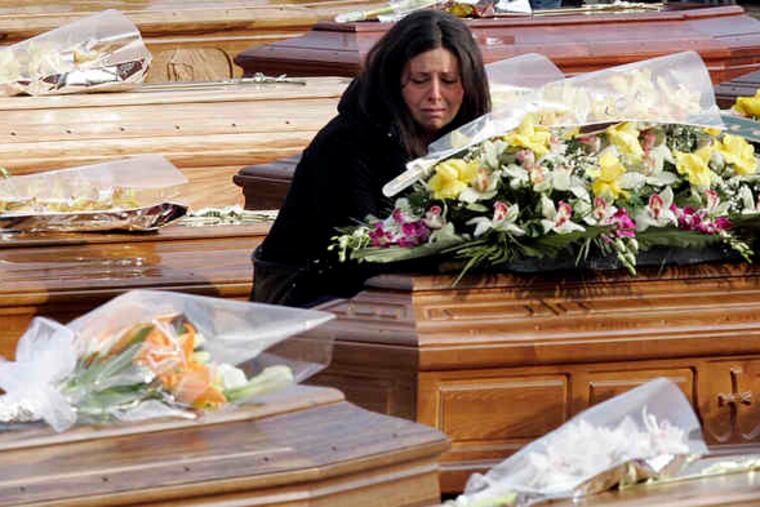
L'AQUILA, Italy - Some semblance of routine was settling in at the tent camps sprawled across Italy's central earthquake-stricken region yesterday, and most of it involved lines: waiting for breakfast, waiting for information, waiting for a shower - a cold shower.
Residents were slowly accepting that this could be their life for at least the next few months until temporary housing could be built. Some couldn't even think about returning to their homes, still spooked by the quake that shook them from their sleep Monday morning and killed at least 293 people.
On the eve of Easter, Roman Catholic faithful confessed their sins in a blow-up tent fitted with an altar and a crucifix to prepare for Mass the next day. In other tents, people gathered around flat-screen TVs to watch a soccer game or a news program reporting that the death toll had risen - with the latest bodies pulled from the rubble of a building in L'Aquila, only a few blocks away.
Their plight was remembered across the nation. Soccer matches yesterday were preceded by a minute of silence, and several clubs were donating gate receipts to help survivors.
The occupants are some of the 40,000 people whose homes were either destroyed, badly damaged or too risky to reoccupy without extensive repairs and shoring-up.
The camps mix the mundane and the surreal. Residents wake up to long lines for a breakfast of tea, yogurt, and sweet croissants, many of them reading newspapers as they wait.
At the entrances to the main camp in L'Aquila, which occupies a running track, a notice announces a lost pit bull, while another notice says psychological help for any of the 1,700 residents is available in a green tent.
Outside many tents, people have hung up laundry to dry.
People sit on plastic chairs chatting with their new neighbors.
Yesterday afternoon, some children and teens were being taught a dance routine to African music by an African man in a traditional blue robe.
Authorities have said it could be weeks, if not months, before it was known which of the houses left standing were safe enough to be repaired and which would have to be demolished.
Engineers and geologists have said that well-constructed buildings meeting seismic-safety standards should not have collapsed as they did, raising fears that shoddy construction factored significantly in the 6.3-magnitude temblor's deadliness and destruction.
L'Aquila prosecutor Alfredo Rossini has opened an investigation into the allegations of poor construction.
Firefighters clearing rubble have said reinforced concrete pillars crumbled like dust, sparking speculation that the cement was of poor quality.
Rossini said his office would investigate the alleged use of sea sand mixed in with cement.
"Sea sand corrodes cement," he said, "which then doesn't hold up at all."