U.S. moves to sink the Pacific cocaine trade
A 2008 law bans semi-submersible vessels, widely used by South American drug smugglers.
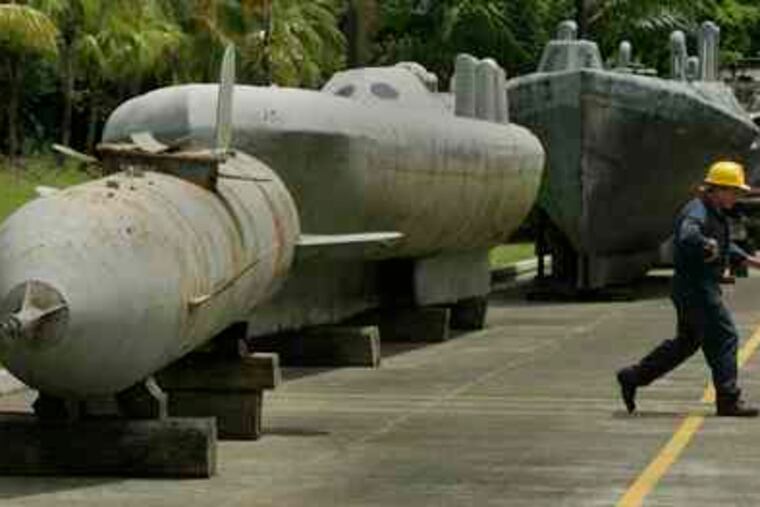
BOGOTA, Colombia - It's a game played out regularly on the high seas off Colombia's Pacific coast: A U.S. Navy helicopter spots a vessel the size of a humpback whale gliding just beneath the water's surface.
A Coast Guard ship dispatches an armed team to board the small, submarine-like craft in search of cocaine. Crew members wave and jump into the sea to be rescued, but not before they open flood valves and send the fiberglass hulk and its cargo into the deep.
Colombia has yet to make a single arrest in such scuttlings because the evidence sinks with the so-called semi-submersible.
Now a recently enacted U.S. law and proposed legislation in Colombia aim to thwart what has become South American traffickers' newest preferred means of getting multi-ton loads to Mexico and Central America.
Twelve people have been arrested under the U.S. Drug Trafficking Vessel Interdiction Act of 2008 since it went into effect in October. It outlaws such unregistered craft plying international waters "with the intent to evade detection." Crew members are subject to up to 15 years in prison.
"It's very likely a game-changer," Jay Bergman, the U.S. Drug Enforcement Administration's regional director, based in Colombia, said of the law. "You don't get a get-out-of-jail-free card anymore."
The law faces legal challenges, though. The defendants have filed pretrial motions saying it violates due process and is an unconstitutional application of the so-called High Seas clause, which allows U.S. prosecution of felonies at sea.
The vessels, hand-crafted in coastal jungle camps from fiberglass and wood, have become the new conveyance of choice for large loads, hauling nearly a third of U.S.-bound cocaine northward through the Pacific, said Coast Guard Rear Adm. Joseph Nimmich, commander of the Joint Interagency Task Force-South based in Key West, Fla.
That's up from 14 percent in 2007, according to the task force, which oversees interdiction south of the United States.
Colombian Navy chief Adm. Guillermo Barrera told a counterterrorism conference in Bogota recently that 23 semi-submersibles capable of carrying between 4 and 10 metric tons each had been seized in the last three years.
Though semi-submersibles aren't new to cocaine transport, a bigger, sleeker, more sophisticated variety that averages 60 feet in length began emerging three years ago.
With just over a foot of above-water clearance and V-shaped prows designed to leave minimal wakes, semi-submersibles are nearly impossible for surface craft to detect visually or by radar outside 10,000 feet.
That accounts for their relatively high success rate.
They are propelled by 250- to 350-horsepower diesel engines and take about a week averaging 7 knots (8 m.p.h.) to reach Mexico's shores, Colombian and U.S. investigators said.
Their fuel tanks carry 3,000 gallons of diesel, so no refueling is needed on the 2,000-mile journey north from Colombia.
With cocaine in Mexico fetching $6,500 per kilo - about triple the Colombian price, according to the U.S. Drug Enforcement Administration - an average 7 metric-ton load yields $45 million.
Crews have no problem scuttling the vessels after off-loading their cargo, investigators say. The roughly $1 million spent on each craft is simply written off as the cost of doing business.
Though authorities caught 11 semi-subs last year in international waters - with 7 tons of cocaine seized in one off Mexico in September - they estimate from intelligence and interdiction that another 60 delivered their cargo, Nimmich said.
The made-to-order vessels have become increasingly sophisticated. Engines and exhaust systems are typically shielded to make their heat signatures nearly invisible to infrared sensors used by U.S. and allied aircraft trying to find them.
The cooling system of a semi-sub seized off Costa Rica in September piped engine exhaust through the hull and discharged it at ambient temperature, Nimmich said.
Such design sophistication doesn't extend to crew quarters.
"The conditions are terrible," said Luis German Borrero, the former navy chief in the Pacific port of Buenaventura. "They don't have bathrooms. The beds are two mattresses draped over the fuel tanks, and the pilot can barely see through very small windows" in mini-cabin.
"The noise and heat must be something infernal," he added.
Nimmich said it's not drug smuggling that worries him, but a larger potential peril:
"I think that what makes semi-submersibles a larger national security threat is: What else can they carry?"