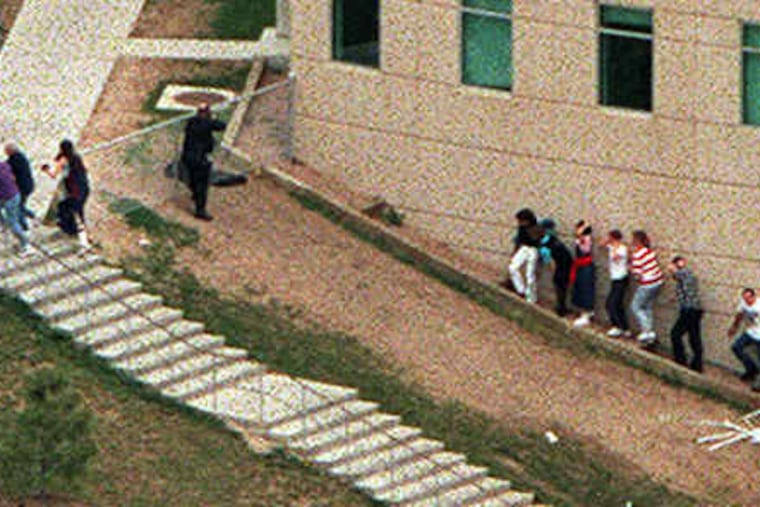
LITTLETON, Colo. - The "boy in the window" - who fell bloodied and paralyzed into the arms of rescuers during the horrifying Columbine High shooting rampage - is doing just fine.
Now 27, Patrick Ireland has regained mobility with few lingering effects from gunshot wounds to his head and leg a decade ago. He is married and works in the financial-services industry. His mantra: "I choose to be a victor rather than a victim."
Like Ireland, many survivors of the April 20, 1999, massacre have moved on to careers in education, medicine, ministry, and retail, despite lingering emotional scars.
"People have been able to have 10 years to reconcile what happened and see what fits in their life and who they are," said Kristi Mohrbacher of Littleton, who fled Columbine as the gunfire erupted.
Just after 11 a.m. on that day, Eric Harris, 18, and Dylan Klebold, 17, stormed the suburban school, killing 12 classmates and a teacher and wounding about two dozen. The massacre ended with the gunmen's suicides.
Sean Graves saw the pair loading weapons in a parking lot and thought they were preparing paintball guns.
Graves, Lance Kirklin, and Daniel Rohrbough were walking toward them for a better look when the gunmen opened fire, killing Rachel Scott and Rohrbough and critically wounding Anne Marie Hochhalter, Graves, and Kirklin, among others.
Ireland was under a table with Dan Steepleton and Makai Hall when they were shot in the knees. Ireland was shot twice in the head and once in a leg, and lost consciousness.
The killers shot out a library window. Graves, lying partially paralyzed on a sidewalk below, worried that they would return.
Harris and Klebold killed 10 students in the library before they left to reload, which gave some survivors a chance to flee.
When Ireland awoke, his vision was blurred. With fire alarms sounding and strobe lights flashing, the partially paralyzed teen began to push himself toward the bullet-shattered window.
Over the next three hours, he pulled his body along, lost and regained consciousness. He figures he traveled 50 feet to the window - kept going by fear of letting family and friends down if he gave up.
He pushed himself up to the window and got the attention of SWAT teams below. He doesn't recall flopping over the sill and dropping into the arms of rescuers, the image that grabbed the attention of TV viewers nationwide.
Graves, now 25, moved into a suburb near the mountains, where he recently purchased a home with his fiancee, Kara DeHart, 22. He walks with a limp and still feels pain, but he keeps a positive attitude. He plans to return to college to pursue a career in forensics science, a path that began to interest him after Columbine.
On today's anniversary, Graves will go back to the spot where he was shot, smoke a cigar, and leave another on the ground for Rohrbough. He does it every year.
With two children at Columbine, Ted Hochhalter watched the drama unfold on television while waiting in a Seattle airport for a flight to Denver. He arrived to find his daughter, Anne Marie, paralyzed and in critical condition, and to learn his son Nathan had been trapped, but unhurt, in the science wing for four hours.
Hochhalter took a leave of absence from his job as a government emergency-management coordinator. Six months later, his wife, Carla, who had a history of mental illness, walked into a pawnshop, picked up a gun, and committed suicide.
Hochhalter believes the shootings exacerbated his wife's illness.
Ireland recognizes he will long be remembered as the face of Columbine because of his dramatic rescue. He accepts it as a way to emphasize that Columbine should be another word for "hope and courage."
Seconds of Silence Mark Oklahoma City attack
A somber crowd of 400 gathered in Oklahoma City yesterday to observe 168 seconds of silence - marking the deaths 14 years ago of 168 people in the nation's worst domestic terrorist attack.
Survivors and victims' family members read victims' names at the spot that the Rev. Tom Ogburn of First Baptist Church of Oklahoma City called "holy ground."
"In our faith, we found hope," he said. "We were wounded, but not broken."
The explosion of a truck loaded with 4,000 pounds of ammonium nitrate and fuel oil tore the face off the nine-story Alfred P. Murrah Federal Building and caused millions of dollars in damage to other structures.
Timothy McVeigh was executed in 2001, and Terry Nichols is serving multiple life sentences on federal and state convictions for their convictions in the bombing. Prosecutors said the plot was an attempt to avenge the deaths of 80 people in the government siege at the Branch Davidian compound in Waco, Texas, two years earlier.
- Associated Press
EndText