Lobster dispute turns violent on Maine island
Residents of Matinicus fiercely defended their fishing territory. In the end, a man was shot.
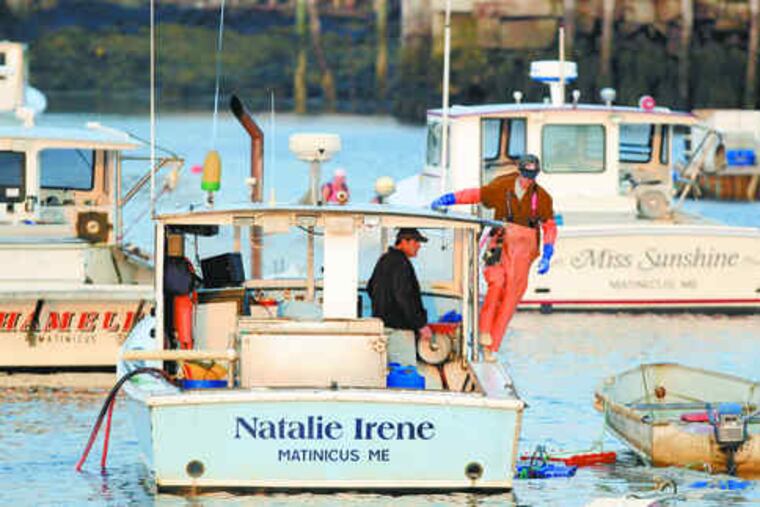
MATINICUS ISLAND, Maine - Life here is defined by the ocean. It's the ocean that feeds the livelihoods of the lobstermen. It's the ocean that dictates the weather. And it's 20 miles of ocean that separates Matinicus from the mainland and makes it a world apart.
The ocean's bountiful waters have also been a source of strife for as long as anyone can remember.
Lobster fishermen have feuded for generations over who can set traps, and where. To protect their fishing grounds, the lobstermen have been known to cut trap lines, circle their boats menacingly around unwelcome vessels, and fire warning blasts from shotguns.
With lobster prices down, the animosity has been particularly shrill this summer.
On a July morning, it reached the boiling point when a longtime lobsterman and his daughter drew guns on two fellow islanders. The lobsterman fired, shooting a man he had known for decades in the neck, police reported.
The shooting has shone a spotlight on a long-standing territorial system all along the ragged Maine coast that gives fishermen unofficial rights to specified waters. The rights are legally unenforceable but usually accepted.
Nowhere are they more strictly enforced than around Matinicus Island, home to a fleet of three dozen lobster boats whose crews have a reputation for outlaw behavior.
Matinicus has a reason for feeling that it's on its own. Slightly smaller than New York's Central Park, the island is the farthest offshore of Maine's 15 year-round island communities. It's so isolated that the ferry comes only once a month in winter, when barely two dozen people live there. There are no restaurants or gas stations. Islanders fax their orders to a mainland grocery store.
Locals now want the state to create a special zone around Matinicus so only full-time residents can fish the waters. Such a move would cut down on the hostility while ensuring the island community's viability, lobstermen say.
Marine Patrol Col. Joseph Fessenden said he respected the unofficial, self-policing territorial system that lobstermen live by - but that laws must be respected.
"We don't let them do their cowboy thing," he said.
Still, Matinicus has more than its share of run-ins - from smelly bait herring dumped into a gasoline tank, disabling a boat, to raccoons, considered pests, dumped on the island, apparently by a man prevented from fishing there. A few years ago, two island fishermen were charged after one fired a shotgun across the bow of the other's boat when it crossed his wake at high speed.
But this summer brought a more serious confrontation.
Alan Miller knew he wasn't welcome to set his traps in waters around Matinicus. Miller, 59, is from Wheelers Bay, a small mainland harbor 20 miles across Penobscot Bay, but he reckoned he was entitled to fish Matinicus waters because his wife, Janan, and his father-in-law, Vance Bunker, were lifelong residents.
Bunker, who has homes on the island and the mainland, shared his son-in-law's belief.
But others disagreed. Matinicus lobstermen had voted more than once against allowing Miller to fish around the island. The votes were cast in secret ballots at annual meetings fishermen used to hold the first Sunday of each June in the basement of the island's white-steepled church.
Nonetheless, Miller this year set hundreds of his traps with their Day-Glo pink buoys in Matinicus waters. Predictably, it wasn't long before somebody cut the lines to many traps, leaving them sitting on the ocean bottom. Replacing a trap can cost $70 to $100.
Early on the morning of July 20, Marine Patrol officers were called to the island on a report of an altercation between Bunker and Chris Young, a 41-year-old Matinicus lobsterman.
Bunker, 68, grew up with Young's father and has known the son all his life. But tempers were hot that morning. Bunker told officers that Young had jumped onto his boat, accused him of cutting his trap lines, and tussled with him, so he sprayed Young with pepper spray.
A short time later, officers received a report that Matinicus fishermen were circling their boats around Miller's vessel outside the harbor. Marine Patrol police responded, and Officer Wes Dean rode back into the harbor on Miller's boat as a precaution. They arrived at Steamboat Wharf about 10 a.m.
That was when Bunker pulled up to the wharf in a pickup truck and confronted Young and Weston Ames, Young's sternman - and when Janan Miller stepped out from behind a stack of lobster traps and leveled a 12-gauge shotgun at Young and Ames, according to investigators' reports.
When Ames tried to push the shotgun barrel away, Bunker pulled a pistol from his holster and fired at him, police said. He missed.
Bunker turned, took aim at Young, and fired again, investigators said. The bullet struck Young in the neck, and he fell to the ground.
The wounded Young was flown to a mainland hospital, where he underwent surgery. The bullet fragmented upon impact, with parts of it coming within 3 millimeters of Young's spinal column, according to a lawsuit he filed against Bunker; it also said Young had suffered neurological damage to his hands and arm.
Bunker said he had shot in self-defense, contending that he had been threatened in the previous days and had pulled his gun because he feared he and his daughter were going to be shot when Ames grabbed for the shotgun.