Germany set to vote today
A new parliament will then pick a chancellor. Excitement is nonexistent.
Just a year ago, Germans were mesmerized by the U.S. presidential campaign. The foreign-policy speech that Barack Obama gave in Berlin attracted 200,000 people.
Today, Germans themselves are electing a new parliament that then will elect a chancellor - and it seems they couldn't care less. German politics are known to be austere, but this time, 20 years after the Berlin Wall came tumbling down, the dullness is excruciating.
Then again, this isn't really surprising given that the two main candidates are partners in government first, and campaign rivals second. Conservative Chancellor Angela Merkel is being challenged by her vice chancellor and foreign minister, Social Democrat Frank-Walter Steinmeier.
The two, on solid terms personally, have worked together fairly well for four years as the leaders of a "grand coalition" of Germany's two biggest parties, Merkel's Christian Democrats and the Social Democrats. Both are sober, pragmatic politicians who avoid heated arguments. To many observers, even the only televised debate of the campaign appeared more of a duet than a duel.
It doesn't help that Merkel seems on track for an easy reelection. The latest polls give the Christian Democrats an average of 35 percent of the vote, with the Social Democrats hovering around 26 percent.
A primary reason for the lack of excitement in the campaign is the absence of fundamental differences between the parties. Since her inauguration in 2005, Merkel has cast off the neoliberal image of the Christian Democrats. The traditionally left-leaning Social Democrats had already moved to the center under the leadership of Merkel's predecessor, Gerhard Schroeder.
Foreign policy is a good case in point: Both Merkel and Steinmeier stress the importance of the German-American partnership. And both back the deployment of German troops to Afghanistan. The topic was propelled onto the campaign stage only by an al-Qaeda video last weekend threatening Germany with terrorist attacks.
A week earlier, an air strike ordered by a German commander apparently killed dozens of civilians in Afghanistan's Kunduz region. Surveys show that more than half of Germans want their troops brought home. But both Merkel and Steinmeier, disagreeing only on the details, remain steadfast in their commitment.
Their grand coalition might have been uninspiring, but it can show off a reputable record domestically, including cutting labor costs and raising the retirement age from 65 to 67. In the financial crisis, the government, hesitant at first, took decisive action and implemented the third-largest stimulus program in the world (in GDP percentage), putting Germany on its way to a relatively swift recovery.
Unemployment is stable at roughly 8 percent, and business confidence is up for the sixth month in a row, especially among small and midsize companies that are the heart of the national economy.
The Social Democrats, though, couldn't profit much from the success. The public credited Merkel, who was in Pittsburgh last week for the G-20 summit, for most of the major achievements, such as the deal that saw General Motors sell its German affiliate Opel to the Canadian automotive company Magna and the Russian bank Sberbank - a move widely considered to have prevented plant closures in Germany.
In the final stretch of the campaign, the Social Democrats have tried to sharpen their profile by focusing on two issues: their opposition to the tax cuts that Merkel believes would further stimulate the economy, and their resolve to close down all German nuclear power plants as soon as possible.
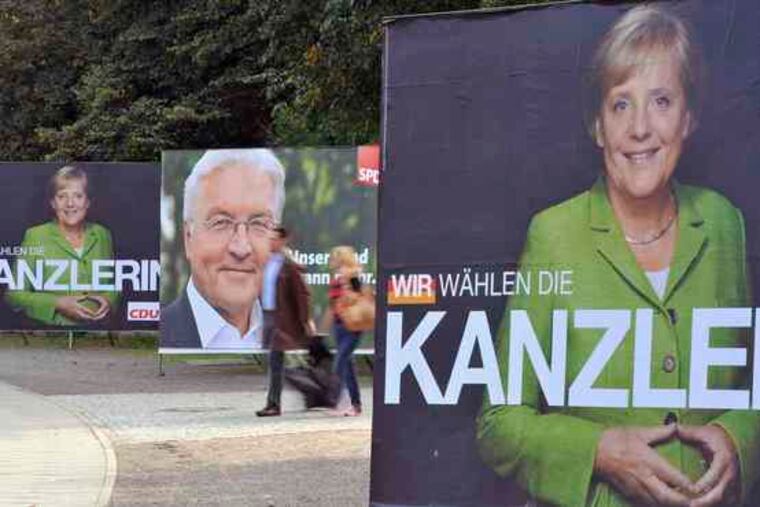
The Christian Democrats have mostly refrained from specific arguments. Their remarkably noncommittal and unaggressive campaign is zeroing in on what they regard their best asset: Merkel, who on campaign posters is portrayed as a mother-of-the-nation figure. A British newspaper called Berlin these days "a sort of Teutonic Pyongyang."
Once widely belittled for her blandness, Merkel, a pastor's daughter from the former East Germany, now displays a calm levelheadedness. Just named the world's most powerful woman by Forbes magazine, and having reluctantly undergone a fashion makeover at the start of her term, Merkel at 54 finally seems to relish the limelight.
The central question is the degree of Merkel's all-but-assured victory. She has made clear her preference for a center-right coalition with the business-friendly Free Democrats, which would give her a stronger mandate for economic reform. But with the Free Democrats polling around 14 percent, a majority in the Bundestag could hinge on a percentage point or two.
Steinmeier, 53, a likable technocrat but not a charismatic campaigner, has gained momentum in the last two weeks, but an upset victory from where he stands now would be unprecedented.
When Franz Muentefering, chairman of the Social Democrats, recently proclaimed, "Angela Merkel can start packing boxes," it sounded embarrassingly detached from reality even for his own supporters.
Germany Bans Flights Over Fest
German authorities banned all flights over Munich's annual Oktoberfest beer festival yesterday after a series of Islamic terror threats targeted Germany for its role in Afghanistan.
About six million visitors pack the massive tents that dot Munich's sprawling 77-acre Theresienwiese beer garden during the 16-day festival known across the globe. This year's event began Sept. 19.
The ban - a measure normally reserved for high-ranking state visits - is to remain in place through the end of the festival on Oct. 4.
Islamic terror groups such as al-Qaeda and the Taliban have directed threatening videos and audio messages at Germany in the last two weeks as citizens prepared to vote today in national elections.
The latest video, released by the Taliban late Friday, included pictures of Oktoberfest and threatened attacks on Germany in revenge for its military presence in Afghanistan.
- APEndText