Penn grad shares physics Nobel with two others
Willard S. Boyle and George E. Smith were brainstorming one afternoon in 1969 at the famed Bell Labs, trying to come up with a new kind of semiconductor memory.
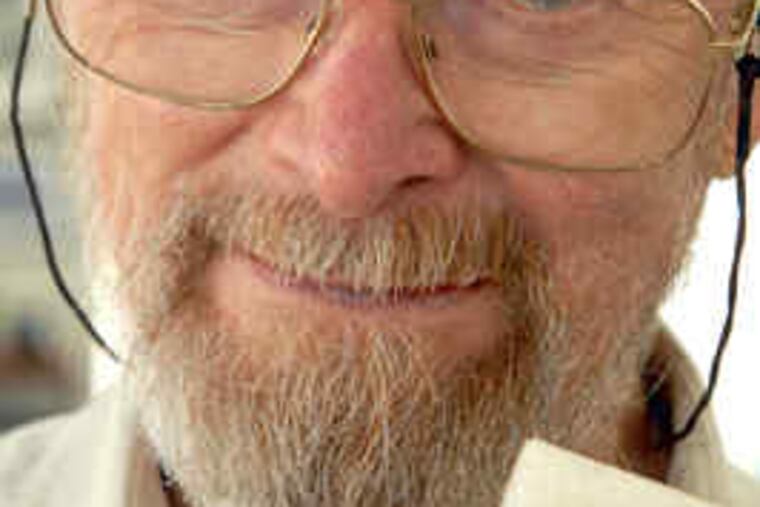
Willard S. Boyle and George E. Smith were brainstorming one afternoon in 1969 at the famed Bell Labs, trying to come up with a new kind of semiconductor memory.
They succeeded, after just an hour of sketching ideas on the blackboard in Boyle's office in Murray Hill, N.J. But the resulting "charge-coupled device" turned out to be much bigger than mere memory.
They soon saw their technology could be used to capture light, and today the invention is at the heart of digital cameras, camcorders, telescopes, and medical imaging equipment. Yesterday the two won the Nobel Prize in physics for their efforts.
Also sharing the prize is Charles K. Kao, whose early work on transmitting light through glass led to the invention of fiber optics, the high-tech plumbing that sends computer and telephone traffic across the globe.
Though not related, the two areas of research are complementary. One technology enables the capture of images from the farthest heavens to the innermost recesses of the human body, while the other provides the massive bandwidth needed to handle all those data. In announcing the award, to be given in December in Stockholm, Nobel officials dubbed the three winners "the masters of light."
"Ours is the age of information and images, and no two things better symbolize this than the Internet and digital cameras," said Robert Kirby-Harris, chief executive at the Institute of Physics in London. "These incredible inventors who have been responsible for transforming the world in which we live very much deserve their prize."
Kao, a former vice chancellor of the Chinese University of Hong Kong, will receive half of the $1.4 million prize. Boyle, of Nova Scotia, and Smith, a 1955 University of Pennsylvania graduate who now lives in Waretown, Ocean County, will split the other half.
Smith, 79, was asleep when the call came at 5:30 a.m., he said. He didn't get to the phone in time, but when he played the message on his machine, he got a surprise.
"They had a Swedish accent," he recalled, in an interview later in the morning.
Smith and Boyle had previously won the Draper Prize from the National Academy of Engineering, which sometimes is a precursor to the Nobel.
Daring to hope, he went to his computer to call up the Nobel Web site, and learned the announcement would not come until 5:45 a.m. Then a Nobel official called back and broke the news.
"Oh my goodness!" Smith said in a recording of the call posted on the Nobel Web site. "I definitely won't go back to sleep."
Their charge-coupled device is made of silicon, consisting of a grid of small capacitors that can store electric charge when struck by light. Today these pockets of charge are better known by another name: pixels.
The information can then be read out by applying a wave of voltage, which draws off the stored charges row by row, almost like soldiers marching single file. The process is sometimes called a "bucket brigade," said Rod Alferness, chief scientist at Bell Labs, which is now part of Alcatel-Lucent.
A prototype chip was built within a week of the brainstorming in Boyle's office, and early cameras using the chip were on the way within a few years. Now such chips are everywhere from household digital cameras - Smith owns a pair - to the Hubble telescope.
Kao's research is from roughly the same era. At the time, telephone traffic was carried on leaky copper wires. They lost 99 percent of the signal after just one kilometer, or less than two-thirds of a mile, requiring periodic amplification.
In 1966, Kao proposed that signals be carried through fibers of highly purified glass, using pulses of light. He bought some of the purest glass he could find, measured how light traveled through it, and realized it was not good enough. Glass made from ultra-pure fused silica would be better, he hypothesized.
Scientists around the world raced to implement Kao's notion. Four years later, a team at the Corning Glass company succeeded, using the fused silica that Kao had suggested.
Kao "was an early pioneer," said Robert Maurer, a member of the Corning team with Peter Schultz and Don Keck.
Those early fiber optics were only a bit better than copper, Schultz recalled. Today's versions maintain 95 percent of a signal after carrying it for one kilometer.
Though unseen, they are ubiquitous. The first fiber-optic cable was laid at the bottom of the Atlantic in 1988, enabling vastly cheaper international phone calls.
Now, according to Nobel officials, if one were to lay out all the world's glass fibers in a line, the resulting thread would encircle the globe 25,000 times.
See more at the Nobel Web site via http: //go.philly.com/nobel.2009 EndText