'Chemical Ali' gets a 4th death sentence
He is to hang for a 1988 gas attack that killed 5,000 in the Kurdish village of Halabja.
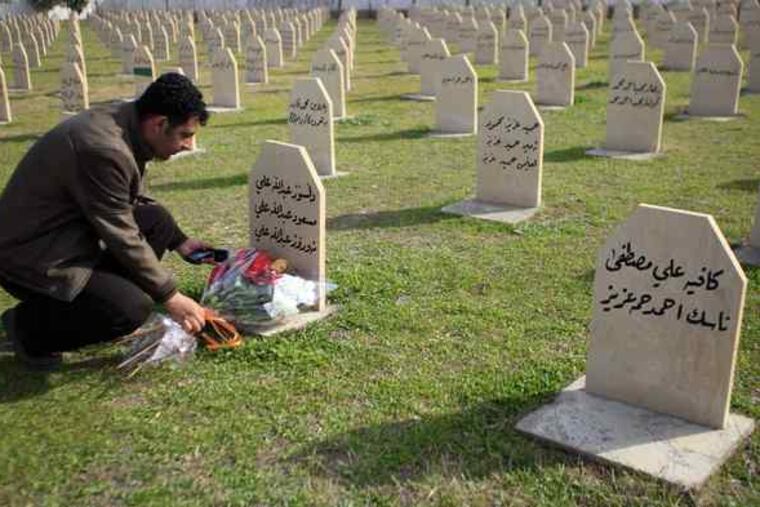
BAGHDAD - Saddam Hussein's notorious cousin "Chemical Ali" was convicted yesterday and sentenced to hang for ordering the most infamous of his crimes, the attacks against the Kurdish town of Halabja that killed more than 5,000 people in clouds of poisonous gas.
The fourth death sentence against Ali Hassan al-Majid for crimes against humanity serves as a reminder that victims of Hussein's atrocities remain determined to seek justice, as some politicians stoke the lingering bitterness toward the old Sunni-led regime to cement the Shiite domination that supplanted it.
For the still-suffering victims of the assault on Halabja more than two decades ago, the verdict brought a sense of closure to an event that came to symbolize the brutality of Hussein's rule. "Now the souls of our victims will rest in peace," said Nazik Tawfiq, 45, a Kurdish woman who said she lost six relatives in the attack. Upon hearing the verdict in the Baghdad courtroom, she fell to her knees to pray.
Majid's previous sentences have not been carried out in part because Halabja survivors wanted to have their case against him heard. Politics also plays a role, with a three-member presidential council representing Iraq's leading factions of Shiites, Sunni Arabs, and Kurds unable to agree to sign off on an earlier execution order.
Prime Minister Nouri al-Maliki, a Shiite who is seeking reelection in March, has taken a tough stance against former members of Hussein's now-banned Baath party. The government has accused Baathists of involvement in a number of major bombings that have undercut its efforts to maintain security as U.S. troops draw down.
Relatives of Halabja's victims clapped and embraced in a screened-off corner of the courtroom after the guilty verdict against Majid, one of the chief architects of Hussein's repression. He is one of the last high-profile members of the former regime still on trial, and he still faces charges in several additional cases.
Another senior figure in Hussein's regime, former Foreign Minister Tariq Aziz, suffered a severe stroke over the weekend and cannot speak, his son said yesterday from neighboring Jordan. Aziz was for years the chief diplomat of Hussein's regime. He was convicted and sentenced to prison for his involvement in the forced displacement of Kurds in northern Iraq and the deaths of Baghdad merchants in the 1990s.
Aziz was taken Thursday to a U.S. military hospital in Baghdad for examination, and his condition was improving, said U.S. military representative Lt. Col. Pat Johnson.
The continuing trials of Hussein's henchmen are seen by many Iraqis as evidence that the country's new Shiite-dominated government remains worried about a possible attempt by the Sunnis and their Arab backers to undermine its grip on power.
Majid earned his nickname because of his willingness to use poison gas against the Kurds.
The 1988 killings remain a source of deep pain, particularly in that community. Many in Halabja still suffer physically from the effects of the nerve and mustard gas that were unleashed on the village at the end of the eight-year Iran-Iraq War.
The chemical air raid is thought to be the worst single attack of its kind against civilians. Survivors feel a sense of injustice that Hussein was hanged for the killings of Shiites after a 1982 assassination attempt against him in a town north of Baghdad but did not live to face justice for the Halabja attack. He was executed in December 2006.