From Haiti to Phila., a surgical mission
Alex Vaccaro paused for a moment before he made the first incision into the young man's back. It was a cut the 48-year-old spine surgeon had made thousands of times, but never so long after such an injury had occurred.
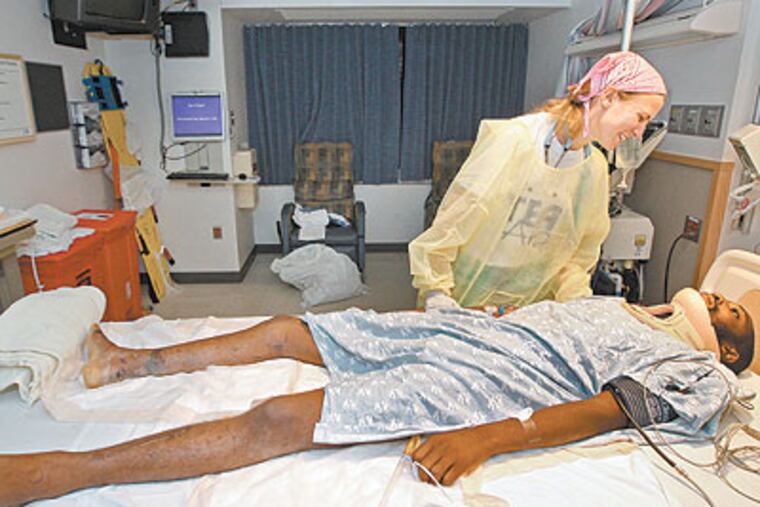
Alex Vaccaro paused for a moment before he made the first incision into the young man's back.
It was a cut the 48-year-old spine surgeon had made thousands of times, but never so long after such an injury had occurred.
For more than two weeks after the earthquake, Wilner Pierre, 29, had been jostled from hospital to hospital in southern Haiti. Most of that time, no one realized he was paralyzed from a broken back; instead, the focus was on his badly fractured right leg.
And each day that passed dimmed the chances Pierre would ever walk again.
Still, Vaccaro hoped to spare the young man lifelong imprisonment in a wheelchair in impoverished Haiti.
Working quickly, Vaccaro exposed six inches of Pierre's spine - two vertebrae above and two below the break.
The crack was impossible to miss, even to the naked eye.
As he worked, Vaccaro couldn't avoid comparing Pierre and another young man who also had arrived at Thomas Jefferson University Hospital the night before.
That patient had been stabbed in the back. The tip of the knife blade had lodged in a vertebra and broken off. But it had stopped before reaching the spinal cord.
He would be fine; surgeons wouldn't even have to remove the blade.
But Pierre? Vaccaro estimated that the young man had a 6 percent chance of getting back on his feet.
Those were slim odds, the surgeon thought as he cut through fat and muscle to expose more of the backbone.
Still, Pierre had a few things in his favor - he had gotten out of Haiti. He was at a major university hospital in the United States. And he had a pretty good spine surgeon, by Vaccaro's own estimation.
Alex Vaccaro 3d was vice chairman of orthopedic surgery at Jefferson. He was president of the American Spinal Injury Association - with a busy international lecture schedule. He was codirector of the Reconstructive Spine Service at the university's prestigious Rothman Institute.
Vaccaro felt lucky. Here he was, the second oldest of six children, the product of a comfortable, middle-class upbringing in suburban North Jersey. His father had worked for IBM; his mother was a real estate agent. Inspired by his family physician, Vaccaro had dreamed, since he was 8 years old, of becoming a doctor.
In high school biology class, he had discovered a love of surgery. He studied at Boston College, earned his medical degree from Georgetown, and did residencies at Cedars-Sinai Medical Center in Los Angeles and at Jefferson.
It was a long way from Pierre's fortunes.
Vaccaro took a deep breath and looked down at his patient. In his hands, the surgeon knew, Pierre's slim odds would improve.
The injury
Pierre wanted to go home to die.
Doctors at a hospital in Leogane - a town 20 miles north of his hometown of Jacmel - told him he needed an operation that was impossible to get in Haiti.
Pierre, a college graduate with a degree in civil engineering, had been unable to find work in his field. He had continued to take classes in hopes of landing a good job.
Despite his slight build – 130 pounds on a 5-foot-9 frame – he worked light construction jobs to help out his family. He lived in his parents' home with his younger brother and sister.
Pierre was the only one in the family seriously injured in the earthquake. His girlfriend also survived. The family earned some money growing produce, which Pierre's mother sold at Jacmel's open-air market.
Unable to help him, the doctors had put Pierre on a bus to Jacmel, where he was taken to another hospital. That's where Katie Gollotto, an American doctor from South Jersey, found him.
He had a fever of 105.9, an unstable femur fracture, pressure ulcers on his buttocks, gangrene on his broken right leg, and a cracked back.
She learned that Pierre had been in a classroom in Jacmel waiting for his professor when the earthquake hit. He had gotten to the stairs when the building collapsed.
He was trapped for nearly four hours before two men heard his cries for help and wrestled him out of the rubble.
Gollotto, who was directing an ad hoc medical team from Philadelphia, knew the young man would die without surgery. But her team didn't have a spine surgeon. Nor was it equipped for such an operation.
She and her colleagues were treating 200 patients a day at the hospital and another 200 at the nearby clinic. She called for help from other hospitals in Haiti. No luck. She contacted the U.S. Navy hospital ship off shore. Strike two. No one could take on Pierre's case.
To help fight off infection and buy Pierre some time, Gollotto started him on antibiotics. Then she called home.
Jack Cohen, an anesthesiologist, was part of the group in Philadelphia providing support for Gollotto's team in Haiti.
Cohen knew just the man. He and Alex Vaccaro routinely worked Eagles home games together as sideline doctors.
He called Vaccaro's cell.
It was Wednesday, Jan. 27, 15 days after the earthquake. Vaccaro was in Washington at NASA headquarters. He had been reviewing proposals for medical experiments in space.
He listened briefly to Cohen's pitch.
"OK, Jack," he said, "what's the next step?"
Vaccaro more than wanted to help in Haiti - he felt obligated. He was a spine surgeon, and, God knows, the quake victims could use him.
But Vaccaro was in the middle of a difficult divorce. If he went to Haiti, he might jeopardize the deal that granted him joint custody of his teenage children. He got them two days a week and every other weekend.
After medical school at Georgetown, he had worked for a Catholic relief organization on the Thai-Cambodian border, treating victims of the Vietnam-Khmer Rouge conflict.
So, two weeks earlier, when a friend called about going to Haiti, Vaccaro had felt terrible about having to say no.
And now, here was a chance to redeem himself.
Vaccaro figured he could operate Thursday or Friday and still devote the weekend to his 14-year-old daughter, Juliana, and his 16-year-old son, Alexander Richard Vaccaro 4th.
Vaccaro called Jefferson's president, Tom Lewis, and asked him to accept the young man and foot the bill for his care.
Lewis agreed.
Now all Vaccaro needed was the patient.
A flight out
Back in Haiti, Gollotto tackled several obstacles. She would have to get Pierre permission to enter the United States. She would have to find someone to donate a medical jet. And she would need a pilot.
Luckily, her partners in Philadelphia were able to help. They were part of a nascent nonprofit, Doctors United for Haiti, and their efforts to help earthquake victims were funded by the Haitian Timoun Foundation.
While Gollotto contacted U.S. officials in Port-au-Prince to get Pierre "humanitarian parole," Cohen and others in Philadelphia worked on the plane.
Jacmel's runway was only 3,300 feet long, too short to accommodate a plane big enough for Pierre's stretcher, his mother, a translator, and Gollotto, who would accompany him.
It took nearly three days to work out the logistics.
Finally, on Jan. 29, a Friday, the plane carrying Pierre left Haiti for Fort Lauderdale, Fla., where a second plane would ferry him to Philadelphia.
That evening, Vaccaro orchestrated surgery preparations from the sidelines of his daughter's basketball game in Bryn Mawr. She had made varsity as a freshman at Baldwin School, and her father - himself voted most athletic at his public high school - did not miss a game.
With few details about the patient, Vaccaro assumed the worst. If Pierre survived his infections, the trauma team would stabilize him and send him to the OR, where his gangrenous right leg would be amputated.
Then Vaccaro would operate on his spine.
After the game, he drove his daughter to a friend's house for the night. He checked on his son at home in Gladwyne. Then he drove his black BMW to the Center City hospital.
One thing the divorce had taught him was how hard his wife had worked at running the family. Without her, he struggled to keep up his 100-hour workweeks, his running schedule (11 marathons - his personal best was 4 hours, 5 minutes), his volunteer work at church, and the relentless stream of academic articles and chapters he wrote.
Now he had to juggle all that on his own and make good on his parenting responsibilities. This weekend, he had the kids. His wife was in Arizona.
Vaccaro arrived at 10:15 p.m. as the trauma team conducted its initial assessment of Pierre.
The surgical ICU room was crowded with nurses, doctors, residents, and others.
Gollotto was there with her children. Andrew, 12, and Annabella, 6, had met the plane at the airport.
Vaccaro recognized Gollotto. In 2008, she had organized a lecture for him at Temple. He remembered her as the strikingly beautiful resident who introduced him.
The trauma team, led by surgeon Gary Lindenbaum, assessed Pierre's condition.
"Let's get him rolled off the board, right now," ordered Lindenbaum.
"He needs a central line, right now," he said. "Culture him for everything . . . every freaking culture we can do."
An 8 a.m. slot
Just outside the room, Vaccaro and a colleague examined Pierre's X-rays from Haiti.
The film didn't show much. What he could see surprised him.
The spinal fracture did not appear to be bad enough to cause Pierre's paralysis. Vaccaro suspected the injury had happened after the initial break. Maybe when two men pulled him from the rubble or during the weeks Pierre had gone without proper care.
Vaccaro knew he would need more advanced scans to assess Pierre's injury.
The surgeon walked back into the room to check the patient and consult with Lindenbaum.
The good news was that the gangrene wasn't as bad as Vaccaro had anticipated.
Maybe they could save the fractured leg. Regardless, Pierre did not require immediate surgery. He could be stabilized overnight.
Lindenbaum ordered broad-spectrum antibiotics, CT scans from "head to toe," and an MRI of the entire spine.
Pierre had a 104-degree fever, indicating an infection, but he was not septic - a systemwide blood infection that could shut down his organs.
Vaccaro called to get an operating room and, after some cajoling, landed an 8 a.m. slot.
By 1 a.m., the surgeon was home. He spent an hour playing video games with his son before going to bed. At 3 a.m., a resident called to wake him. The scans were ready.
Vaccaro got up, logged on to his computer, and began to review the images.
He called his colleague Greg Gebauer, who would direct the residents, and laid out a plan for the surgery.
By 5:30 a.m. Vaccaro was back at the hospital. He did his rounds and then met with his team to review Pierre's scans and finish working out a plan of attack.
Vaccaro wouldn't make a single cut into the patient without knowing exactly what he would find.
And he was on a schedule. His son had a private baseball practice session at 11 a.m.
He couldn't miss that.
In the OR, Pierre was sedated so the anesthesiologist could intubate him and put him under. A spine-surgery table was prepared.
A neurophysiologist attached electrodes to Pierre's legs and abdomen. He tested for motor function and sensory responses - a baseline before surgery.
The first electric pulses got no response - no motor function.
The neurophysiologist sent out the second set of pulses.
"I've got some small sensories from the legs," he told Vaccaro.
"Now," the surgeon said, "there is a chance."
Two titanium rods
At 9:24 a.m. Vaccaro made his first incision.
He sliced along Pierre's spine from the 10th thoracic vertebra to the second lumbar vertebra - T10 to L2, a six-inch stretch - while Gebauer worked on Pierre's hip.
Gebauer harvested a small bit of iliac crest at the top of the hip bone to use as a graft on the broken spine.
Vaccaro and Gebauer inserted four pairs of 1.6-inch-long pedicle screws. Their surgical instruments resembled a handyman's tools - sterile screwdrivers, augers, wrenches. After each set of screws was tightened down - first T10, then T11, L1, and finally L2 - Vaccaro ordered an X-ray to ensure they were parallel.
The screws would hold two titanium rods on either side of the spine. After all eight screws were in place, a nurse handed the surgeons a two-foot-long rod and a bolt cutter.
Vaccaro estimated the length he would need. Gebauer cut the first rod. Vaccaro held it against Pierre's spine for a more accurate measurement; a few more centimeters needed to come off. They trimmed to size and used the rod as a template for the second one.
They attached the first rod.
It was 10:05.
A cell phone buzzed. The circulating nurse answered for Vaccaro and held the phone to his ear. It was Juliana. She was ready to go home.
"Are you still at the hospital?" she asked her dad.
He assured her he would pick her up as soon as he was done.
Turning back to the patient, Vaccaro took a pair of wrenchlike tools to bend the rod down in the middle, cinching together the fracture a bit more, and further straightening Pierre's spine.
The surgeons shortened the second rod and attached it to the other side of Pierre's spine.
Vaccaro bent that one down, too. And the first one again. He wanted to get the spine as straight as possible.
At 10:10 they took another X-ray. "Looks great," Vaccaro said. "That's what we want his spine to look like . . . nice and straight. So we are done."
It was 10:12 a.m. Plenty of time for Vaccaro to pick up his son, drive to practice, and then get his daughter.
Gebauer stayed to close and get Pierre ready for his next surgery, an operation to nail together the right femur.
An hour later, Pierre was flipped onto his back.
At 11:30, orthopedic surgeon Javad Parvizi and his team drilled into Pierre's femur through an incision below his kneecap.
They threaded a guide wire through the soft center of the bone, but it was difficult to align the two broken edges.
With Gebauer and two residents assisting him, Parvizi got the guide in just before noon.
The scrub nurse handed him the drill. With progressively larger "reamers," he widened the opening in the center of Pierre's femur to fit in the nail that would hold the bone together. Twenty minutes later, they hammered in the nail.
They finished at 12:30.
A surgeon's prayer
Two days later, a Monday, Pierre lay in the surgical ICU. He continued to spike fevers.
His doctors found a urinary-tract infection, pneumonia, and fluid collecting in his lower leg. Blood tests revealed that his liver was acting up - possibly the result of muscle breakdown from being immobile for 17 days.
Also troubling were the numerous small blood clots in his lungs. He needed to get blood-thinning medication, despite the risk of postsurgical bleeding.
The trauma team at Jefferson managed his care, hunting for the source of his infections.
That same day, Vaccaro flew to Hawaii to teach at the Mayo Clinic's annual spine course. He monitored Pierre's progress from afar.
Pierre's spine was good. But it would take months before they'd know if he would walk again. Then there was the question of rehab. Jefferson would have to cover that, too.
Vaccaro knew he was blessed. His life was busy. True, the divorce had complicated things.
But in the end, it had forced him to forge a closer bond with his kids. His life was better for that.
He prayed that some of his good luck would rub off on his Haitian patient. He had good fortune to spare.
Epilogue
After a rough week, Pierre's condition improved. His fever hovered above normal yesterday but had dropped. His infections were almost under control, but he still had pneumonia.
Vaccaro was pleased with his patient's progress. It looked as if his colleagues had saved Pierre's right leg.
Today, Vaccaro was expecting another young Haitian man with a spinal injury.