Karen Heller: Taxing nothing but patience
Welcome, friends, to the latest installment of "Getting Squat Done in Harrisburg." In coming years, Pennsylvania faces billions of dollars in revenue shortfall attributable to a stagnant economy, the end of federal stimulus funding, and skyrocketing pension contributions for teachers and state employees, the equivalent of a colossal balloon mortgage come due.
Welcome, friends, to the latest installment of "Getting Squat Done in Harrisburg."
In coming years, Pennsylvania faces billions of dollars in revenue shortfall attributable to a stagnant economy, the end of federal stimulus funding, and skyrocketing pension contributions for teachers and state employees, the equivalent of a colossal balloon mortgage come due.
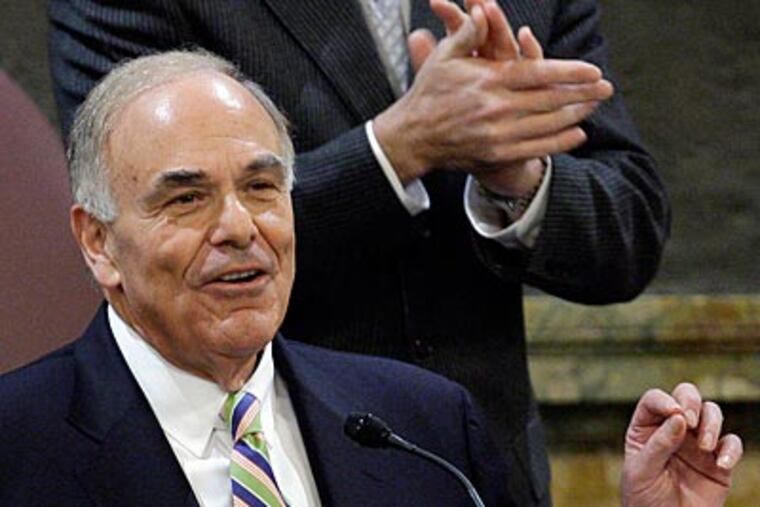
Edward G. Rendell announced the final budget of his gubernatorial reign last week. Needing to address the chasm in projected revenues, Rendell proposed cutting the sales tax but adding 74 new items - count 'em, 74 - to be taxed, many of them previously unfettered by levies. That's because many goods and services, like smokeless tobacco and natural gas and soda, which should be taxed, are tended to by lobbyists like pampered pets.
Moments after Rendell offered the budget, Senate President Pro Tempore Joe Scarnati (R., Jefferson) graciously declared the proposal "dead on arrival."
I'm telling you, in our state capital it's all lollipops and rainbows. Such behavior actually demonstrates that Washington isn't the only place where the Senate serves as a seat of obstruction. To be fair, House Majority Leader Todd Eachus (D., Luzerne) also griped, "We must guard against the tendency to take a slash-and-burn approach to budgeting and simply cut without regard to the human cost."
Almost immediately, you could hear the sound of a hundred lobbyists revving their engines to stop Rendell from taxing their clients. If nothing else, Rendell's proposal is a stimulus bill for lobbyists.
Pennsylvania's sales tax began in 1953, only to have lobbyists chipping away at it ever since. The exemptions in the sales tax are "a testament to the power of lobbyists and special interests," Rendell said last week.
The natural gas industry spent $1 million in the first half of last year successfully lobbying against any tax on the huge bonanza of the Marcellus Shale field, arguing that it would discourage drilling.
Garbage. Natural gas is a drug. Drillers last month paid twice the amount to lease state forests that the state expected to take in. And there's gold in that gas. In 2007, Oklahoma and Texas each raised almost $1 billion in severance, or extraction, taxes.
With the latest round of proposed taxes, state legislators immediately started crying about potential harm posed to the little guy.
True, many proposed taxes, like on dry cleaning and veterinary fees, affect small businesses. But helicopters, natural gas, and cigars have nothing to do with the little guy. Altria Group, formerly Philip Morris, complained that a tax would harm state cigar makers - like Altria, the nation's largest tobacco company.
Rendell wants to increase education funding, the rare instance where the little guy would, in fact, benefit.
The inability to have a dialogue, to even discuss proposed changes, has turned much of what Harrisburg does into a farce. "Many of us had run on a platform of open and accountable government," State Rep. Barbara McIlvaine Smith (D., Chester) writes in today's Currents section of The Inquirer about why, after two terms, she'll leave the legislature. "We were the 'reformers.' We were going to make a difference and get things done. Our enthusiasm was matched only by our naivete. Nothing gets done unless leadership sanctions it."
Tim Potts of Democracy Rising PA, a frequent Rendell critic, says, "I think the governor deserves credit for doing something about this looming problem. There are legitimate gripes here, a lot to discuss. Every day is a field day for lobbyists, and also a field day for people raising campaign money."
Rep. Josh Shapiro (D., Montgomery) is one of Smith's fellow reformers. Though undecided about Rendell's tax proposals, he cautions, "You shouldn't take anything off the table before you have a chance to analyze it. To do so otherwise is irresponsible."
In hard times, you either cut services or raise revenues. Possibly, you must do both. Slamming doors while offering no alternative solutions is lousy governance. Arguing for the "little guy" doesn't work when your little guy is big business and the voter seems inconsequential.
"The fiscal storm is coming," Shapiro cautions.
Ask your state representative and senator where, precisely, the commonwealth is going to cut costs or raise the revenues to operate.
Karen Heller: Lobbyists, Start Your Engines
Gov. Rendell proposed cutting the sales tax but ending the exemptions for these products and services:
Accounting, auditing, and bookkeeping services
Administrative services
Advertising, public relations, and related services
Air transportation
Airline catering
All other professional and technical services
Amusement and recreation industries
Architectural, engineering, and related services
Bad debts
Basic cable television
Call-center credit
Candy and gum
Caskets and burial vaults
Catalogs and direct-mail advertising
Charges for returnable containers
Coal
Coin-operated food and beverage vending machines
Commercial vessels (construction and repair)
Commercial vessels (equipment and maintenance)
Common carriers
Construction of memorials
Consulting (scientific, environmental, and technical)
Custom programming, design, and data processing
Dry cleaning and laundry services
Electric (residential)
Electrical, plumbing, heating, and air-conditioning service fees
Financial institution fees
Firewood
Fish feed
Flags
Fuel oil/gas (residential)
Funeral parlors, crematories, and death-care services
Gratuities
Helicopters
Horses sold to out-of-state buyers
Hotel charges (permanent residents)
Information services
Investment-grade metal bullion and coins
Legal services
Liquor and malt beverages bought from retail dispenser
Magazines
Manufacturing exemption (public utility)
Motor vehicles (out-of-state purchases)
Museums, historical sites, zoos, and parks (for profit)
Newspapers
Nonprescription drugs
Other transportation
Other: personal services
Parking lots and garages
Personal-care services
Personal-hygiene products
Rail transportation equipment
Recreational parks, camps, and campgrounds
Rental of films for commercial exhibition
School buses
Scientific research and development services
Services to buildings and dwellings
Specialized design
Spectator-sports admissions (excludes schools)
Stair-lift devices
Telephone (residential)
Temporary usage
Textbooks
Theater, dance, music, and performing arts admissions (for profit)
Tourist-promotion agencies
Transit and ground transportation
Trout
Truck transportation
Uniform commercial-code filing fees
Veterinary fees
Warehouse storage
Waste-management and remediation services
Water and sewage services
Wrapping and packing supplies
SOURCE: Rendell administration
EndText