Karen Heller: Spotlight shining on Camden's Tent City
Tent City sits nestled in woods between the River Line tracks and the I-676 jughandle in Camden. The triangular sylvan pocket is also known as Transitional Park, though some denizens have slept here for years.
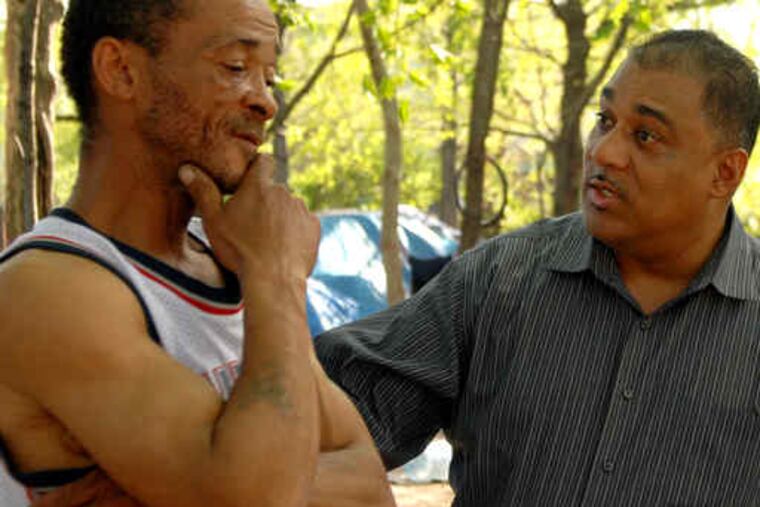
Tent City sits nestled in woods between the River Line tracks and the I-676 jughandle in Camden. The triangular sylvan pocket is also known as Transitional Park, though some denizens have slept here for years.
Makeshift homes are equipped with queen-size beds, propane heaters, bookshelves, storage areas. But the place is unsanitary and unsafe, rife with hazards, drug abuse. A rape was reported here two weeks ago.
Tent City is a township unto itself, with a self-proclaimed mayor, board of directors, and media-savvy spokesman equipped with a laptop and cell phone. This is, after all, New Jersey, a state prone to establishing a municipal government wherever a dozen people congregate.
The homeless enclave has attracted international attention, a documentary photographer, school groups. It's a destination, and a persistent problem for Camden, which has enough problems already.
On Wednesday, the Tent City Task Force - comprising 50 government officials, homeless advocates, and representatives of nonprofits - gathered to determine what could be done before the next day's deadline to move all residents. The date was imposed not by a government entity, but by the squatters.
"We have no jurisdiction over that land and were never going to evict them," said county spokeswoman Joyce Gabriel. "Our mission is to help the homeless find housing. In the end, it's their individual choice."
Camden County has 1,400 homeless residents, even more who are the verge of becoming so, yet Tent City continues to command the most attention. "It's gotten to the point where we can no longer be effective," said Gino Lewis, the county's director of community development. The residents "asked us for help that they no longer want to have."
The occupied property is largely controlled by the state Department of Transportation, which can't provide social services, housing, or financial assistance for relocation.
"There's no specific policy or strategy that's been determined," state Deputy Attorney General Jennifer Fradel said. "But continued occupation of that land can't continue."
One of four Camden homeless encampments, Tent City is the largest and most celebrated, with a population peaking around 100 last summer and numbering about 30 today, including one pregnant woman, possibly two. On Thursday, more volunteers and reporters were in attendance than residents.
Many of the squatters have histories of mental illness and substance abuse. Convicted felons live here, too; they face challenges securing jobs and apartments.
And then there's self-appointed Mayor Lorenzo "Jamaica" Banks, 58, the man who established the April 15 deadline and appears to have no intention of leaving. Jamaica, a slight freckled man in a freshly laundered polo jersey, claims he "doesn't do inside."
He extols Transitional Park's virtues. "You get a peace of mind being here. We're building self-esteem. Society forgot all about us," Jamaica said, though that hardly seems the case. A stream of volunteer workers and visitors appears daily, with plenty of food and offers of assistance.
"What will it take for me to leave? A job with the county. A ranch house that isn't near anyone. My rent paid for six months, a vehicle." He paused. "Oh, and one horse."
Homeless advocate Sister Mary Scullion said that "when you find something as horrible as this that works for you, it's all you really have. It helps if people can see that they have meaningful choices. But they need viable alternatives, not shelters."
Sherone Hurst lit a fire in a wheelbarrow. "Cooking's my thing," he said. He's been here five months. "I want to get me any apartment and get back to work," said Hurst, 45. "We just want a little helping hand."
James Boggs, an eloquent, Ed Bradley look-alike who served time for bank robbery, said Tent City "is just like any block in any city in any state in the country. There are people you love, and people you can't stand." Boggs, 56, is the community spokesman when Jamaica doesn't feel up to the task.
"I only talk to big papers, not the little ones," Jamaica said with regal disdain.
Perhaps the attention has become the new drug, one that rather than hastening Transitional Park's dissolution is sustaining its momentum. A few residents appear hooked on being an issue, while some visitors relish hanging out with the downtrodden who are engaged in a sustained act of civil disobedience.
This isn't Walden. It's Camden.
The road to good intentions can lead anywhere, but for now it lies squarely in a sylvan triangle between an interstate exit ramp and the River Line tracks.