Iraqis argue priority for the Babylon ruins
Some want gift shops. Others want authenticity.
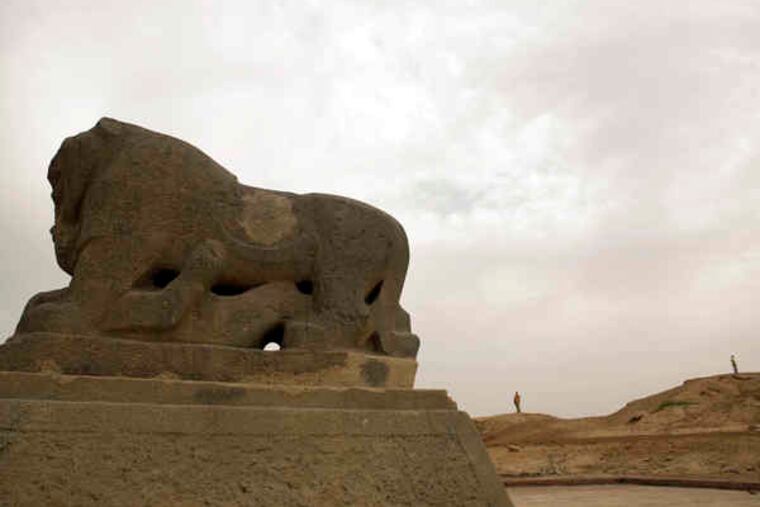
BABYLON, Iraq - A U.S.-funded program to restore the ruins of ancient Babylon is threatened by a dispute among Iraqi officials over the project's priorities.
Local officials want work swiftly done to restore the crumbling ruins and start building restaurants and gift shops to draw in tourists.
Antiquities officials in Baghdad favor a painstaking approach to avoid the gaudy restoration mistakes of the past.
The ruins of the millennia-old city, famed for its Hanging Gardens and the Tower of Babel, have suffered heavily over recent decades.
Deep in Iraq's verdant south, the cluster of excavated temples and palaces was repaired by dictator Saddam Hussein in the 1980s. But towering structures of modern yellow brick used in that renovation marred the fragile mud brick ruins. After his fall in 2003, a U.S. military base on the site did new damage.
An estimated 95 percent of the city remains unexcavated, buried under mounds that archaeologists hope to uncover.
But for that to happen, they argue, slow and meticulous work needs to be done to train Iraqis in conservation and draw up a preservation plan that can be used to get the site UNESCO World Heritage status and drum up international funds.
A two-year, $700,000 project to do that, funded by the U.S. State Department and carried out by the New York-based World Monuments Fund, began last year. If it succeeds, it could be a model for saving other ancient sites in a land where urban civilization was born.
"I'm optimistic because what is happening in Babylon is the proper and scientific step and, God willing, the work in Babylon will open up new horizons," said Qais Hussein Rashid, head of Iraq's impoverished antiquities department.
Founded in the late third millennium B.C., Babylon rose to prominence under King Hammurabi about 4,000 years ago. His famous law tablet now resides in Paris' Louvre museum.
In subsequent centuries, the city was conquered, razed, and rebuilt several times, becoming the largest city in the world with 250,000 inhabitants under King Nebuchadnezzar II in 600 B.C.
Nebuchadnezzar built the hanging gardens, one of the seven wonders of the ancient world, apparently for his wife Amyitis, who was homesick for her native Medea. He also exiled the Jewish people from Israel, gaining Babylon a bad rap in the Judeo-Christian tradition.
Given the state of the remains, the World Monuments Fund is expanding its project, seeking up to $1 million from the United States to restore two monuments in urgent need of rescue: the 2,500-year-old Nabu-Sha-Khare temple and the remains of the monumental Ishtar Gate, the main entrance to Nebuchadnezzar's city.
"It is a rare example of a fairly intact temple from the new Babylonian period," said Jeffrey Allen, a project coordinator. But plaster smeared over the mud brick building in the 1980s is flaking away and in some places the weight of the modern materials has pulled down the ancient walls.
The 45-foot-tall foundations of the Ishtar Gate remain impressive, built of bricks decorated with exquisite reliefs of dragons and bullocks. Cement flooring laid down in the 1980s, however, has pushed groundwater into the gates' walls, disintegrating the bricks and destroying the lower row of carved animals.
Now that the surrounding area is secure, provincial officials are eager to have visitors - with their cash - coming to the site again.
"We are not satisfied with the pace of the work in the site, which is being totally neglected by the antiquities board," said Mansour al-Manae, a member of the provincial council and head of its tourism committee.
Already the province has taken over part of the site, converted some modern buildings into facilities for visitors.
"We are trying our best to attract investments in order to build restaurants and other attractions," Manae said.
Allen says going slow now will pay off more later - with international donors.