Utah firing squad executes 2-time killer
He spent 25 years in prison. His death spurred calls to end capital punishment.
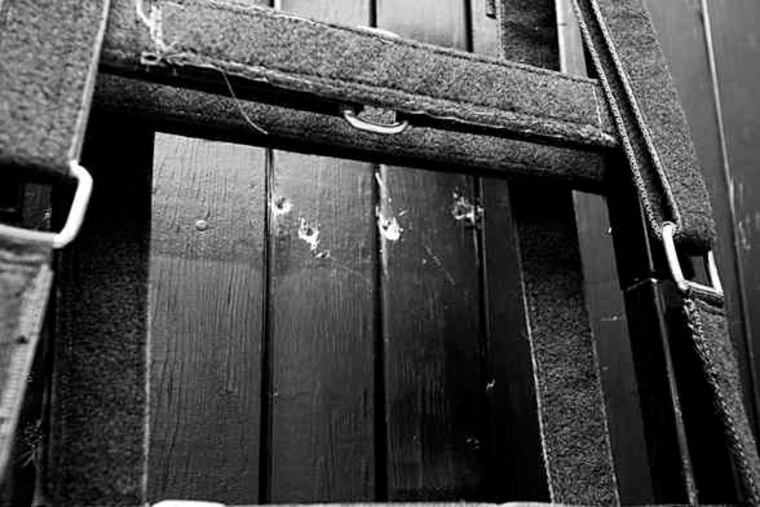
DRAPER, Utah - A barrage of bullets tore into Ronnie Lee Gardner's chest where a target had been pinned over his heart. Two minutes later, the twice-convicted killer was pronounced dead as blood pooled in his dark-blue prison jumpsuit.
It was the first time in 14 years that an American inmate had been executed by firing squad, a method Gardner chose over lethal injection. But death-penalty opponents around the world reacted with horror all the same, renewing an international debate about capital punishment in the U.S.
Gardner, 49, was the third man to die by firing squad since the Supreme Court reinstated the death penalty in 1976. Unlike Gary Gilmore, who famously said, "Let's do it," before he was shot on Jan. 17, 1977, Gardner offered few words. Asked if he had anything to say before a black hood was fastened over his head, he said simply: "I do not, no."
The five executioners were police officers who volunteered for the task at the Utah State Prison. They stood about 25 feet away, behind a wall cut with a gunport. One of their .30-caliber Winchester rifles was loaded with a blank so no one would know who fired the fatal shots.
Reporters witnessing the execution did not see the rifles or hear the countdown to the trigger-pull. Utah Department of Corrections Director Thomas Patterson said the countdown had gone "5-4-3 ..." with the shooters starting to fire at the count of 2.
There was no blood splattered across the white cinderblock wall and no audible sounds from the condemned. As the medical examiner checked for vital signs, the hood that had covered his face was pulled back, revealing Gardner's ashen face. He was pronounced dead at 12:17 a.m.
His last meal included steak, lobster tail, apple pie, vanilla ice cream, and 7-Up, prison officials said.
Gardner was sentenced to death in 1985 for fatally shooting a lawyer during a failed escape attempt from a Salt Lake City courthouse. At the time, he was facing a murder charge in the 1984 shooting death of a bartender named Melvyn Otterstrom. Gardner pulled a gun that was smuggled into the courthouse and shot lawyer Michael Burdell as Burdell hid behind a door.
In April, a judge ordered the execution to proceed, and Gardner politely declared: "I would like the firing squad, please."
He was allowed to choose the firing squad because he was sentenced to death before Utah eliminated it as an option. State officials scrapped it in 1984 after previous executions attracted unwanted publicity. Of the 49 executions carried out in the state since the 1850s, 40 were by firing squad.
Historians say the firing squad persisted in Utah long after the rest of the nation abandoned it because of the 19th-century doctrine of the state's predominant religion.
Early members of the Church of Jesus Christ of Latter-day Saints believed in the concept of "blood atonement" - that only through spilling one's own blood could a condemned person adequately atone for his or her crimes and be redeemed in the next life. The church no longer promotes such teachings.
The European Union issued a statement Friday expressing its "profound regret" for the execution. "The EU reiterates its universal opposition to the use of capital punishment and urges the immediate establishment of a global moratorium on its use," the statement said.
The American Civil Liberties Union decried Gardner's execution as an example of the "barbaric, arbitrary and bankrupting practice of capital punishment." Religious leaders called for an end to the death penalty at an interfaith vigil Thursday evening in Salt Lake City.
"Murdering the murderer doesn't create justice or settle any score," said the Rev. Tom Goldsmith of the First Unitarian Church.
Gardner's family did not witness the execution. His brother, Randy, said afterward: "I don't agree with what he done or what they done, but I'm relieved he's free."
Burdell's family opposed the death penalty and had asked for Gardner's life to be spared.