Karen Heller: Gutting car-safety bill could have a high cost
The teenage brain is not like other brains. It's prone to risk. The "age of reason," according to neuroscience studies, doesn't arrive until around 25. Adolescence may not be the best time to start driving.
The teenage brain is not like other brains. It's prone to risk. The "age of reason," according to neuroscience studies, doesn't arrive until around 25. Adolescence may not be the best time to start driving.
Teenagers are four times more likely to have car accidents than older drivers. Crashes are the leading cause of death among adolescents, accounting for one in three. That number was 3,500 deaths in 2008.
Teenagers don't like rules, especially when they apply to driving, but each time a state imposes tougher laws, the number of fatalities and accidents decreases markedly.
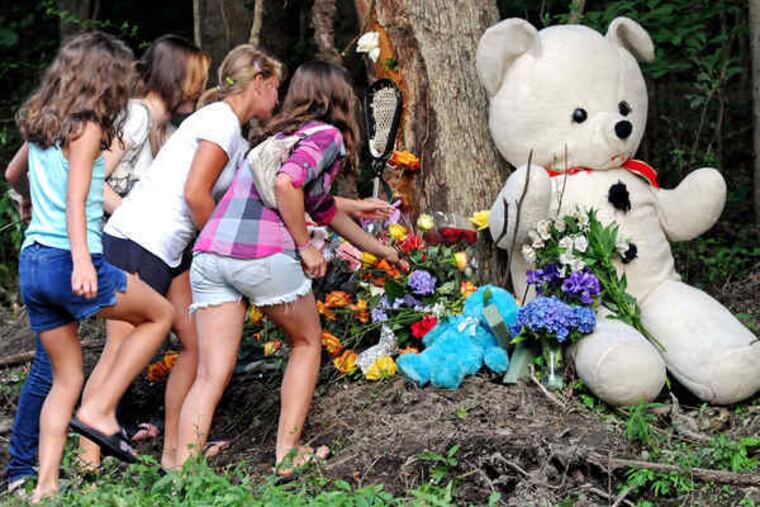
On Friday, Montgomery Alexander Duguay Wood, Monte to his family and friends, a month shy of his 17th birthday and working on attaining the rank of Eagle Scout, crashed his car at 3:10 a.m. on Beaver Dam Road in Honey Brook Township, Chester County. He was killed, along with passenger Britany Pearl Snarkey Leger, 15.
Two back-seat passengers, Damien Paterno and Cameron Merlino, both 15, were severely injured.
Alcohol was not a factor, police said, but when it struck a tree and utility pole, the Mitsubishi Lancer Evolution was speeding.
In April 2009, the House overwhelmingly approved a bill for tougher restrictions on teenage drivers in Pennsylvania, one of six states without them. The bill would limit adolescent drivers to one nonfamily passenger under the age of 18.
Scientific research indicates that teenagers are easily distracted and have more accidents when multiple peers are in the vehicle. Common sense tells us this, too.
The bill called for restrictions on cell phones and fines for failure to use seat belts, which contribute to accidents. Again, you don't need research to back this, but there is plenty.
The insurance industry backed HB 67. Law enforcement officials backed HB 67. Phone providers had no problem with HB 67. The medical community backed HB 67. Parents backed HB 67, mothers like Karen Cantamaglia and Marlene Case, who lost their teenage sons last November in a fatal accident, again in Chester County.
You know who didn't back HB 67? The state Senate.
"It came out of the transportation committee clean," says chairman Sen. John Rafferty (R., Chester). "Then all these amendments came along."
Senators, on both sides of the aisle, urban and rural, mucked up the bill beyond recognition, crossing out so much that it resembled a redacted FBI document with highly sensitive information.
Instead of legislating and imposing restrictions, senators argued, let's educate. Teenagers in rural areas need flexibility to go to work, or the movies. Tougher standards require parental control, the senators reasoned, not more state laws. Smaller government is better.
HB 67 became unrecognizable. Cell-phone use became a secondary offense. Under an amendment, after six months of driving without an accident, teen drivers would have been allowed to transport as many as three nonfamily members.
"I was surprised by the decision the Senate made to water down this bill to the point that it would literally do nothing to save lives in Pennsylvania," says Rep. Josh Shapiro (D., Montgomery).
On July 1, the House gave up on concurrence, rejecting the Senate's version.
"We didn't think it was worth having," says the original bill's sponsor, Rep. Joseph F. Markosek (D., Allegheny), majority chair of the House Transportation Committee. "What we pass on the state level trumps all the other legislation on the books." Which means the weaker cell-phone restrictions would trump tougher legislation passed in Philadelphia and other cities. "And you keep on having these accidents. A rite of passage becomes a trip to the hereafter."
So it's back to the drawing board in the fall. "We're not going to get as strong a bill as we originally sent," Markosek says. "I don't like it. I think it's a no-brainer."
The legislation might have helped prevent the horrible tragedy on Beaver Dam Road in Honey Brook Township, and then again not.
Teenagers embrace risky behavior. They can have the most loving, caring parents in the world, refrain from drugs and alcohol, know right from wrong, and still make mistakes.
Wood, Paterno, and Merlino weren't wearing seat belts.
Wood was driving at 3 in the morning, in direct violation of Pennsylvania's graduated driving license, which prohibits driving from 11 p.m. to 5 a.m.
So legislators and critics can argue that no law would make a difference.
But they would be wrong.
Every year, tougher driving laws pass to extraordinary success in reducing accidents. Parents understand the laws. Police and state troopers enforce them. Over time, teenagers learn their importance.
Fatality rates are dropping with every measure. Nationally, graduated driver's licenses have reduced accidents by almost 40 percent. New Jersey, with far stricter driving laws, had 590 traffic fatalities in 2008; Pennsylvania had 1,468.
These laws don't cost taxpayers a cent, and they can save parents and their children so much more.