Bullfighting banned in a region of Spain
An ending in Catalonia, but no national move is seen.
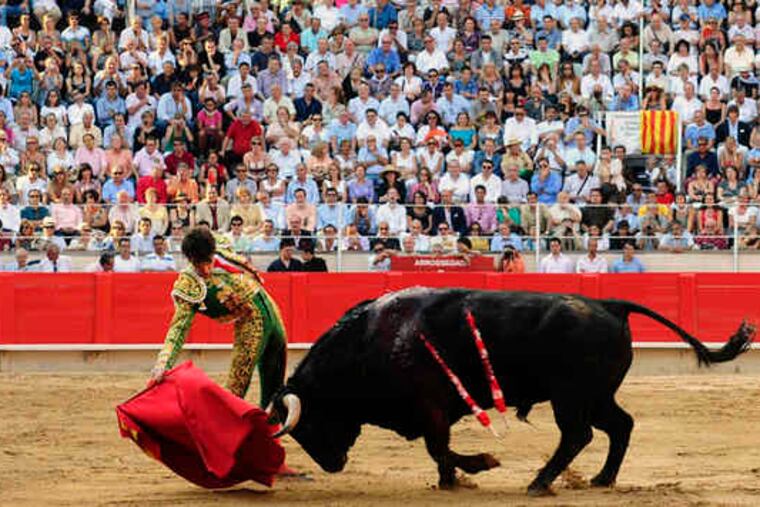
BARCELONA, Spain - Lawmakers in the region of Catalonia thrust a sword deep into Spain's centuries-old tradition of bullfighting, banning the blood-soaked pageant that has fascinated artists and writers from Goya to Hemingway.
Wednesday's vote in the Catalan parliament prohibits bullfighting, starting in 2012 in the northeastern region that centers on Barcelona. Although animal-rights activists want to extend the ban, there is no significant national movement to do away with bullfighting in the rest of Spain.
Many see the vote as a political statement by a wealthy and powerful region that likes to assert how different it is from the rest of Spain, rather than an expression of concern over cruelty to the half-ton beasts by sword-wielding matadors.
The center-right Popular Party, which is fervent about the idea of a unified Spain run from Madrid, said it would fight the ban - the first by a major region in the country. It will press the national parliament to pass a law giving protected status to bullfighting and bar regions from outlawing it, said Alicia Sanchez-Camacho, president of the party's Catalan branch.
Still, animal-rights activists rejoiced and cheers broke out in Catalonia's 135-seat legislature when the speaker announced the ban had passed, 68-55, with nine abstentions.
"We are euphoric with the banning of bullfighting in Catalonia. It's the beginning of the end," said Nacho Paunero, president of the animal-rights group Refuge, which collected 50,000 signatures in a bid to force a similar vote in the Madrid regional parliament. "We want debate in Madrid now."
The practical effect of the ban is limited: Catalonia has only one functioning bullring, in Barcelona, while another little-used ring is being turned into a shopping mall. It stages 15 fights a year that are rarely sold out, compared with a nationwide 1,000 bouts a season.
Still, bullfighting fans, who count King Juan Carlos in their number, and Spanish conservatives have taken the drama over the fiesta nacional very seriously, seeing a stinging rebuke in the grassroots drive that started in the region last year.
"I'm not particularly a fan of bullfighting, but there's a long tradition of it in Spain, especially in Barcelona," said Juan Antonio Samaranch Jr., son of the late former head of the International Olympic Committee. "I am pretty much against banning anything. I would have voted against it."
Joan Puigcercos, a lawmaker from a Catalan pro-independence party, insisted the ban was not about politics or national identity but rather "the suffering of the animal. That is the question, nothing more."
But Catalan regional president Jose Montilla said legislators should have let bullfighting vanish on its own, rather than legislate an end to it and deny the people's right to choose whether to go to the ring.
Ernest Hemingway wrote about bullfighting and the running of the bulls in Spain's annual San Fermin Festival in his 1924 novel, The Sun Also Rises, and about the traditions of the sport in his later nonfiction book, Death in the Afternoon.
Bullfighting is also popular in Mexico, parts of South America, southern France, and Portugal.
In Madrid, the Refuge group recently presented 50,000 signatures to force a similar vote, but it faces a tougher battle because the regional parliament is controlled by conservatives. Two other regions also controlled by conservatives, Valencia and Murcia, have granted protected status to bullfighting.
Fernando Sanchez, 61, a Madrid grocer who goes to bullfights occasionally, said his shop was buzzing about the ban. He called it a slap at free choice and blamed it on "a handful of guys who want to break away because it is called the fiesta nacional. If it were called the Catalan fiesta, they would not mind."