Chilean miners to aid rescue effort
The 33 men will clear away tons of debris that will fall as an exit hole is drilled.
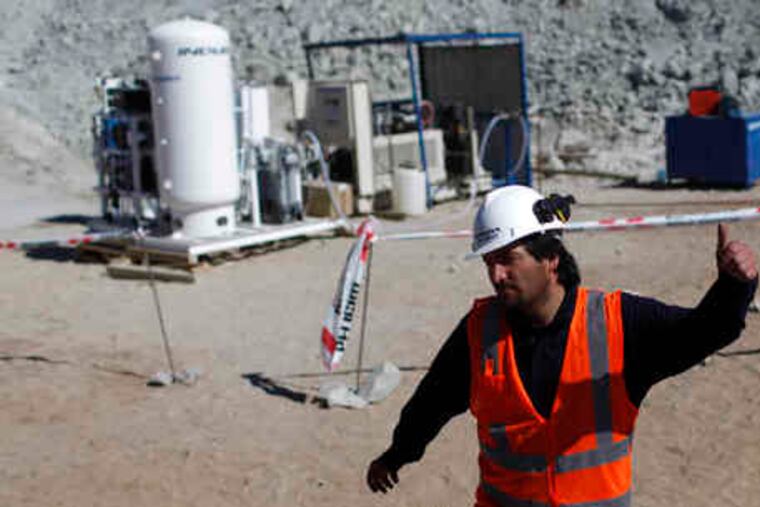
SAN JOSE MINE, Chile - The 33 trapped Chilean miners who have astonished the world with their discipline almost a half mile underground will have to aid their own escape by clearing thousands of tons of rock that will fall as the rescue hole is drilled, the engineer in charge of drilling said Sunday.
After drilling three small bore holes in recent weeks to create lines of communication with the miners and deliver food and medicine, Chile's state-owned Codelco mining company is to begin boring a rescue hole Monday afternoon that will be wide enough to pull the men up through 2,300 feet of rock and earth.
The first step will be to drill a "pilot hole," similar in size to the other three. Then much larger machine cutters will slowly grind through that hole, forcing crushed rock to fall down into the mine shaft near the trapped men.
Failure to keep the bottom clear of debris could quickly plug the hole, delaying a rescue that officials say could take three to four months.
"The miners are going to have to take out all that material as it falls," Andres Sougarret, Codelco's head engineer on the operation, said in a telephone interview.
In all, the trapped miners will have to clear between 3,000 and 4,000 tons of rock, work that will require crews of about half a dozen men working in shifts 24 hours a day.
The men have basic clearing equipment, such as wheelbarrows and industrial-size battery-powered sweepers, Sougarret said. The hole will likely end up several hundred yards from their living area in the mine's shelter, giving the men room to maneuver and store the rocks, he said.
Sougarret declined to estimate how long the work would take, saying it would depend on how each step went.
On Sunday, Mining Minister Laurence Golborne reiterated the government's estimate of three to four months to rescue the men, rejecting local reports citing engineers who said it could be done in much less time.
Golborne, wearing a hard hat and standing in front of the bore hole where rescuers first made contact with the men, said experts had analyzed 10 methods to get the men out and would continue to study other options, but "nothing has yet been found that will be quicker."
A new video of the trapped men released Sunday shows them sending greetings to their families, talking about how they are doing better since receiving food, and breaking into tears as they discuss loved ones.
"I'm sending my greetings to Angelica. I love you so much, darling," 30-year-old Osman Araya said as his voice choked and he began to cry. "Tell my mother, I love you guys so much. I'll never leave you, I will fight to the end to be with you."
Throughout the interviews, as the men started to choke up, a voice behind the camera urged them on: "Let's go, let's go! You can do it!"
From the moment the mine collapsed Aug. 5, the trapped men have had a central role in keeping themselves alive - getting to the safety chamber, rationing food, and keeping order with extraordinary discipline.
Telephone wire was being snaked down one of the bore holes Sunday, and Golborne said that within a few hours one representative from each family would be allowed to talk to the miners - the first verbal communication they would have. Until now, handwritten notes have been passed through tubes send up and down the bore holes.
Many of the men have severe skin irritations from the hot, wet conditions underground and were sent special clothing that dries quicker. They also were given small mats to sleep on so they would not have to rest directly on the damp ground.