Serving their nation despite 'enemy' label
Japanese American unit closer to congressional honor.
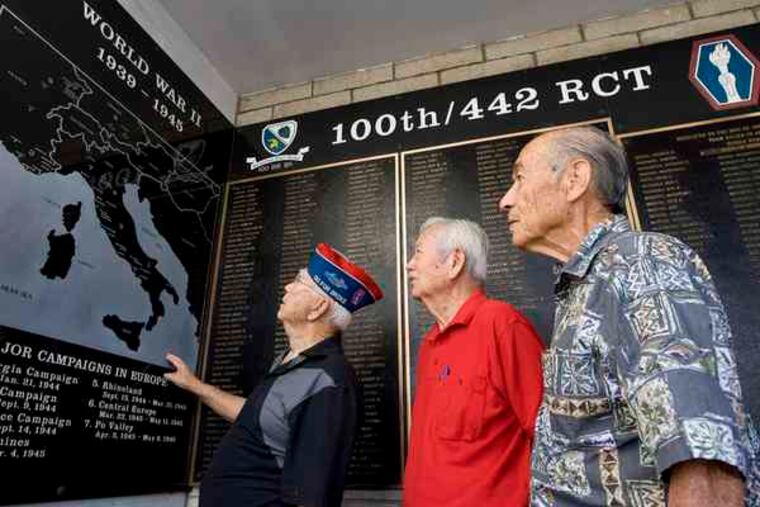
HONOLULU - Ronald Oba grew up saluting the U.S. flag and saying the Pledge of Allegiance in school, like millions of other American boys.
But he was labeled an "enemy alien" after Japan bombed Pearl Harbor on Dec. 7, 1941, because his ancestors came from the same land as the attacking planes.
To prove his loyalty, Oba joined the Army as soon as President Franklin D. Roosevelt allowed Japanese Americans to enlist. His segregated unit - the 442d Regimental Combat Team/100th Infantry Battalion - soon became the most highly decorated military unit in U.S. history for its size and length of service.
This month, Congress is expected to award its highest honor, the Congressional Gold Medal, to Oba and others who fought, even as their countrymen viewed them with suspicion and distrust. Many wore the uniform while their families spent the war in detention camps back home.
The honorees would include about 6,000 Japanese Americans who served as translators and interpreters against Japan, often on the front lines with Marines and soldiers fighting from island to island across the Pacific.
The elite medal has been given selectively since 1776, when George Washington was awarded the first. Other honorees include the Wright Brothers, Thomas Edison, Rosa Parks, and the Dalai Lama. Congress awarded the medal to the Tuskegee Airmen, the first group of black fighter pilots, in 2006.
Oba is grateful, saying the medal would spread awareness about the veterans.
"We appreciate our legacy being carried on," Oba, now 87, said in an interview at the Honolulu clubhouse for 442d veterans. "Finally, they're recognizing our contribution during World War II."
Just outside the clubhouse is a memorial listing the names of nearly 800 Japanese American soldiers killed in action. A plaque spells out the unit's motto - "Go for broke" - a pidgin, or Hawaii Creole English, expression meaning "give it your all."
A large granite map shows where the 442d, which absorbed the 100th Battalion during the war, pushed its way through Italy and France. The area covers the Vosges Mountains, where the unit suffered 800 casualties maneuvering through fog and dense forest against hidden German machine guns to rescue the trapped "Lost Battalion" of the nearly all-Texan 36th Division.
Sen. Daniel Inouye, who took a break from college to enlist and lost his right arm fighting in Italy, said he didn't help draft the bill because he would be honored by it. But the Hawaii Democrat said the medal would give the veterans "a jolt of joy."
"Keep in mind, there were some who volunteered from behind barbed wires. We in Hawaii volunteered knowing that we were 'enemy aliens.' And that's not easy," Inouye said.
The senator said he hoped the award would come soon because the youngest unit members were in the their mid-80s and only about a third were still alive.
"I just hope that Congress will pass it in time so that some of us may look upon and reflect and say that it was all worth it," said Inouye, who turned 86 this month.
The House is expected to vote on the measure as early as this week. The Senate unanimously passed the bill last month.
Harold Fudenna, a Military Intelligence Service translator who served while his parents were at an internment camp, died before he could be honored. The California native was listening to radio communications in New Guinea in 1943 when he intercepted a Japanese message specifying the time Admiral Isoroku Yamamoto - the architect of the attack on Pearl Harbor - would be flying to inspect his troops.
Fudenna's translation allowed the United States to shoot down Yamamoto's plane, dealing a severe blow to Japanese morale. Gen. Douglas MacArthur called the feat "one of the singularly most significant actions of the Pacific War."
Keith Fudenna said his father, who died in 1993 at the age of 75, would be pleased by the medal but would deflect any honors. "He did not think that what he did was that big of a thing," said the son.