New light shed on woman's war heroics
Agent Eileen Nearne, who never spilled a secret, had been underestimated and belittled by her male superiors.
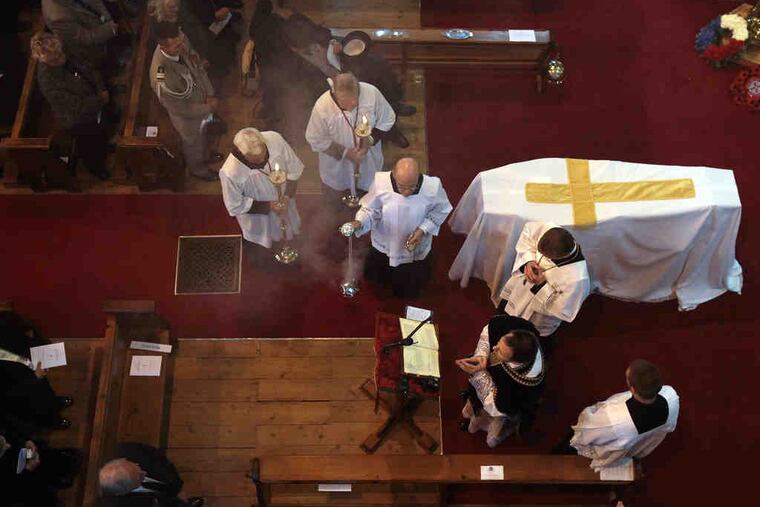
LONDON - Buried deep in Eileen Nearne's secret World War II file, released Friday by the National Archives, is the secrecy agreement she signed Sept. 4, 1942. It was a commitment she honored until her death last month at 89.
When Nearne died alone, with precious little support or human contact, none of her neighbors knew she had been decorated for her bravery behind enemy lines in occupied France.
Her wartime role was not publicly acknowledged until local officials went into her apartment after her death and found a trove of medals, records, and memorabilia, including French currency used during the war.
Nearne's file, released after a Freedom of Information request, sheds new light on her wartime exploits, which were so extraordinary that advancing American forces refused to believe her when she rushed out of a church in Germany and claimed to be an undercover British agent who had escaped from a German concentration camp.
The Americans did not believe her story and kept her captive for a month, holding her with Nazi prisoners until an English officer came to fetch her, telling the Americans that Nearne's story - incredible though it seemed - was true, the file says.
It shows that Nearne - a young woman tortured by the Gestapo who never broke or spilled a secret - was consistently underestimated and belittled by her male superiors as she was trained for a perilous clandestine assignment as a wireless-transmitter operator.
Her trainer reported that she did not seem suited for intelligence work.
"She is not very intelligent or practical and is lacking in shrewdness and cunning," he wrote Jan. 26, 1944. "She has a bad memory, is inaccurate, and scatterbrained." He went on to describe her as a "very feminine and immature" person who was too inexperienced for deployment.
Mark Dunton, contemporary-history specialist with the National Archives, said a none-too-subtle sexism seemed to blame. "Her training officers completely underestimated her," he said.
The harsh assessment of her potential for espionage contrasts sharply with a note in the file that recommends Nearne be made an Officer of the British Empire for her wartime contributions.
The note says that for 51/2 months, "she maintained constant communications with London from this most dangerous area and by her cool efficiency, perseverance and willingness to undergo any risk in order to carry out her work made possible the successful organization of her group and the delivery of large quantities of arms and equipment."
The request was granted. Nearne was also honored by French officials.
She left the relative safety of England on March 2, 1944, several months before the D-Day invasion started the liberation of the European continent. She was able to transmit without detection, helping to coordinate resistance forces and munitions, until she was arrested by Gestapo agents in late July.
"They asked me questions about my code," Nearne says in a statement contained in the file. "I told them lies."
The agents humiliated Nearne and placed her in an ice-cold bath, but she did not bend, providing only false addresses of bogus contacts.
Finally they gave up and Aug. 15 sent her to Ravensbruck concentration camp in Germany. She eventually escaped with two French women when she was being transported to a new location in the middle of the night.