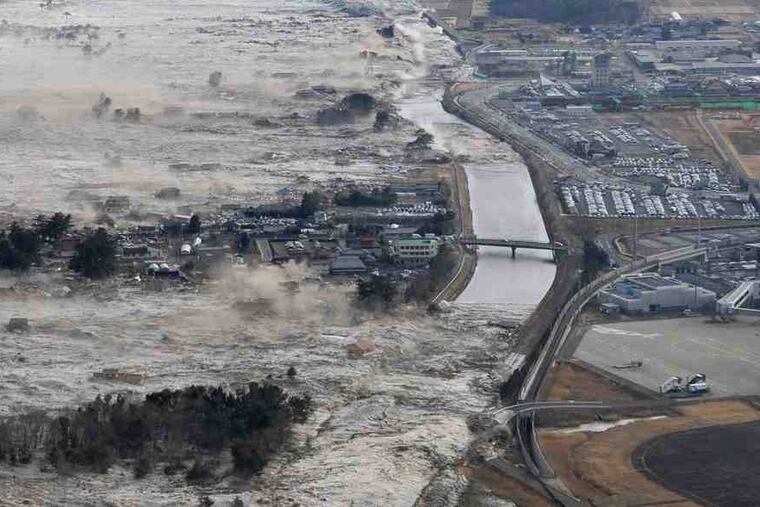
TOKYO - Japan's northeastern coast was a swampy wasteland of broken houses, overturned cars, sludge and dirty water today as the nation awoke to the devastating aftermath of one of its greatest disasters, a powerful tsunami created by one of the strongest earthquakes ever recorded.
The death toll from yesterday's massive magnitude 8.9 quake stood at more than 200, but an untold number of bodies were believed to be lying in the rubble and debris, and Japanese were bracing for more bad news as authorities tried to reach the hardest-hit areas.
Aerial footage showed military helicopters lifting people on rescue tethers from rooftops and partially submerged buildings surrounded by water and debris. At one school, a large white "SOS" had been spelled out in English.
The earthquake that struck off the northeastern shore was the biggest recorded quake ever to hit Japan. It was nearly 8,000 times stronger than one that devastated Christchurch, New Zealand, last month, scientists said.
The official casualty toll was 236 dead, 725 missing and 1,028 injured, although police said 200-300 bodies were found along the coast in Sendai, the biggest city in the area. Authorities said they weren't able to reach the area because of damage to the roads.
Black smoke could still be seen in the skies around Sendai, presumably from gas pipes snapped by the quake or tsunami.
President Obama pledged U.S. help following what he called a potentially "catastrophic" disaster. One U.S. aircraft carrier is already in Japan and a second was on its way, he said.
The entire Pacific had been put on alert - including coastal areas of South America, Canada and Alaska - but waves were not as bad as expected.
The magnitude-8.9 offshore quake struck at 2:46 p.m. local time (Japan is 14 hours ahead of Philadelphia). It shook dozens of cities and villages along a 1,300-mile stretch of coast and tall buildings swayed in Tokyo, hundreds of miles from the epicenter.
Minutes later, the earthquake unleashed a 23-foot tsunami along the northeastern coast of Japan near Sendai.
Large fishing boats and other vessels rode the high waves ashore, slamming against overpasses or scraping under them and snapping power lines along the way. A fleet of partially submerged cars bobbed in the water. The tsunami roared over embankments, washing anything in its path inland before reversing direction and carrying the cars, homes and other debris out to sea. Train service was suspended in northeastern Japan and in Tokyo, which normally serves 10 million people a day. Untold numbers of people were stranded in stations or roaming the streets. Tokyo's Narita airport was closed indefinitely.
A ship with 80 dock workers was swept away from a shipyard in Miyagi prefecture. All on the ship were believed to be safe, although the vessel had sprung a leak and was taking on some water, Japan's coast guard said.
Japan declared its first-ever states of emergency for five nuclear reactors at two power plants after the units lost cooling ability in the aftermath of the earthquake, and workers struggled to prevent meltdowns.
The earthquake knocked out power at the Fukushima Daiichi plant, and Japan's nuclear-safety agency said pressure inside the reactor had risen to twice the level considered normal.
Authorities said radiation levels had jumped 1,000 times normal inside Unit 1 and were measured at eight times normal outside the plant. Thousands of people were urged to leave their homes.
Tokyo Electric Power Co. warned of an "extremely challenging situation in power supply for a while."
The utility, which also operates reactors at the nearby Fukushima Daini plant, later confirmed that cooling ability had been lost at three of four reactors there, as well as a second Fukushima Daiichi unit. The government promptly declared a state of emergency there as well.
The Defense Ministry said it had sent troops trained to deal with chemical disasters to the plants in case of a radiation leak.
A large fire erupted at the Cosmo oil refinery in the city of Ichihara and burned out of control with 100-foot flames whipping into the sky.
Tokyo was brought to a near standstill. Tens of thousands of people were stranded with the rail network down, and the streets were jammed with cars, buses and trucks trying to get out of the city, which set up 33 shelters.
The tsunami hit Hawaii before dawn yesterday, with most damage coming on the Big Island. The waves covered beachfront roads and rushed into hotels. One house was picked up and carried out to sea. Low-lying areas in Maui were flooded by 7-foot waves.
On the U.S. mainland, marinas and harbors in California and Oregon bore the brunt of the damage, estimated by authorities to be in the millions of dollars. Boats crashed into each other in marinas and some vessels were washed out to sea.
Rescue crews in northern California were searching for a man who was swept away while taking pictures. Two people with him tried to rescue him, although they were able to return to shore.
Japan's worst previous quake was a magnitude 8.3 in Kanto that killed 143,000 people in 1923, according to the United States Geological Service. A 7.2-magnitude quake in Kobe killed 6,400 people in 1995.