Neighbors recount what they knew
The compound owners had given a reason for the thick walls. People suspected smugglers.
Editor's Note: This story was originally published on May 4, 2011.
ABBOTTABAD, Pakistan - The two men who built the compound in which Osama bin Laden had been living had explained its unusually thick walls by saying they had been involved in a violent feud in their home village and needed to prevent their women from being seen, in accordance with strict Islamic custom, local residents said.
Residents said the two were brothers who identified themselves usually as Arshad and Tariq Khan, though they also went by the names of Rashid, Ahmed, and Nadeem. They were ethnic Pashtuns from near Peshawar, Pakistan, residents said they were told. Most inhabitants of Abbottabad are not Pashtun.
Residents said the two were friendly and often could be seen with children buying soft drinks and candy at a nearby shop. Although they did not socialize with locals, they took part in the local custom of visiting neighbors to offer condolences for a death or to celebrate weddings and births, residents said.
They had one immutable rule, however - when children playing nearby accidentally knocked a ball into the compound, they were not allowed to collect it.
Residents confirmed U.S. officials' assertions that the house was built in 2005.
"I worked on the house construction as a laborer. There was nothing unusual about how it was built, except the size of the compound wall," said a shopkeeper, Rasheed, 32, who said the brothers frequently visited his shop with five to seven children who he assumed were theirs.
"Because of the wall, people thought that they were smugglers, not terrorists," he said.
Rasheed said that the wall, which is at least 12 feet tall and topped with barbed wire, is about 3 feet thick.
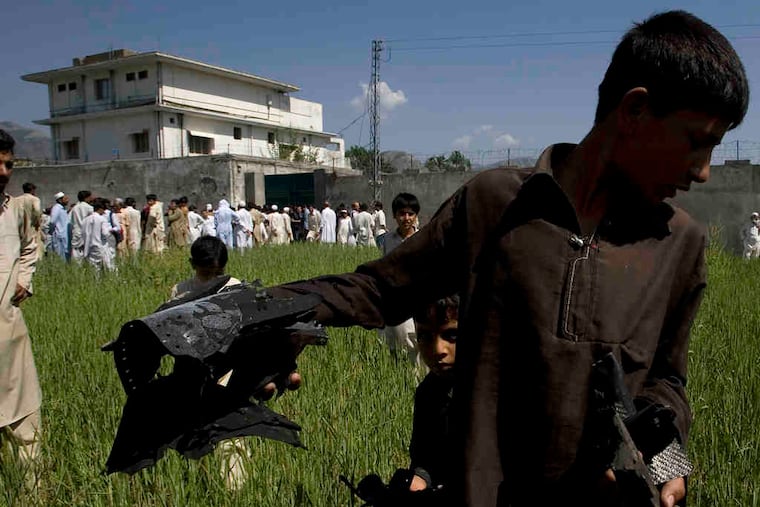
Pakistan security allowed a swarm of Pakistani and foreign reporters as far as the wall Tuesday to inspect the house. Excited local children ran around collecting burned parts from an American helicopter that was destroyed after it became disabled during the raid that killed bin Laden.
Two security cameras that neighbors said had once been present were missing. Next to the house was a large, empty compound, where locals said two cows and some goats had been kept.
The house defied the luxurious description that U.S. officials had offered. Its paint was peeling, and it appeared to have no air-conditioning, which would have made it a sweltering place in the summer for bin Laden.
The brothers drove two vehicles, a small white Suzuki van and an SUV, said Zain Muhammad, 80, who lives in a tiny ramshackle house 10 yards across the street from the bin Laden home.
That white Suzuki may be the key to tracking down bin Laden. According to U.S. officials, that vehicle was tracked traveling from Peshawar to the compound.
"We never saw any women or any Arabs," Muhammad said. "I didn't notice any particular comings and goings from the house at night."
But a Pakistani spy agency official said at least two women had been left in the house after the American raid. One of those, who authorities believe is a Yemeni and one of bin Laden's wives, was shot in the leg and was treated at a local military hospital.
The wife and children remain in Pakistani custody, though the official declined to say where. CIA Director Leon Panetta, speaking to NBC News, confirmed that Pakistan had detained some members of bin Laden's family at the compound.
"We have asked access to those individuals so we can continue to gather intelligence," Panetta said.
Teenager Umar Nassir said neighbors were concerned that bin Laden's refuge in Abbottabad might bring more trouble.
"The schools in the city have been closed for three days," he said. "We worry that al-Qaeda will come back to attack in our town and take revenge for Osama's death."