Mini-'zoo' at Immaculata teaches nature's diversity
Under the watchful eye of Sister Susan Cronin, the iguanas lie down with the rabbits. While not exactly a scene out of the Bible, it's a zoological encounter brokered by a nun on a mission to save unwanted animals - and provide some informal education in the process.
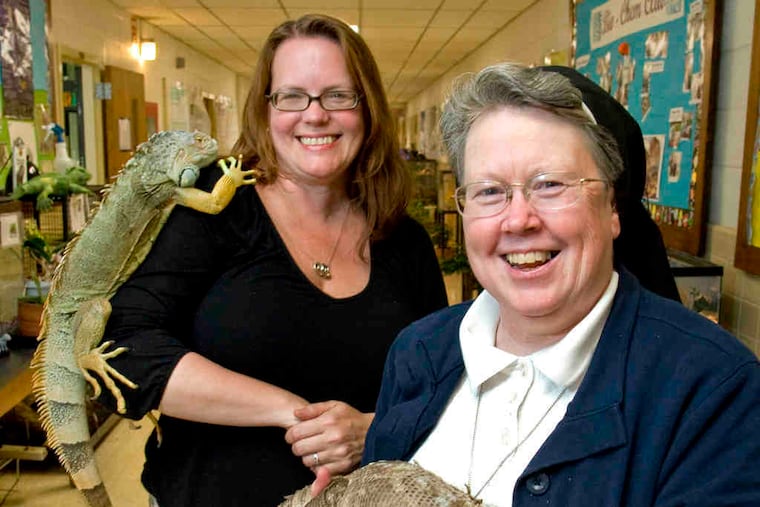
Under the watchful eye of Sister Susan Cronin, the iguanas lie down with the rabbits.
While not exactly a scene out of the Bible, it's a zoological encounter brokered by a nun on a mission to save unwanted animals - and provide some informal education in the process.
The creatures in question are part of a menagerie of about 60 animals that Cronin, chairwoman of Immaculata University's biology department, has gathered in an impromptu zoo that has taken over a wing of one of the main academic buildings of the small Catholic college in Chester County.
Tanks containing frogs to fish line the hallway; a former lab has been converted into an open-air rabbit pen and home for several bird species.
Despite being a genetic researcher herself, Cronin said that none of the animals are study subjects.
Rather, she said, they are there to showcase nature's diversity.
"Our premise is biology is living," she said, adding that the "informal education" the zoo represents is "the best kind."
Sister Elaine Glanz, dean of the university's college of undergraduate studies, agreed.
"It's fun. That's the bottom line," Glanz said, adding that the zoo helps promote the idea that the animals that students study deserve respect.
The zoo started small when the department's lab manager, Deb Tischler, learned that a local pet store was going out of business.
Tischler and Cronin, two big-time animal lovers, sprang into action. Before they knew it, the two were in charge of a gecko, a turtle, and a toad.
Since then, they've steadily added to the collection, expanding outward from the retrofitted lab to the adjoining hallway and a classroom.
"We didn't formally go and ask if we could have a zoo," Cronin said. "It just kind of gradually came about. As more and more people started looking at it, it just kind of took off."
Almost all the animals, are rescues. That includes Gandalf the savannah monitor, a big lizard who politely wipes his mouth against a nearby rock after chowing down on defrosted mice. Critters come from sources ranging from the state Fish and Boat Commission, which turned over some confiscated turtles, to students' dorm rooms.
One frog is a refugee from the school's physiology lab.
Dennis McMichael, director of operations for the Chester County SPCA, said his group gives Cronin animals that are "particularly difficult to place."
"Whenever we get any sort of reptile in here, Sister Cronin is usually the first person we call," he said.
Not that all of Cronin's animals are kept in tanks or cages.
The savannah monitor has a leash and harness for walking, and the two iguanas hang out above the rabbit enclosure on nice days, taking in the sun from a nearby window.
Then there's the king pigeon named Snow White. She hops from her perch and waddles behind Cronin as she walks, sparking bemused looks on the faces of students as they pass by.
The zoo's limited space means Cronin and Tischler have become more selective when it comes to the animals they accept.
And as the zoo has gotten larger, they've taken on a few work-study students to help care for the animals and accepted donations to help defray the $100 to $200 a month they spend on animal food.
Cronin, who keeps a pet bull python in her office, said managing the zoo isn't a burden despite the time it eats up.
"When you like something, you don't really worry about it," she said.