Olympian Maddy Crippen on swimming safety after brother Fran's death
In October, one of America's top swimmers - Fran Crippen of Conshohocken - drowned in mid-80-degree water during the 10K Marathon Swimming World Cup race off the coast of the United Arab Emirates.
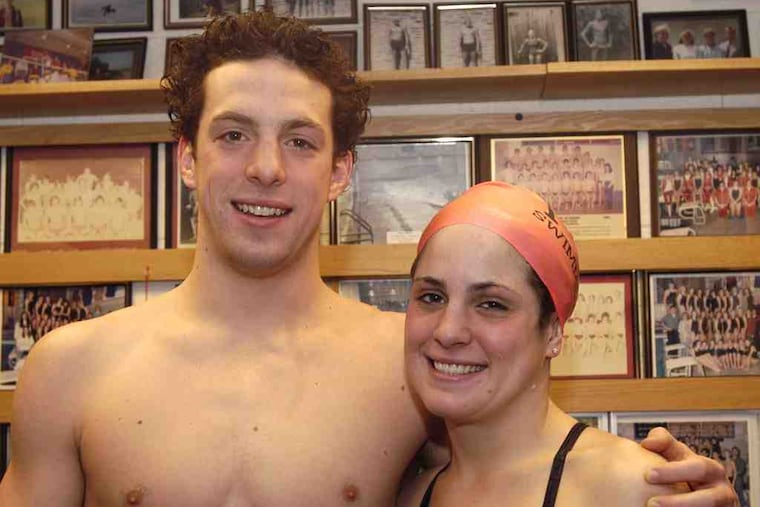
In October, one of America's top swimmers - Fran Crippen of Conshohocken - drowned in mid-80-degree water during the 10K Marathon Swimming World Cup race off the coast of the United Arab Emirates.
Since then, his sister Maddy has made safety in open-water swimming her mission. Maddy Crippen, an Olympic swimmer, is a managing director with the architectural/engineering firm Nelson. She spoke to Inquirer staff writer Mari A. Schaefer.
Question: How has Fran's death changed your outlook?
Maddy Crippen: It has forced me to see that every little conversation can count. Every time you talk to a kid or say, "Good job" or "Try to do better," it really does affect them.
I think that a lot of times you get so caught up in the everyday-to-day life that you forget it could end in a heartbeat. I am trying to say yes to as many things as I can do, and still manage my life and relationship with family. There is always time to do something you care about.
Q: What is the Fran Crippen Elevation Foundation, and what do you hope to accomplish?
Crippen: Fran was a professional swimmer and relied a lot on the generosity of other people to finance his life. Grants and scholarships were important to his livelihood, and that is how it started, to continue that vision and that passion he had.
The other aspect is just being a voice for athletes.
Q: How popular is open-water swimming, now that it has been an Olympic sport since the 2008 Games in Beijing?
Crippen: It is like the Broad Street Run having 30,000 people in it this year and 10 years ago it had 1,000. We want to make sure it can continue that upward trend but that it is safe. If you fall on the road, they will see you. If you fall in the water, you are not going to be seen.
Q: At the Jersey Shore, there's about one race each weekend. What safety factors should local organizers consider?
Crippen: It is so important to work with beach patrols, local lifeguards, and the communities to make sure that they are aware and they are there to help. The best people at lifesaving are the lifeguards. They have the most experience at saving lives and watching the ocean. I have become a huge fan of the U.S. Lifesaving Association.
Q: How should an athlete who has never entered an open-water swim train?
Crippen: Join a masters team or local club swim team. Start small, and do a triathlon that is a 400-meter swim with not very many people. When you do the Philly Triathlon in August, you will know what it is like to be in water and not be able to see the bottom and be able to control yourself when there are a hundred other people kicking and moving their arms. The only way to get used to that is experience.
Q: Is the sport of open-water swimming doing enough to set and maintain adequate safety standards?
Crippen: Prior to Fran's death, no. But I think since Fran died there is increased awareness and intense scrutiny on everything.
Q: You recently attended a conference on safety at open-water events in San Francisco. What recommendations came out of it?
Crippen: We talked about everything from having sharks and predators in the water to hypothermia and hyperthermia and how race directors and event organizers dealt with that.
Yes, heat exhaustion was the reason Fran passed out. The reason he died was that no one was there to save him, and no one was watching him. The conditions can be all different as long as you have the right people there to have their eyes on the swimmers.
The U.S. is more focused on the conditions when sending our athletes out of the country. USA Swimming just hired a national team manger to go to every race. It was one of Fran's big issues.
Q: The water temperature, in the mid-80-degree range, contributed to Fran's death. Should there be temperature limits for competitive international events?
Crippen: I think we need to have some sliding scale depending on a mixture of air and water temperature and the difference between freshwater and saltwater. We need to develop guidelines.
Q: FINA, the international governing body of swimming, recently released a comprehensive report about your brother's death. What are your thoughts on the results?
Crippen: I believe it was very extensive, and I commend the commission for doing their due diligence. Fran wasn't found for two hours. The report really drove home the fact no one saw him stop. That is why we have to make sure people watch our athletes and make sure they are cared for.
Q: Are you still swimming?
Crippen: Once I stopped, I really did stop. Just recently I have been swimming a little bit. There's a great public pool a couple blocks from my house, so I have no excuses.