At U.N., a 'damaged' Iran leader
Ahmadinejad is ready for his annual trip to New York, in a much weaker position.
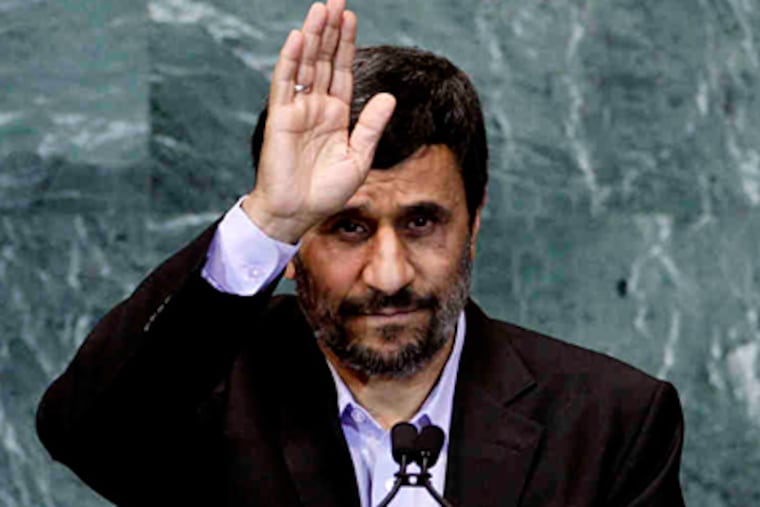
CAIRO - There was a time when Iranian President Mahmoud Ahmadinejad used his annual trip to the United Nations for two big objectives: basking in the attention of America's media hub and personally delivering the views of the Islamic Republic to Western leaders.
The spotlight-seeking is still there. But what's missing this year is any sense that Ahmadinejad is still a trusted messenger for the ruling clerics after trying to expand the limits of his power and being batted down harshly.
"He's damaged," said Ahmad Bakhshayesh, a political-affairs professor at Tehran's Azad University. Dubai-based analyst Theodore Karasik sees "a badly wounded lame duck" arriving in New York for the U.N. General Assembly session that begins Tuesday.
There's little doubt about Iran's political pecking order these days: Ahmadinejad and his allies are sharply diminished, while the theocracy and its protectors - including the hugely powerful Revolutionary Guard - are grinding away at any opposition.
This suggests Ahmadinejad's voice may be as booming as ever at the United Nations - and in possible side trips around New York - but his role as an emissary of Iran's ruling system is severely muted.
It adds to the increasing difficulties for Western officials to interpret Iran's moves with international talks stalled over Tehran's nuclear program, and key Middle East ally Bashar al-Assad in Syria locked in a battle for survival against Arab Spring protesters.
The crosscurrent messages were on full display this week over possible negotiations to free two Americans jailed in Tehran as spies. Ahmadinejad said a bail-for-freedom deal could on the fast track. But Iran's judiciary - directly controlled by Iran's supreme leader, Ayatollah Ali Khamenei - quickly slapped him down with a blunt reminder that only the courts have the authority to set a timetable on a possible release.
By the recent standards of Iran's infighting, Ahmadinejad got off easy.
Dozens of his political backers have been arrested or hounded out of the public eye by hard-line forces in recent months. His protege and top aide, Esfandiar Rahim Mashaei, has been effectively blackballed from his goal of succeeding Ahmadinejad in 2013 elections by a series of reputation-killing accusations.
In June, Ahmadinejad railed against his opponents - and Khamenei by extension - for launching a "politically motivated" campaign, and he vowed to stand by Mashaei, whose daughter is married to the president's son.
"Ahmadinejad will be going to the U.N. weaker and more isolated at home than any other time" since taking office in 2005, said Meir Javedanfar, an Israel-based analyst and coauthor of an Ahmadinejad biography, The Nuclear Sphinx of Tehran.
It wasn't too long ago that Ahmadinejad was seen as a favored son of Iran's hierarchy. Khamenei stood by the president's side after his disputed reelection in June 2009 and kept up the show of unity as security forces systematically crushed the opposition protests and put a ring of silence around its leaders, who are believed to be under round-the-clock watch.
Cracks began to show as the political comfort level grew after the unrest ebbed. Ahmadinejad cautiously tried to nudge the boundaries of his office into the exclusive territory of the ruling clerics, who oversee all important policies, appointments, and programs - including nuclear and missile development.
The sharp message back to Ahmadinejad: Stick to your own affairs that mostly occupy domestic issues and promoting the leadership's stances around the world.
Ahmadinejad eventually made conciliatory statements to Khamenei and his inner circle. But it also would seem that Ahmadinejad promised a change of public tone along with the contrition. Much of his old bombast has been replaced by more subdued atmospherics - appearing at times more professorial than the firebrand who once called for Israel to be wiped off the map.
Shortly after Ahmadinejad returns to Iran from New York, the country will shift into election mode for parliamentary balloting in March. The vote will be a clear test for Ahmadinejad's final year in office.