French Socialists appear ready to win lower house
President Francois Hollande's Socialist Party, bolstered by leftist allies, stands positioned to take control of the lower house of parliament so he can revamp a country his partisans see as too capitalist for the French, and push to save the eurozone through growth, not austerity.
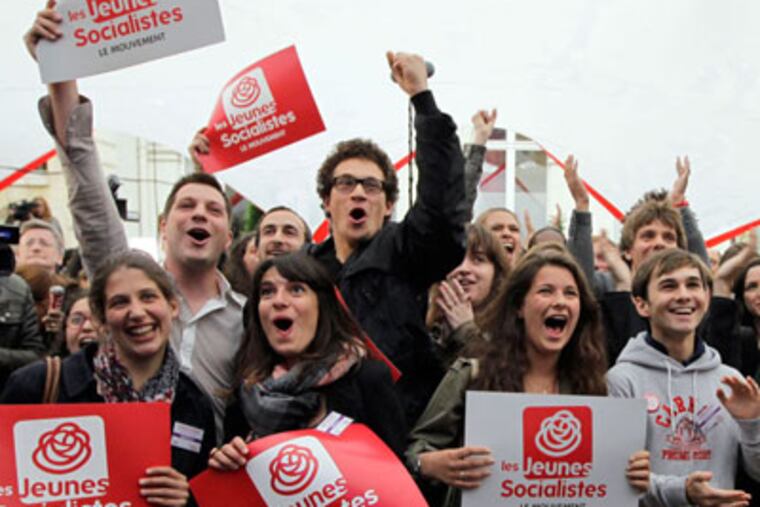
President Francois Hollande's Socialist Party, bolstered by leftist allies, stands positioned to take control of the lower house of parliament so he can revamp a country his partisans see as too capitalist for the French, and push to save the eurozone through growth, not austerity.
The conservative party of former President Nicolas Sarkozy, which has controlled the 577-seat National Assembly since 2002, will likely lose its grip on power in the final round of voting in a week. Sarkozy was defeated in the May 6 final round of the presidential race.
Hollande will likely not get his wish for a pure Socialist Party sweep of the seats of power in France, but he need not fret.
Polling agency projections after Sunday's first round of voting in legislative elections show the Socialists slightly behind Sarkozy's UMP party. But other leftist parties expected to support Hollande - including the communist-inspired Leftist Front and the main environmental party - did well Sunday.
A leftist victory in the voting, five weeks after Hollande took office, would brutally jar the French political landscape.
Leftists are forecast to take between 300 and 366 seats in the next parliament, and the conservatives between 210 and 270 seats, according to the CSA and TNS-Sofres polling agencies.
That would be a sharp shift from the current parliament, where the conservative UMP and its allies had 346 seats and leftists 226 seats.
Sarkozy's party, the Union for a Popular Movement, or UMP, is trying to save its honor. Leading UMP figures vowed not to make alliances between rounds with the extreme-right National Front, which moved into position to grab its first small presence in parliament in more than 25 years.
Eyes are on the National Front at voting time both because of the stigma of racism and anti-Semitism that clings to the party and because of its potential for cutting into the win margin of the mainstream right.
Socialists or other leftists were leading in 70 of 116 districts where the vote count was complete Sunday evening, according to official results. The Interior Ministry is releasing results gradually through the night, district by district.
Socialists and other leftists won between 31 percent and 35 percent of the nationwide vote Sunday, while UMP candidates and their allies won between 34 percent and 35 percent, according to estimates by polling agencies CSA, TNS-Sofres, Ipsos and Ifop. The projections, based on actual vote results in select polling stations nationwide, were in line with expectations.
Turnout was relatively low, estimated at 57 percent, well below the 63 percent in the last parliamentary elections five years ago.
Hollande's Socialists appealed for support in next week's final race. Should they lose in a surprise comeback by the right, Hollande would be forced to appoint a conservative prime minister and carry on in what the French refer to as "co-habitation," in which life can be as tense as within a bickering couple unable to repair their relationship or to divorce.
A Socialist win would give the left control of both houses of parliament and the regions.
Socialist Prime Minister Jean-Marc Ayrault called on voters to give the government a "large, solid and coherent majority" in the second round so "the change you voted for May 6 can be put in motion."