Signs of progress as N.Y. struggles
"We are going to need some patience and some tolerance," the governor said.
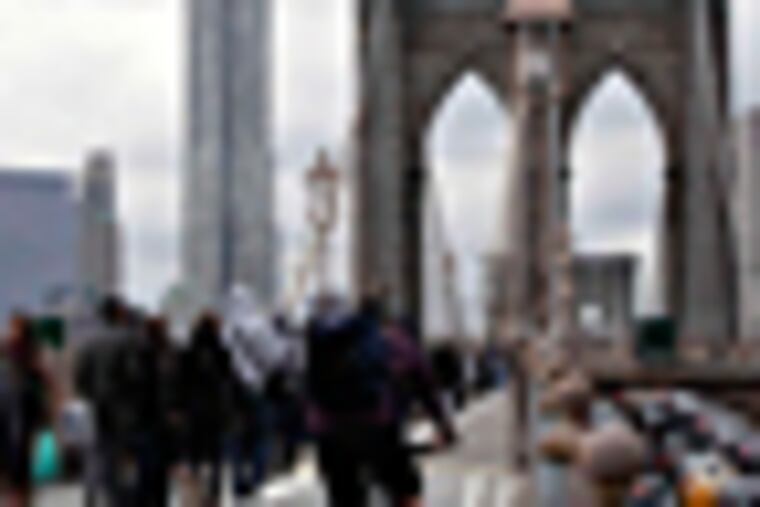
NEW YORK - Flights resumed, but slowly. The New York Stock Exchange got back to business, but on generator power. And with the subways still down, great numbers of people walked across the Brooklyn Bridge into Manhattan in a reverse of the exodus of 9/11.
Two days after Sandy rampaged across the Midatlantic and Northeast, killing at least 74 people, New York struggled Wednesday to find its way. Swaths of the city were still without power, and all of it was torn from its daily rhythms.
At luxury hotels and drugstores and Starbucks shops that bubbled back to life, people clustered around outlets and electrical strips, desperate to recharge their phones. In the Meatpacking District of Manhattan, a line of people filled pails with water from a fire hydrant. Two children used jack-o'-lantern trick-or-treat buckets.
Gov. Andrew Cuomo declared a transportation emergency Wednesday night and said all fares on the city's commuter trains, subways, and buses would be waived Thursday and Friday, to to help alleviate the kind traffic that clogged city streets Wednesday. "The gridlock was dangerous, frankly," he said.
On Wednesday, both were frayed. Bus service was free but delayed, and New Yorkers jammed on, crowding buses so heavily that they skipped stops and rolled past hordes of waiting passengers.
New York City buses serve 2.3 million people on an average day, and two days after the storm they were trying to handle many of the 5.5 million daily subway riders, too.
As far west as Wisconsin and south to the Carolinas, more than six million homes and businesses were still without power, including about 650,000 in New York City, Mayor Michael Bloomberg said.
He said 500 patients were being evacuated from Bellevue Hospital because of storm damage. The hospital has run on generators since the storm. About 300 were evacuated from another Manhattan hospital Monday.
He also canceled school the rest of the week, and the Brooklyn Nets, who just moved from New Jersey, scratched their home opener against the Knicks on Thursday.
Still, there were signs that New York was flickering back to life.
Flights resumed at Kennedy and Newark airports on what authorities described as a very limited schedule. Nothing was taking off or landing at LaGuardia, which suffered far worse damage. Amtrak said trains would start running in and out of New York again on Friday.
The stock exchange, operating on backup generators, came back to life after its first two-day weather shutdown since the blizzard of 1888.
Most Broadway shows returned for Wednesday matinees and evening shows.
Across the Hudson River in New Jersey, National Guardsmen in trucks delivered ready-to-eat meals and other supplies to heavily flooded Hoboken and rushed to evacuate people from the city's high-rises and brownstones. The mayor's office put out a plea for people to bring boats to City Hall for use in rescuing victims.
Large portions of the old factory city were still flooded, and pumps were working round-the-clock to clear a toxic and potentially deadly mix of more than 500 gallons of water, oil, and sewage. National Guard troops in 2.5-ton humvees patrolled the flooded streets, seeking to evacuate the most vulnerable of the city's 20,000 stranded residents, nearly half of Hoboken's population, who were told to stay inside and signal for help with pillowcases.
Mayor Dawn Zimmer stood in the gathering darkness Wednesday afternoon and begged the outside world to speed more supplies, such as flashlights, batteries, food, generator fuel, and drinking water.
"We ask anyone who's listening to deliver supplies to us," she said from the steps of City Hall, which was without power.
In New York, masses of people walked shoulder-to-shoulder across the Brooklyn Bridge to get into Manhattan for work, reminiscent of the escape scenes from the Sept. 11 attack.
People who did have power took to social media to offer help to neighbors.
"I have power and hot water," Rob Hart of Staten Island posted on Facebook. "If anyone needs a shower or to charge some gadgets or just wants to bask in the beauty of artificial light, hit me up."
Simon Massey and his 9-year-old son, Henry, took one last walk near their powerless apartment in Manhattan before decamping to a friend's place in Brooklyn where the electricity worked.
"I'm feeling scared," said Henry, a third grader who missed a third day of school. "It just feels really, really weird. New York's not supposed to be this quiet."