Bid for justice for slain son
It's no easy task in Honduras, but one father is doing his best.
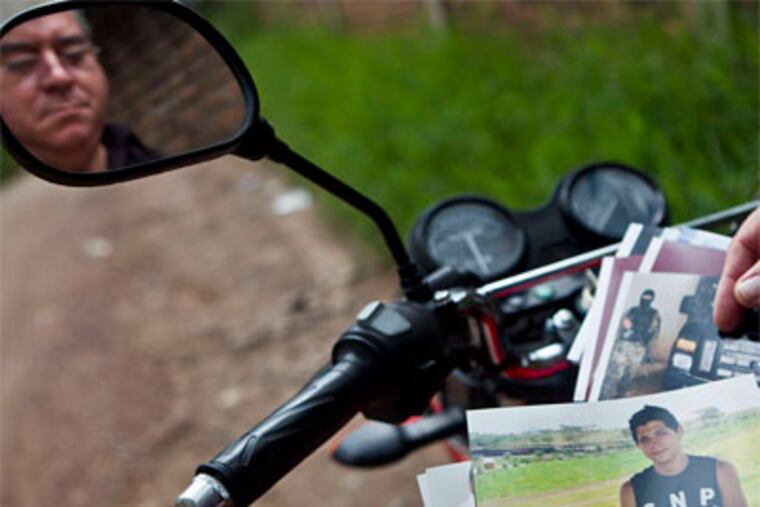
TEGUCIGALPA, Honduras - In a capital so dangerous that only the "walking dead" are said to venture out after dark, nothing could draw an obedient son into the deserted night.
Nothing, that is, but a girl.
Ebed Yanes had friended her on Facebook, and the studious 15-year-old was desperate to meet her. "My parents are still awake," he wrote her that Saturday night in May. "I'll shower while they go to bed and I'll get the keys to the motorcycle."
But he never found her. "I've been looking for 45 minutes," he texted, "but now I better get back before the soldiers catch me."
Ebed knew he lived in a perilous country, with a murder rate that likely makes Honduras the most violent country in the world. The state of emergency declared by the government wouldn't stop him. Nor would the drug gangs that handle three-quarters of all cocaine headed for the United States. By 1:30 a.m., Ebed was dead, slumped over his father's motorcycle with a bullet to the back of his head.
Figuring out what happened has become a mission for the boy's father, Wilfredo Yanes, and reveals the dysfunction that's made this impoverished country a barely functioning state. It's also raised questions about the efficacy of millions of dollars in anti-narcotics aid the U.S. military has provided Honduras.
"I'm not only reacting to the impotence that my son's death made me feel," said Wilfredo, 57, an organic-food supplier. "I can't allow for rights to be violated, and even less if it's my family's right to life."
Every Sunday, before going to church, Ebed's job was to wash the family's car. That Sunday, Wilfredo noticed that his car was still dirty. Ebed was not in bed, and the family's motorcycle was missing.
Ebed never left their gated community alone, had never taken public transportation, and didn't know his way about the city.
"We need to stay calm," Wilfredo told his wife, Berlin Caceres, 42, a university professor.
First they filed a missing-person report with police. They also turned to the homicide division, where officers said they had found a motorcycle next to the body of an unidentified young man.
Wilfredo walked into the morgue alone and found his only son, with a broken jaw that hadn't even seen its first shave and an exit wound next to his mouth.
On his way to the funeral, he stopped at the police station near where Ebed had been found. Two policemen said they had heard shots late Saturday but had been too afraid to go out and investigate.
On the block where his son died, a witness told Wilfredo he had seen six to eight masked soldiers in dark uniforms approaching a body. They poked it with their rifles, then picked up the empty bullet casings and returned to their vehicle, an unusually big pickup truck.
After the sun came up, residents said, they went outside and gathered bullet casings that the soldiers had failed to find. They gave them to the father, who carried them to his son's funeral.
That night, at Ebed's wake, Wilfredo made a promise: "My son will not be just one more statistic."
The father knew the odds he faced: Police investigated only 21 percent of the nation's cases in 2010 and 2011, records show.
He reached out to Julieta Castellanos, the president of National University, whose son had been killed at a police roadblock last year. She had become a fearless critic of police impunity and advised Wilfredo to gather evidence and contact the prosecutor's office.
Days later, Wilfredo and his wife drove through the hilly outskirts of the capital, looking for a vehicle that fit the witness descriptions. On their third trip, they stumbled upon an army checkpoint near the alley where their son was killed. The pickup they found matched the one neighbors had described.
Days later, Wilfredo was sitting in the office of the country's head prosecutor, German Enamorado, who was outraged by the story. He assigned two prosecutors to the case that same day.
There was one problem, though: The poorly equipped prosecutors didn't even have a car. Wilfredo offered to drive.
At army headquarters, they found an incident report saying a man on a motorcycle had fired on soldiers at the checkpoint and fled.
Then they learned chilling news: The Ford pickup had been donated by the U.S. government, and the special forces unit had been trained by the United States and even vetted as free of corruption and involvement in human-rights violations.
In other words, these were Honduras' finest soldiers.
The army chief, Rene Osorio, told the press Ebed had deserved what he got. "Everyone who does not stop at a military checkpoint is involved in something," Osorio said.
Called in by Enamorado, the soldiers said they couldn't remember a man on a motorcycle.
After the interview, however, one soldier called his own mother and told her a very different story, according to the investigative file. He said he had been ordered to lie about the shooting. He later testified that the soldiers had chased Ebed through dark alleys until the motorcycle turned into one that was too narrow for their truck. The lieutenant ordered the unit to open fire. Col. Juan Giron then arranged the cover-up, according to the soldier, who is now a protected witness.
Enamorado said it was right to chase Ebed, to try to stop him, even to shoot into the air. But not at a fleeing suspect.
Within 17 days of opening the case, three soldiers were arrested, and Eleazar Abimael Rodriguez, 22, was charged with murder and imprisoned. The two others, including the officer who ordered the unit to shoot, were suspended from the army and released on bail awaiting trial, charged with covering up a crime and abuse of their office. The military has denied any officer wrongdoing.