Tunisian killing ignites anger
An opposition leader who a day earlier predicted assassinations was himself gunned down.
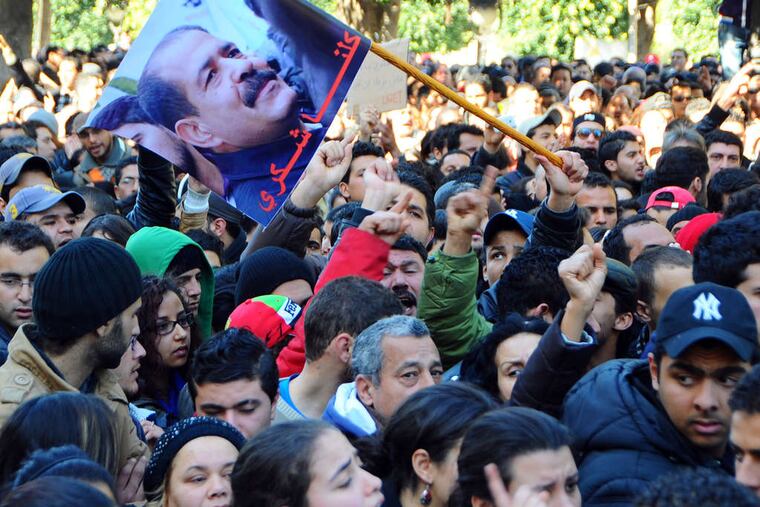
TUNIS, Tunisia - The assassination of a leading opposition figure in Tunisia on Wednesday triggered protests across the nation and raised fresh concern about the legacy of the "Arab Spring," the pro-democracy movement now threatened in several countries by turmoil between Islamists and secular liberals.
Chokri Belaid, 48, head of the Democratic Patriots party, was shot on his way to work in Tunis, the capital, the day after he predicted a wave of political assassinations. No one claimed responsibility for the attack, but it came amid a democratic transition endangered by Islamist hard-liners with caches of smuggled weapons.
Youths hurled rocks at police around the country and thousands marched through tear gas in Tunis. Offices of the Islamist Nahda party, which dominates the government, were reportedly ransacked in a spasm of anger that had simmered for months over the country's political infighting and stalled reforms.
Prime Minister Hamadi Jebali announced that he was forming a new, technocratic government to guide the country until elections "as soon as possible."
Tunisia is the birthplace of the Arab Spring uprisings, which began in 2010 when a vegetable vendor set himself on fire after being harassed by police. Its revolution was embraced by the West as a model for relatively peaceful upheaval, especially compared with the bloodshed that followed in Libya and Syria. But the sharpening division between Islamists and secularists is threatening that transition.
Similar scenarios are playing out in Egypt and other countries, but Tunisia's radical Islamists, many of whom fought in Algeria and Iraq, have been more prone to violence.
Secularists say Nahda is manipulating radical Salafis, who adhere to a literal interpretation of the Quran, as part of a broader agenda to tilt the nation toward extremism. Salafis rail at what they regard as liberalism seeping in from the West, and their anger is stoked by emboldened clerics.
Belaid, a lawyer and outspoken leftist, was a fierce critic of Nahda's inability to unite political factions. He was a polarizing figure and often accused the party of not clamping down on Salafi attacks on movie houses, galleries and others they deem as against Islam.
He was accused by the government of inciting demonstrations over inflation and unemployment.
Belaid had received death threats and said on a television talk show Tuesday that Nahda had given a "green light" for assassinations. His wife, Basma, accused Nahda of orchestrating his killing, reportedly carried out by a lone gunman wearing a traditional hooded robe.
Nahda's leader, Rachid Ghannouchi, denied involvement, saying, "We denounce this cowardly act that threatens the revolution and the stability of the country."