Freight-train blast rattles Baltimore area
Smoke could be seen for miles, but local officials reported no chemical threat.
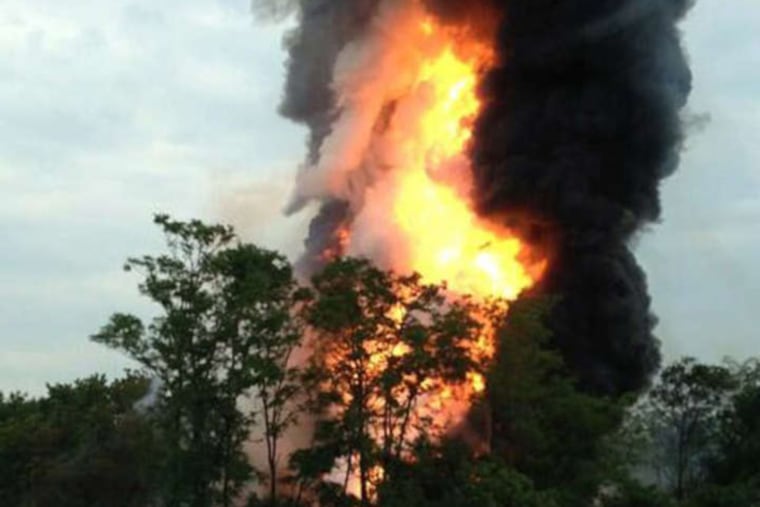
ROSEDALE, Md. - A CSX freight train crashed into a trash truck and derailed Tuesday in a Baltimore suburb and the explosion that followed rattled homes at least a half-mile away, sending a plume of smoke into the air that could be seen for miles, officials and witnesses said.
In the third serious derailment this month, the dozen or so cars, at least one carrying hazardous materials, went off the tracks about 2 p.m. in Rosedale, a Baltimore eastern suburb. A hazardous materials team responded, but Baltimore County Executive Kevin Kamenetz said at a news conference that no toxic inhalants were being released. Officials did not order an evacuation.
By nightfall, the hazmat team had left, meaning there was no more danger posed from the chemicals in the railcar, said Baltimore County Police Capt. Bruce Schultz.
The truck driver, 50-year-old John J. Alban Jr., was in serious condition Tuesday night, a hospital spokeswoman said. Two CSX workers aboard weren't hurt.
Dale Walston said he lives about a half-mile away and that he thought he could smell chemicals.
"It shook my house pretty violently and knocked things off the shelves," he said in an e-mail.
The face of one warehouse near the train tracks blew off.
Even hours after the blast, the thick plume of black smoke could be seen for miles and had drifted and covered the eastern part of Baltimore.
Later, the smoke that was left had lightened considerably, changing from black to gray, though the fire wasn't yet extinguished.
CSX spokesman Gary Sease said in an e-mail that on one of the cars was sodium chlorate, which the Department of Transportation classifies as a hazardous material. However, Baltimore County Fire Chief John Hohman said the chemical was not in any of the cars that were still burning into the evening. The bleaching agent is used in making paper.
Nick Materer, an Oklahoma State University chemist, said that sodium chlorate, when combined with fuel, makes a more volatile mixture. "When you mix them together and add fire, they go boom," he said in a phone interview.
Materer said the chemical is usually shipped as a white powder but it can also be in a liquid solution. Either way, he said, the fumes can irritate the lungs if inhaled.
Exactly what triggered the explosion was being investigated, and Hohman said firefighters told residents of about 70 nearby homes that they could leave if they wanted to and shelter would be provided.