Lifetime cost of care of wounded
No agency has calculated for higher survival rates, longer tours of duty, multiple injuries.
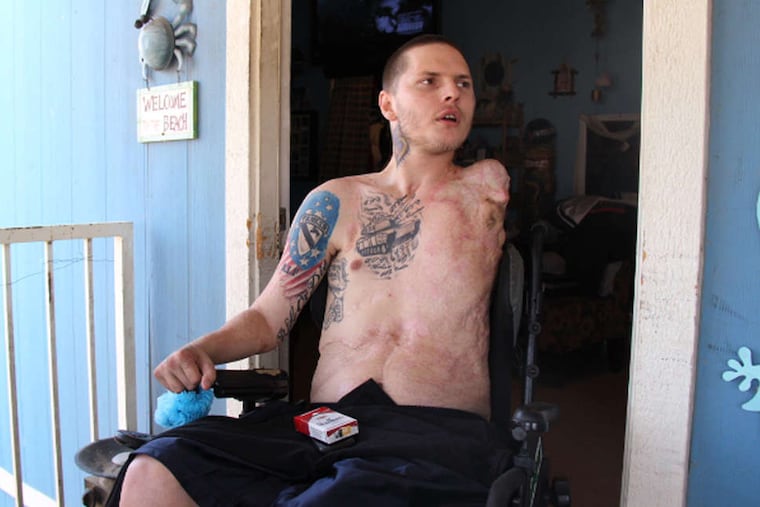
Jerral Hancock wakes up every night in Lancaster, Calif., around 1 a.m., dreaming he is trapped in a burning tank. He opens his eyes, but he can't move. He can't get out of bed. He can't get a drink of water.
Hancock, 27, joined the Army in 2004 and went to Iraq, where he drove a tank. On Memorial Day 2007 - one month after the birth of his second child - Hancock drove over an IED. Just 21, he lost an arm and the use of both legs, and now suffers from post-traumatic stress disorder. The Department of Veterans Affairs pays him $10,000 every month for his disability, his caretakers, health care, medications and equipment.
No government agency has calculated fully the lifetime cost of health care for the large number of post-9/11 veterans of the wars in Iraq and Afghanistan with life-lasting wounds. But it is certain to be high, with the veterans' higher survival rates, longer tours of duty, and multiple injuries, plus the anticipated cost to the VA of reducing the wait times for medical appointments and reaching veterans in rural areas.
As veterans age, their injuries worsen, said Linda Bilmes, a professor in the Kennedy School of Government at Harvard University and coauthor of The Three Trillion Dollar War: The True Cost of the Iraq Conflict. The same long-term costs seen in previous wars are likely to be repeated to a much larger extent.
Post-9/11 veterans in 2012 cost the VA $2.8 billion of its $50.9 billion health budget for all of its annual costs, records show. And that number is expected to increase by $510 million in 2013, according to the VA budget.
Like Hancock, many veterans returning from Iraq and Afghanistan have survived multiple combat injuries because of military medicine's highly advanced care. Doctors at Brooke Army Medical Center in San Antonio, Texas, repaired Hancock's body with skin grafts and sent him to spinal-cord doctors for the shrapnel that paralyzed him. He can only move the thumb on his right hand.
Injuries like Hancock's likely will lead to other medical issues, ranging from heart disease to diabetes, for example.
"So we have the same phenomenon but to a much greater extent," Bilmes said. "And that drives a lot of the long-term costs of the war, which we're not looking at the moment but which will hit in 30, 40, 50 years from now."
Veterans like Hancock will require decades of costly rehabilitation, according to a 2012 Military Medicine report that analyzed the medical costs of war through 2035. More than half of Iraq and Afghanistan veterans are between 18 and 32, according to 2011 American Community Survey data. They are expected to live 50 more years, the Institute of Medicine reports.
About 25 percent of post-9/11 veterans suffer from post-traumatic stress disorder (PTSD), and 7 percent have traumatic brain injury (TBI), according to Congressional Budget Office analyses of VA data. The average cost to treat them is about four to six times greater than those without these injuries, the CBO reported. And polytrauma patients cost an additional 10 times more than that.
Post-9/11 veterans use the VA more than other veterans and their numbers are growing at the fastest rate. Fifty-six percent of Iraq and Afghanistan veterans use the VA, and their numbers are expected to grow by 9.6 percent this year and 7.2 percent next year, according to a VA report from March 2013.
In response to multiple injuries suffered by Iraq and Afghanistan veterans, the VA established its polytrauma care system in 2005, creating centers around the country where veterans are treated for multiple injuries, ranging from TBI and PTSD to amputations, hearing loss, visual impairments, spinal-cord injuries, fractures, and burns. Post-9/11 veterans make up around 90 percent of polytrauma patients, said Susan Lucht, program manager of the polytrauma center at the Southern Arizona VA Health Care System in Tucson.
Each polytrauma patient costs the VA on average $136,000 a year, according to a CBO report, using VA data from 2004 through 2009.
Doctors and economists argue that today's conversation should not only be about the primary wounds of war, but about the medical issues that are often associated with them. PTSD, for example, is often associated with smoking, substance abuse, depression, anxiety, heart disease, obesity and diabetes. Amputations are associated with obesity, cardiovascular disease, osteoarthritis, back pain, and phantom limb pain.
While polytrauma centers have expanded across the country, that doesn't mean that all veterans live close enough to access them. In many parts of country, health care is hampered by distance because veterans who use the VA live far away from their closest VA hospital. (In the Philadelphia area, there are VA hospitals in South Philadelphia and Coatesville. The closest one in New Jersey is in Somerset County.)
And many VA hospitals fall behind in entering data from private health records or following up with patients, especially mental health patients for whom follow-up care is particularly important, according to VA Office of Inspector General reports.
The VA doesn't always provide timely mental health evaluations for first-time patients, and existing patients often wait more than the recommended 14 days for their appointments, the OIG reported last year.
"Long wait times and inadequate scheduling processes at VA medical centers have been long-standing problems that persist today," the U.S. Government Accountability Office reported in February. Inconsistent scheduling policies, staffing, phone access and an outdated scheduling system make the problem worse.
Meanwhile, both the GAO and OIG have reported that VA's data on wait times for medical appointments is unreliable, and some schedulers entered incorrect dates or changed them to meet performance standards.
Whatever changes or remains the same in VA care, Jerral Hancock knows that he never will return to a normal life.
Hancock misses the adrenaline rush of life before his injury. He longs for a wheelchair that will go faster than 5 m.p.h. He described the time he fell out of his hospital bed as exhilarating. He broke his cheek open, but he loved it.
With the $100,000 the Defense Department gave Hancock for his injuries when he was discharged, he bought two mobile homes outside Los Angeles, one for himself and his two children, ages 9 and 6, and one for his mother and stepfather, who take care of him full time. Hancock supports all of them with his monthly disability check from the VA.
The VA bought him a wheelchair and put a lift into his front porch. It widened the doors in his mobile home so his wheelchair could fit in and out. It will pay for his medications and all of his medical care for the rest of his life.
But when Hancock arrived at his new home, he couldn't fit his wheelchair in the front door. So he kept one wheelchair inside, and his stepfather carried him through the door and down the steps to a second wheelchair that he paid for himself. It took eight months for the VA to pay him $1,000 for the second wheelchair, and four months to put a lift into his front porch.
"I was stuck in the house for six months over this fight," Hancock said. "I had a wheelchair upstairs and I had a wheelchair downstairs. And my caretaker carried me up and down the stairs from wheelchair to wheelchair. It was ridiculous."
Even with all of the money that the VA spends on Hancock's medical and family care, he lives in a mobile home, with a bedroom that has little extra space with a hospital bed and a wheelchair in it. He can't fit into his children's bedrooms. And his air-conditioning hardly works, but he can't be in the heat for too long because his burns prevent him from sweating.
Hancock's children also have had to adjust.
"My son watched me walk off - he was going on 3 - and I jumped on a bus with a couple hundred pounds of gear," he said. "The next time he saw me, I lost 100 pounds. . . . I looked like a skeleton and I had tubes coming out everywhere. . . . My daughter, this is all she knows."
Wednesday: The high rate of veteran suicides.