Marking deadly Tahrir clash
Activists returned to the Cairo square, protesting military rule and trying to restart fight for democracy.
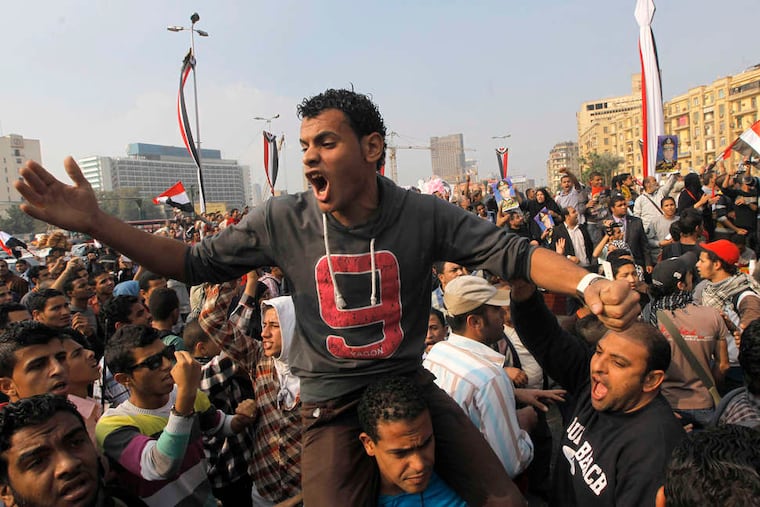
CAIRO - Protesters returned to Egypt's iconic Tahrir Square on Tuesday for the first time since the military overthrew Egyptian President Mohammed Morsi in July, this time to mark the two-year anniversary of one of the deadliest clashes between security forces and demonstrators demanding civilian rule.
Tuesday's protest was an effort to restart the push for democratic reforms, but with support for the military soaring among Egyptians, the demonstration instead showcased the uphill battle democracy advocates face.
On Nov. 19, 2011, tens of thousands filled Tahrir Square and neighboring Mohammed Mahmoud Street. At least 42 were killed when the military sought to clear the square. On Tuesday, the crowds were much smaller.
Protesters wrecked a state memorial dedicated to the slain protesters, only hours after it was inaugurated. The interim prime minister, military chief Gen. Abdel-Fattah el-Sissi, dedicated the memorial's empty base - a statue to top it is planned later - with great fanfare Monday. By Tuesday morning, the pedestal was reduced to a lump of concrete covered in revolutionary graffiti. Before dawn, activists had ripped off its stone cladding and spray-painted it with slogans denouncing both Morsi and his nemesis el-Sissi.
Infuriated revolutionary activists point out that most protesters killed over the last 21/2 years died at the hands of police, who have not faced trials. They say security forces have returned to their brutal ways under Mubarak.
Protesters said they hoped to sow public doubt about supporting a military that has failed to deliver the kind of economic reform desperately needed in this flailing nation. They also sought to emphasize how the military has suppressed freedom of expression.
"After Morsi was removed, a lot of things that the revolution was against have come back. People are starting to see," said Azza Abdul Ara, 26, an engineer. The military "is trying to end the revolution."