New 'NERDS' updates the saga of nerds
In the world of social media and digital communications, 2007 was the olden days. That year, the musical NERDS debuted, to great applause, at the Philadelphia Theatre Company. The musical satire tracks the careers of Steve Jobs and Bill Gates, the world's two most famous (and richest) nerds.
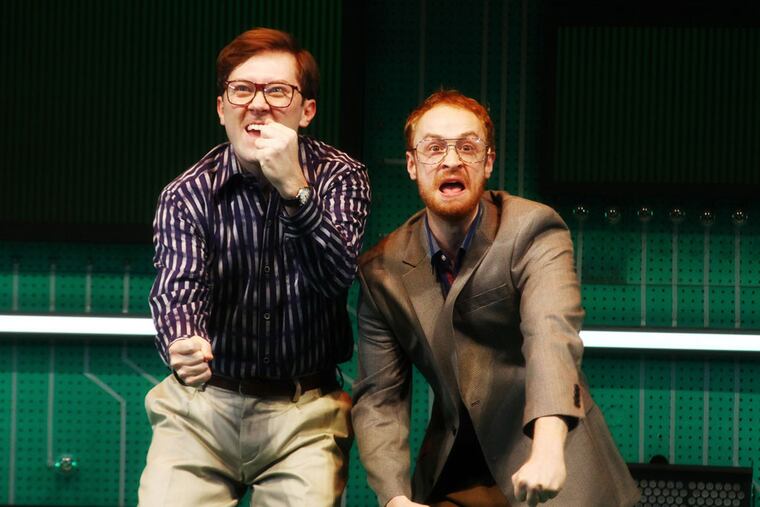
In the world of social media and digital communications, 2007 was the olden days.
That year, the musical NERDS debuted, to great applause, at the Philadelphia Theatre Company. The musical satire tracks the careers of Steve Jobs and Bill Gates, the world's two most famous (and richest) nerds.
Now it's back, same place, running from Friday to Dec. 29.
Problem is, in the world of social/mobile computing/com, 2007 is unimaginably long ago . . . pre-iPhone!
"With writing a show on technology, the blessing is, it's always relevant," says Erik Weiner, speaking from the show's rehearsal space in Manhattan with coauthor Jordan Allen-Dutton. "The curse is, it's a moving target. So much has changed in computer history. So we've had to tweak the show in a lot of ways. Consider this the new operating version, NERDS X."
Allen-Dutton adds: "The Internet, mobile devices, it's all unfolded in a way people couldn't have imagined, chapter after chapter, in their ramifications for society."
Weiner and Allen-Dutton, both 36, call themselves "computer geeks." They grew up "on the Stanford University campus, pretty much" (Allen-Dutton), and in San Francisco (Weiner), so they saw the Silicon Valley explosion up close. They wrote an MTV skit about Gates, and Allen-Dutton's mother, Mary Lou Allen, said, "You ought to make it into a musical." Bingo.
That musical "comes from a loving place," Weiner says, "but we wanted to poke fun, because there's a lot that's funny about it."
Reflect on 2007. Apple, with Jobs at the helm, released the first-generation iPhone. The mobile world exploded, a world that is now . . . well, the world. Back in 2007, Gates was full-time chairman at Microsoft, not going part-time until mid-2008. It was a busy year, full of rollouts successful (Office 2007) and less so (Vista).
Enter NERDS. "Our producers connected with the Philadelphia Theatre Company, and that's how we came to debut there," Weiner says. It would win Barrymore Awards for outstanding new play and outstanding original music.
Six years on, much has changed. Apple and Microsoft, still hoovering up cash, grab fewer headlines than, say, Twitter or Vine. Jobs is with the angels; Gates is out changing the world with the Bill and Melinda Gates Foundation. Smartphones took the Web off the desk and sent it running all over the place.
So a lot in NERDS had to be tweaked, right?
"It's the show you loved the first time," Weiner says, "but we've added some things, written new jokes, a couple new songs."
"We made sure to mention the Arab Spring," Allen-Dutton says. "That changed people's minds about whether social media could be relevant."
"And near the end, we have a new song," Weiner says, "which puts all these fantastic changes in perspective."
NERDS also takes loving aim at the social stereotype of the nerd. Stanley Bahorek, who plays Gates, says that "after this show, I'll always take it as a compliment if anyone calls me a nerd."
Bahorek describes his role as "sort of a fantasy/farce version of Gates' life, a caricature of the Silicon Valley genius billionaire. I have the utmost respect for the actual Bill Gates - I watch his TED talks on YouTube, and his ideas on malaria, world hunger, they're brilliant. But we're having a larger kind of fun with the idea of the nerd."
That's the second wave of change, already cresting in 2007: the growing place of the nerd in popular culture - thanks largely to Jobs, Gates, and their fellow geniuses' success stories.
As a nerd, "you're probably going to get picked on or ridiculed," Bahorek says, "or people will make fun of your passion for Star Trek figurines or original-cast recordings of Broadway shows. But a nerd is just a person who's really vulnerably passionate about something. All of us have something like that."
Since 2007, society increasingly has embraced the geek and the nerd. (Come to think, didn't Big Bang Theory debut in 2007?)
"We're in a time of serious mainstreaming of this kind of outsider," says Alissa Quart. She's an authority. Her book Republic of Outsiders: The Power of Amateurs, Dreamers and Rebels examines how formerly marginalized people - including everyone on the spectrum of those with more technical than social skill, shall we say? - are becoming more and more central to our more and more technophilic society.
"When it hits human resources, when companies are looking to hire these people, you know it's arrived," Quart says.
And beyond H.R. "Before, we tacitly valued these people's skills, which we all rely on in a tech age like this," Quart says. "Now we have outright heroes of this ilk.
"It's cool to think that Silicon Valley is producing culture."
Allen-Dutton says that has been happening for a while. "In this really crazy way," he says, "the '60s idea of a people's revolution kind of morphed in the Silicon Valley into the computer revolution."
What are Web access, or processing speed, or mobility, after all, but - power to the people? Right on.
THEATER
NERDS
Presented by Philadelphia Theatre Company at the Suzanne Roberts Theatre, Broad & Lombard Streets, Friday through Dec. 29.
Tickets: $51-$56
Information: 215-985-0420 or www. philadelphiatheatrecompany.org
EndText
215-854-4406 @jtimpane