Question: What led to N.Y. rail tragedy?
NEW YORK - A New York City commuter train rounding a riverside curve derailed yesterday, killing four people and injuring more than 60 in a crash that threw some riders from toppling cars and swiftly raised questions about whether excessive speed, mechanical problems or human error played a role.
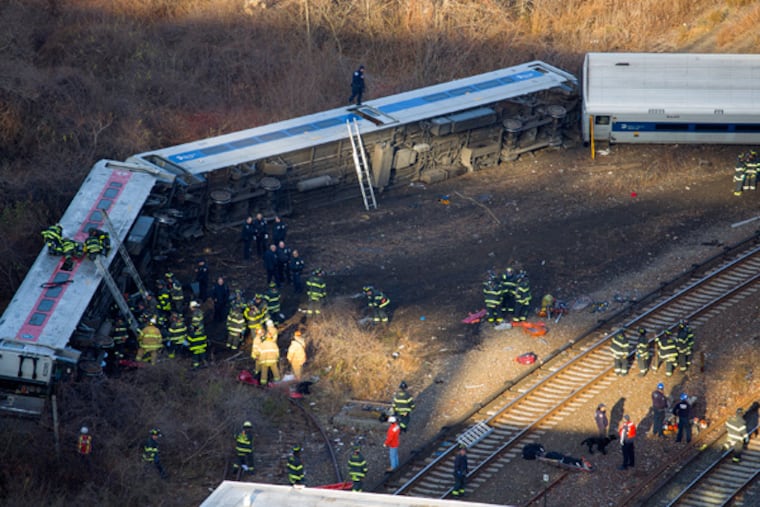
NEW YORK - A New York City commuter train rounding a riverside curve derailed yesterday, killing four people and injuring more than 60 in a crash that threw some riders from toppling cars and swiftly raised questions about whether excessive speed, mechanical problems or human error played a role.
Some of the roughly 150 passengers on the early morning Metro-North train from Poughkeepsie to Manhattan were jolted from sleep about 7:20 a.m. to screams and the frightening sensation of their compartment rolling over on a bend in the Bronx where the Hudson and Harlem rivers meet. When the motion stopped, all seven cars and the locomotive had lurched off the rails, and the lead car was only inches from the water. The nation's second-biggest commuter railroad had never experienced passenger death in an accident in its 31-year history.
In their efforts to find passengers, rescuers shattered windows, searched nearby woods and waters and used pneumatic jacks and air bags to peer under wreckage. Officials planned to bring in cranes during the night to right the overturned cars on the slight chance anyone might still be underneath, National Transportation Safety Board member Earl Weener said.
The agency was just beginning its search into what caused the derailment, and Weener said investigators had not yet spoken to the train conductor, who was not injured.
Meanwhile, thousands of people braced for this morning's complicated commute, with shuttle buses ferrying passengers to another line.
Investigators were due to examine factors ranging from the track condition to the crew's performance. Gov. Andrew Cuomo said the track did not appear to be faulty, leaving speed as a possible culprit for the crash. The speed limit on the curve is 30 mph, compared with 70 mph in the area approaching it, Weener said.
Authorities did not yet know how fast the train was traveling but had found a data recorder, he said.