9/11 museum offers sights and sounds of tragedy
NEW YORK - The museum devoted to the story of Sept. 11 tells it in victims' last voice mails, in photos of people falling from the twin towers, in the scream of sirens, in the dust-covered shoes of those who fled the skyscrapers' collapse, in the wristwatch of one of the airline passengers who confronted the hijackers.
NEW YORK - The museum devoted to the story of Sept. 11 tells it in victims' last voice mails, in photos of people falling from the twin towers, in the scream of sirens, in the dust-covered shoes of those who fled the skyscrapers' collapse, in the wristwatch of one of the airline passengers who confronted the hijackers.
By turns chilling and heartbreaking, a place of both deathly silence and distressing sounds, the National September 11 Memorial Museum opens this week deep beneath ground zero, 121/2 years after the terrorist attacks.
The project was marked by construction problems, financial squabbles and disputes over the appropriate way to honor the nearly 3,000 people killed in New York, Washington, and the Pennsylvania countryside.
Whatever the challenges in conceiving it, "you won't walk out of this museum without a feeling that you understand humanity in a deeper way," museum president Joe Daniels said Wednesday.
The privately operated museum - built along with the memorial plaza above for $700 million in donations and tax dollars - will be dedicated Thursday with a visit from President Obama and will be open initially to victims' families, survivors, and first responders. It will open to the public Wednesday.
Charles G. Wolf, who lost his wife, Katherine, planned to be at the ceremonial opening. "I'm looking forward to tomorrow, and I'm dreading tomorrow," he said Wednesday. "It brings everything up."
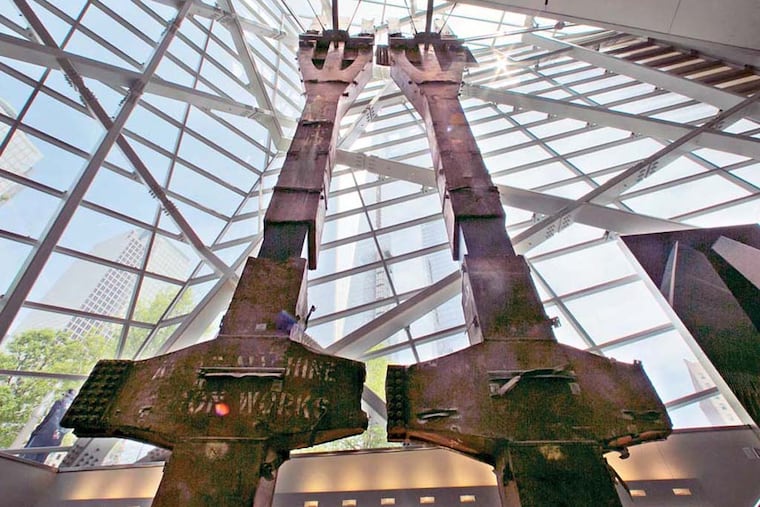
Visitors start in an airy pavilion where the rusted tops of two of the World Trade Center's trident-shaped columns shoot upward. From there, stairs and ramps lead people on an unsettling journey into 9/11.
First, a dark corridor is filled with the voices of people remembering the day. Then visitors find themselves looking over a cavernous space, 70 feet below ground, at the last steel column removed during the ground zero cleanup - a totem covered with the numbers of police precincts and firehouses and other messages.
Descend farther - past the battered "survivors' staircase" that hundreds used to escape - and there are such artifacts as a mangled piece of the antenna from atop the trade center and a fire truck with its cab shorn off.
Five Quick Museum Facts
The National September 11 Memorial Museum opens to the public May 21, preceded by a ceremony Thursday that will include President Obama, families and other officials.
Its Mission
The exhibits tell the stories of the more than 2,700 people who died in New York, those who survived, and how the world has changed since the attack. Museum director Alice Greenwald said the museum is "about understanding our shared humanity," while former Mayor Michael Bloomberg called it a reminder "that freedom is not free."
Museum's Size
The museum occupies 110,000 square feet on the 16-acre trade center site, tracing the foundations of the twin towers 70 feet underground.
Construction and Foundation
Below the Sept. 11 memorial plaza, with its two fountains outlining the footprints of the towers, the museum reaches down to bedrock, where the towers' steel columns were anchored. It's bounded by a slurry wall that kept back the Hudson River after the attack.
Costs
The plaza and museum together cost $700 million to build, subsidized with $390 million in tax-funded grants; officials hope the $24 museum entrance fee expected to generate about $40 million a year will help cover operating costs, expected to be
about $60 million a year. Fund-raising will cover the rest, for now.
Special Artifact
Among the more than 10,000 artifacts, 23,000 still images and 500 hours of video and film, plus 1,970 oral histories, one special item is what Patricia Reilly looked for among the displays during an earlier tour for families: her sister's picture ID card from the 101st floor office in the south tower where she died. - AP
EndText