In Japan, a race against time to save 2 hostages
The premier, up against a Friday deadline, pursued diplomacy.
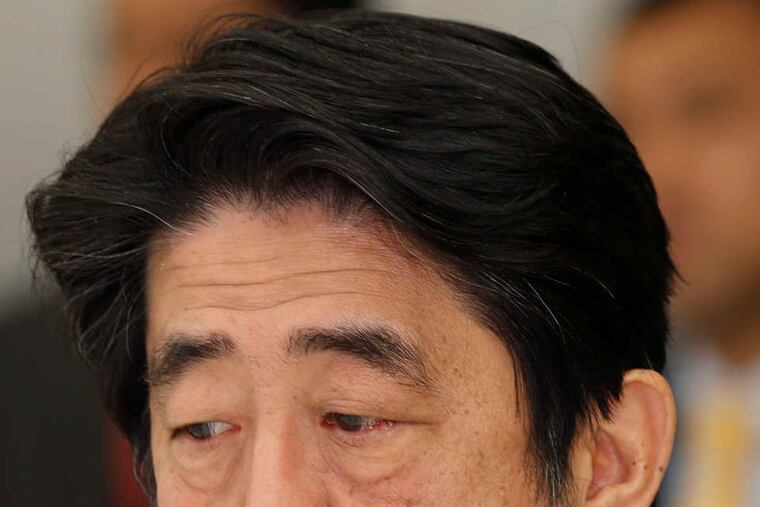
TOKYO - Japan is doing all it can to free two hostages the Islamic State is threatening to kill unless it receives $200 million, Prime Minister Shinzo Abe said Wednesday, vowing never to give in to terrorism.
Abe returned to Tokyo from a six-day Middle East tour slightly ahead of schedule and convened a cabinet meeting.
"We are fighting against time, and we'll make an all-out effort and use every diplomatic route that we have developed to win the release of the two," he said.
Abe said he was consulting with leaders in the region. A convoy carrying Japanese Vice-Foreign Minister Yasuhide Nakayama left the embassy in Jordan's capital Amman on Wednesday for an unknown location in the city. Jordan's King Abdullah II later met with him, according to Jordan's Petra News Agency.
The Islamic State demanded the $200 million ransom in a video posted online Tuesday that showed a knife-brandishing masked militant standing over the kneeling captives. It gave a deadline of 72 hours, which the video's release time suggests would expire sometime Friday.
Abe and other Japanese officials have not said directly whether Japan will pay ransom for the captives, 47-year-old freelance journalist Kenji Goto and 42-year-old Haruna Yukawa, the founder of a private security company.
Government spokesman Yoshihide Suga confirmed Japan believes the threat is authentic. "Japan's aim is not to kill the Muslim people, as the militant group claims it to be," Suga said. "We strongly urge them not to harm the two Japanese and release them immediately."
Abe has limited choices, among them to openly pay the extremists or ask an ally such as the United States to attempt a risky rescue inside Syria. Japan's military operates only in a self-defense capacity.
But officials are adamant that Japan will continue to provide non-military aid to the region.
"We will never give in to terrorism," Abe said.
In past international hostage situations involving Japanese captives, at least one has been killed while most have been released. It is unclear how many times Japan paid ransom. The only confirmed case was in Kyrgyzstan in 1999.
Japanese media reported Wednesday, citing unnamed officials, that Goto's wife received an e-mail on her mobile phone in December demanding a ransom of more than 2 billion yen ($17 million).
She exchanged several e-mails with the unknown person, whose e-mail address was similar to one used by the Islamic State, the Kyodo News service and other media reported. The messages did not include a threat to kill Goto, it said.
Securing the hostages' release will be hard, "because all Japanese diplomats left Syria as the civil war escalated," Tsutomu Ishiai, foreign news editor for the major newspaper Asahi Shimbun, said in a commentary.