Isolated Nepal villagers desperate for any help
PASLANG, Nepal - There is almost nothing left of this village but enormous piles of broken red bricks and heaps of mud and dust.
PASLANG, Nepal - There is almost nothing left of this village but enormous piles of broken red bricks and heaps of mud and dust.
One of those piles was once Bhoj Kumar Thapa's home, where his pregnant wife pushed their 5-year-old daughter to safety in a last, desperate act before it collapsed and killed her during Saturday's earthquake.
On Tuesday, Thapa and others in Paslang were still waiting for the government to deliver food, tents - any kind of aid - to this poor mountain village near the epicenter of the quake that killed more than 4,700 people, injured more than 8,000, and left tens of thousands homeless.
"When I got home, there was nothing," said Thapa, an army soldier. "Everything was broken. My wife - she was dead."
An official came, took some pictures and left - without delivering anything to the village of about 300 people north of the capital of Kathmandu, he said.
Paslang is only 1.8 miles up the mountain from the town of Gorkha, the district headquarters and staging area for rescue and aid operations. But the villagers, who have no idea when they might get help, are still sleeping together in the mud and sharing whatever scraps of food they can pull from beneath their ruined buildings. Three people in the hamlet have died.
Officials and foreign aid workers who have rushed to Nepal following the magnitude 7.8 earthquake are struggling against stormy weather, poor roads, and a shortage of manpower and funds to get assistance to the needy. On Tuesday, the district managed to coordinate 26 helicopter trips to remote villages to evacuate 30 injured people before a major downpour halted the effort.
"We need 15,000 plastic tarps alone. We cannot buy that number," said Mohan Pokhran, a district disaster-management committee member. Only 50 volunteer army and police officers are distributing food and aid for thousands in the vicinity, he said.
"We don't have nearly enough of anything," Pokhran said.
On Tuesday came more tragedy: A mudslide and avalanche struck near the village of Ghodatabela, and 250 people were feared missing, district official Gautam Rimal said. Heavy snow had been falling, and the ground may have been loosened by the quake.
The challenge is to reach them in rugged isolated villages. Trucks carrying food were on their way to affected districts outside the hard-hit and densely populated Kathmandu Valley.
Geoff Pinnock of the U.N.'s World Food Program was leading a convoy of trucks north toward the worst-affected areas when the rain began, causing a landslide.
"I can maybe get one truck through and take a risk driving on the dirt," he said, "but I think we'll have to hold the materials back to try to get them out tomorrow by helicopter."
The World Food Program said that distribution of rice would begin Wednesday in Gorkha district and that the agency planned to provide $116 million worth of food in the next three months.
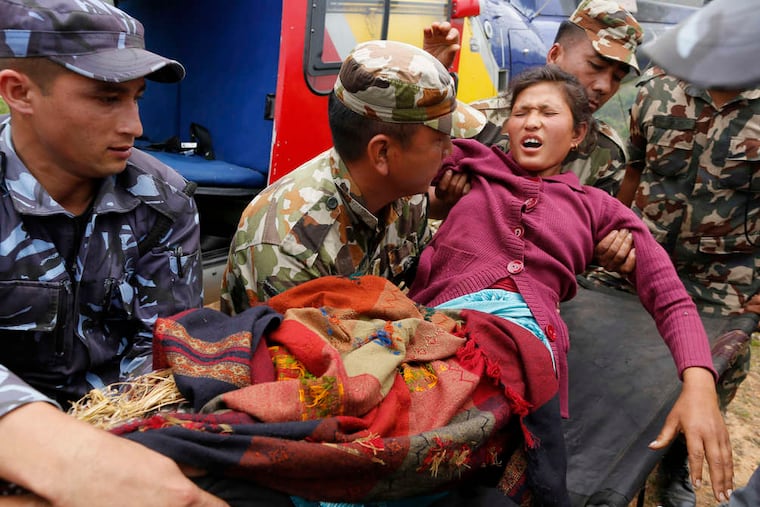
In the town of Gorkha, rescue helicopters delivered several injured women who grimaced and cried out in pain, unable to walk or speak.
Sita Karki winced when soldiers lifted her. Her broken and swollen legs had been tied together with wisps of hay twisted into a makeshift splint. "When the earthquake hit," she said, "a wall fell on me and knocked me down."
Nepal's death toll rose to 4,768, said police officer Hari Bhakt in Kathmandu. An additional 61 were killed in neighboring India, and China's official Xinhua News Agency reported 25 dead in Tibet.