Moderate Republicans jockey for second place in N.H.
HOOKSETT, N.H. - The sign at the foot of American Legion Post 37's driveway promoted an upcoming "awesome meat raffle," which seemed appropriate to the task at hand on a subfreezing night last week.
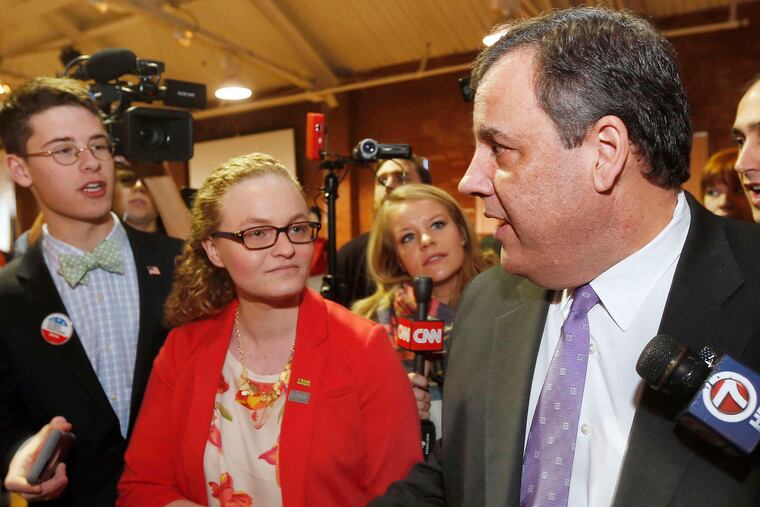
HOOKSETT, N.H. - The sign at the foot of American Legion Post 37's driveway promoted an upcoming "awesome meat raffle," which seemed appropriate to the task at hand on a subfreezing night last week.
Inside, about 100 New Hampshire voters had turned up to consider taking a chance on Ohio Gov. John Kasich in the state's first-in-the-nation Republican presidential primary Feb. 9.
"Folks, you've got to be in the real world," Kasich said. "You've got to have somebody who's a legitimate reformer and has a record of accomplishing things," He boasted of a balanced budget as a congressional leader in the 1990s and job growth in Ohio, where he was reelected in the key swing state by 30 points in 2014.
Kasich and three other candidates seen as relative moderates - Florida Sen. Marco Rubio, New Jersey Gov. Christie, and former Florida Gov. Jeb Bush - are battling to become the chief alternative to businessman Donald Trump and Texas Sen. Ted Cruz, champion of the hard right.
New Hampshire looms large in the fight because it traditionally has been fertile ground for middle-of-the-road contenders.
"If I get smoked here, I'm going to cry, and I'm going to go home," Kasich said in the steamy Legion hall.
He was joking, but the stakes are high.
The situation marks a reversal of the usual GOP story line. In the past, conservatives clawed each other's eyes out to become the counterweight to the next-in-line candidate with the most money and establishment endorsements, only to watch the anointed ones almost always win.
This time, traffic is jammed in the center lane of the ideological freeway. And with voting less than a month away, the competitors for the establishment vote are attacking each other like frustrated drivers flipping the bird.
A super PAC supporting Rubio started airing TV ads that question Christie's conservative bona fides (including his embrace of President Obama during Sandy and onetime support for Common Core education standards) and use the Bridgegate scandal to impugn his ethics. In New Hampshire appearances, Christie has shot back that Rubio has "never run anything."
Another outside group backing Bush is airing an ad that blasts Rubio for missing votes in the Senate, and a group aligned with Kasich is casting doubts on Christie's record in New Jersey, including the nine downgrades of the state's credit rating and its underfunded public-employee pension plan.
The Bush group also is distributing literature pointing out that, in Florida, he was praised for leading the state through nine hurricanes, not just one.
All of the jockeying is aimed at coming in second to Trump. Many experienced Republican hands in the state believe that Trump will win New Hampshire, barring any surprises; the real contest is to become the favorite of party leaders and donors eager to stop the reality-TV mogul from getting the GOP nomination.
"They don't have to win New Hampshire to beat Trump," said Fergus Cullen, former chair of the state GOP. "They have to beat each other. They're fighting for the right to consolidate other mainstream Republicans down the line."
In 1996, conservative populist Pat Buchanan won the New Hampshire primary with 27 percent of the vote, but then-Sen. Robert Dole was able to coalesce more mainstream Republicans behind him to win the nomination.
Trump has an average of 27 percent support in polls, according to Real Clear Politics.
Cruz, who is leading in Iowa, is running second to Trump in New Hampshire, with an average of 14 percent. But he has not campaigned in the state since November, while Christie, Kasich and Bush are investing substantial time there.
The three governors are bunched tightly together, according to the polling average.
There are few glaring policy differences among the candidates - who, broadly speaking, all favor tax cuts, reductions in regulation, and a muscular foreign policy. So the primary will turn on nuances, their records, and matters of style.
"It's sort of like World War I trench warfare - 20 yards at a time, and no one has the sarin gas or the favorable wind conditions to release it yet," said Dave Carney, a New Hampshire GOP strategist who has run several presidential campaigns but is unaffiliated in 2016.
"All of the establishment candidates are running races from 12 years ago," he said. "All the same themes, and nobody is breaking out of the pack."
Rubio, who spent three days in New Hampshire last week, argued that he was best positioned to unite conservatives and moderates in the GOP and, at 43, could offer a generational contrast to likely Democratic nominee Hillary Clinton.
Christie said he's best positioned to unite the party and brushed off attacks on him as insufficiently conservative. "They're ranting and criticizing because we're winning," he said during a town-hall meeting in Rochester, N.H.
Bush, who carries toy tortoises ("slow and steady") in his pockets, made a virtue of his low-key manner and record of conservative successes in Florida. "If you're looking for the big personality on stage who's going to insult people, I'm not your guy," he said.
Exit polls show that the number of New Hampshire voters who fix on a choice in the final days of the campaign has grown. In 2012, 46 percent of GOP primary voters picked a candidate in the three days leading up to the election, up from 39 percent in 2008 and 26 percent in 2000.
"There's a lot of movement likely in the next three weeks," said Andrew Smith, director of the University of New Hampshire Survey Center. "Using polls to predict anything right now is just silly."
In addition, New Hampshire allows undeclared voters to choose a party on Election Day, making for a fluid electorate and challenges for campaigns in identifying and mobilizing likely supporters.
"I want someone who is middle of the road, who can win," said Jerry Orgler, 72, a retired high school physics teacher who came to the Kasich event here. He said afterward that he is leaning toward the Ohio governor, based on his experience running a large state.
"Jeb Bush would have difficulty getting elected - he might get eaten up in a one-on-one debate with Hillary Clinton," said Orgler, of Sandwich, N.H. "I think Christie could do the job, but he has a little too much of an edge on him."
215-854-2718 @tomfitzgerald