Developer says land was taken improperly
He alleges that his land was taken by eminent domain for the benefit of a private company.
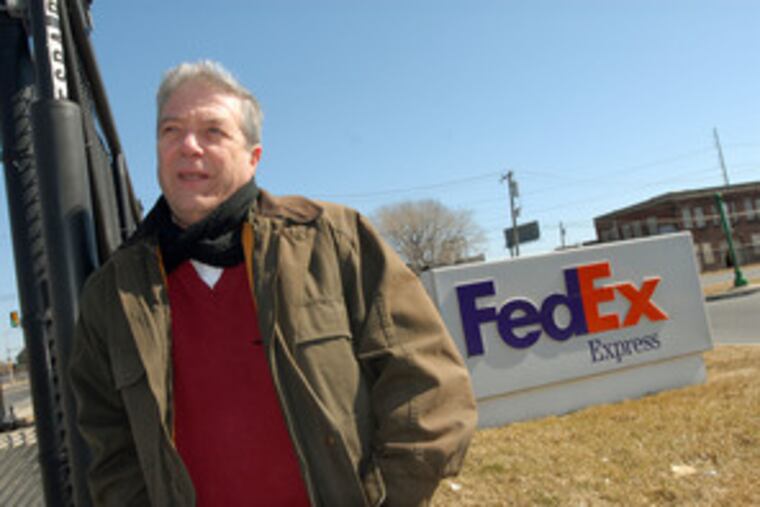
Don't tell developer Stephen Stein he can't fight City Hall.
Ever since Philadelphia took land he owned on Grays Ferry Avenue near 36th Street to pave the way for a FedEx facility in 2001, there have been days Stein stubbornly thinks of nothing else.
The heart of his claim is that the city confiscated his land illegally to benefit a private company.
"I want my ground back, and I want reimbursement for all my legal fees," he said, thumbing through documents in the two lawsuits he filed against the taking, and a surveyor's plan of the 3.5 disputed acres.
The empty land, in a run-down part of the city formerly used for meat packing, was declared "blighted" a decade ago by the Redevelopment Authority.
How distressed is the surrounding area? The nearest neighborhood is called Forgotten Bottom.
Stein, who lives in Narberth and dabbles in several businesses, including the sale of rock salt to municipalities for icy highways, portrays himself as a one-man band against insiders aligned with powerful forces in the city's administration. He hints, without providing evidence, that the rights of scores of Philadelphia property owners have been abused when the government's power to condemn property for the public good has been wielded for the private gain of well-connected parties.
The Redevelopment Authority, in a brief filed by its lawyer Paul Sandler, said taking Stein's parcel was consistent with the authority's goal of ameliorating blight to make the area more attractive for commercial and residential development. Asked last month and again last week if that meant the apparent benefit to FedEx was purely incidental, Sandler said he needed to check whether his client, the Redevelopment Authority, wanted him to speak publicly about the case. He never called back.
Marjorie Stern Jacobs, coauthor of supplements to the leading text on Pennsylvania eminent-domain law, is an authority on the subject. A former Philadelphia deputy solicitor now in private practice with Duane Morris, the city's 11th-largest law firm, Jacobs has been on both sides of condemnation disputes.
In her experience, she said, most are about fair compensation, not the legitimacy of the underlying decision to take the land. She doubted whether the law in Philadelphia was used routinely to benefit private parties.
But Stein, sticking to his guns, thinks that it is and that his perseverance can be the catalyst for a potential federal class-action lawsuit. Represented by lawyer Michael Pileggi, Stein has filed a federal civil-rights action that alleges the taking is illegal.
Stein is also in Pennsylvania state court, represented by attorney Sue French of Wolf, Block, Schorr & Solis-Cohen, the city's ninth-largest law firm. In 2005, a Common Pleas jury awarded Stein $1.5 million for his confiscated ground. But no money changed hands because both sides appealed. Oral arguments in the case were heard last week by a three-judge panel of Commonwealth Court.
"Even if one could argue that there is a public purpose to bringing FedEx and the jobs it brings to Philadelphia, all [the city] needed was to condemn for a right-of-access easement" to create a driveway, "and Stein could have held onto his land," French said.
Whether Stein's posture is a principled stand or a legal tactic to raise his damages is a good question. It could be both.
Under the law of eminent domain, the government has the right to condemn, confiscate and pay fair market value for any property if the purpose of the taking is "the public good."
But Stein, 64 - whose real estate business, Down Under G.F.B. Inc., was cofounded by his father, Morris, now deceased - contends the taking of his dogleg-shaped parcel near a bend in the Schuylkill was solely to benefit a private party, FedEx, which built a distribution warehouse on adjacent ground in 2001 and needed Stein's parcel to create a driveway.
Among the evidence Stein has marshaled is a 2004 e-mail acquired through legal discovery. The e-mail is from a manager in the city Commerce Department to a lawyer for another city department. It states that the condemnation of Stein's land "was catalyzed due to the FedEx property transaction and for no other reason."
Another element of Stein's case is a contract between the city's industrial development authority and the real estate acquisition arm of FedEx. In it, the city agrees to condemn Stein's land and convey it to FedEx "free of charge."
Although the city at first offered Stein $159,000 for his land and then raised it to $250,000, he appealed to a three-person panel of the city's Board of View, which in 2003 raised his damages to $910,000, with interest.
But the case didn't stop there.
The city appealed to Common Pleas Court, hoping to get the figure reduced. Stein cross-appealed, believing the land would be worth between $2 million and $4 million if the adjacent Waste Management Inc. solid-waste transfer station eventually activated a contiguous rail spur so it could move trash by train to distant landfills as the ones in the Philadelphia region filled up.
That, says Stein, is the "highest and best use of the land." If in the end he can't get it back, he wants at least to be paid accordingly.