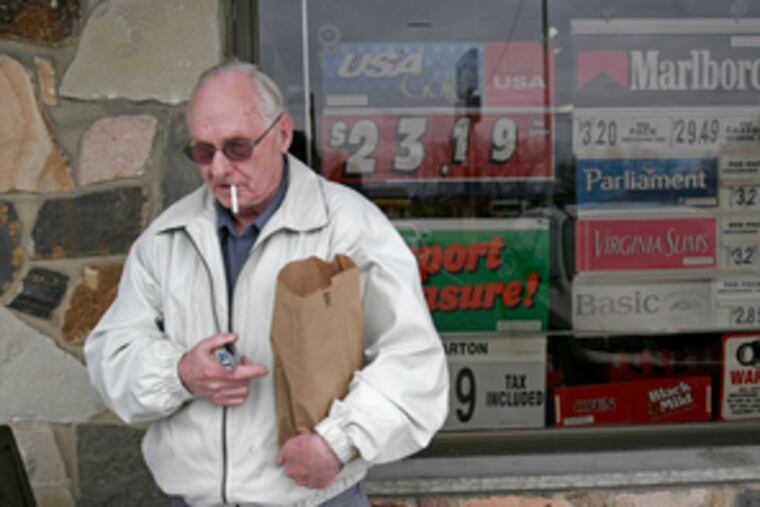
NEW CASTLE, Del. - One after another, the cars pull into the parking lot of an unassuming strip mall just a short jaunt from the Delaware Memorial Bridge.
Pennsylvania plates, Jersey plates. Barely a Delaware tag in the bunch.
The destination? The Delaware Tobacco Outlet, just one of many such emporiums in this tiny state.
The lure: smokes that are a whole lot cheaper than those closer to home, thanks to Delaware's low cigarette tax.
"I try to come once every two weeks," said Tracy Major, 46, a laborer from Salem County who looked pretty happy with his score of Marlboro Lights. "It's two for the price of one."
Just as New Jersey is the place for Pennsylvanians to go for lower liquor prices, Delaware is a regular port of call for smokers from Pennsylvania, New Jersey, Maryland, and even New York.
Do the math.
New Jersey, with a tax of $2.58 a pack, has the highest state cigarette tax in the country, according to data compiled by the Campaign for Tobacco-Free Kids. The Garden State raised its tax four times in the last five years. Pennsylvania is 17th in the nation with $1.35 a pack. The tax was increased twice in the last five years, and Gov. Rendell wants to hike it another 10 cents.
Compare that to Delaware, where the tax is a mere 55 cents a pack, although Gov. Ruth Minner would like to raise it to $1.
(For what it's worth, the most expensive place to buy cigarettes in the country is Chicago, where city, county and state taxes cha-ching in at $3.66 a pack.)
The tax difference means a pack of Marlboros that costs $5.96 in Jersey and $4.41 in Pennsylvania is $3.10 at the Delaware Tobacco Outlet.
No one knows how many out-of-staters buy butts in Delaware. However, some would say that other states' tax hikes have been Delaware's windfall, particularly in recent years.
"It's like we had the benefit of a tax hike without having to raise taxes. Other people are paying for it," said David Gregor, Delaware Finance Department's chief of fiscal and policy analysis.
This year, Delaware's cigarette tax revenues are expected to reach $90 million – an increase of more than 200 percent, from almost $28 million in 2002.
In fiscal 2003, when Pennsylvania and New Jersey raised cigarette taxes and Delaware imposed a statewide ban on smoking in public places, the First State's cigarette tax revenue jumped nearly 32 percent.
"There's no other explanation for that other than the prices in other states," Gregor said. "People in Delaware didn't raise their smoking 30 percent."
In New Jersey, tax increases helped cigarette tax revenues rise 103 percent from $388.7 million in 2002 to $789 million last year, according to figures provided by state Treasury spokesman Mark Perkiss.
In Pennsylvania, cigarette tax revenues grew almost 197 percent during the same period. However, partly due to a drop in smoking, revenue is expected to fall this year by $14 million, or 2 percent, if Rendell doesn't get his tax increase, state Revenue Department spokeswoman Stephanie Weyant said.
So it's no surprise that Delaware cigarette outlets have multiplied.
"It was only us for a number of years," said Shirley Legeza, manager of the Delaware Tobacco Outlet on smoke-shop-dense Route 13. "Within the last four years they've cropped up all over."
Of her store's customers, "I would say 95 percent are from out of state," Legeza said.
But it's not all easy.
"It's a competitive business," said Mitch Minker, regional manager of Delaware Cigarette & Tobacco Outlets, which has 11 stores. "There's stores up and down the highway. And people are quitting smoking every day. You have to have a good location and a good price."
Selling cigarettes to out-of-staters doesn't violate Delaware law, said David Smith, special investigator for the state Finance Department.
Bringing them home is another story. What smokers may consider simply exercising their inalienable right to a bargain the government considers tax evasion.
It's illegal to have out-of-state cigarettes in New Jersey, Perkiss said.
In Pennsylvania, you are allowed to have up to a carton, but you're still supposed to pay the amount of tax you would have paid if you bought them in-state, according to Weyant.
Folks aren't exactly rushing to volunteer that tax; Pennsylvania collected only $16,660 that way last year.
Nor are enforcement agents lying in wait on the other side of the bridge, ready to nab smokers and their Delaware discounts.
Officials acknowledge they are more likely to pursue bigger fish, such as people buying to resell, and, more recently, people evading the tax by buying cigarettes from online or mail-order vendors. States have recently begun invoking a federal law that requires those vendors to surrender the names of customers so authorities can go after them for the tax.
Since the late 1990s, New Jersey has collected about $10 million from residents who had tried to duck the tax by buying online or through mail order, Perkiss said.
Pennsylvania also intends to go after online and out-of-state mail-order cigarette customers.
Last week, the state Department of Revenue sent tax bills to more than 4,300 Pennsylvanians who bought at least 100 cartons of cigarettes via mail or Internet since January 2005.
Because some of those people might not have known they were doing anything wrong, Weyant said a deferred payment plan is available.
Will that increase the number of people crossing the bridge? It's already pretty lively.
"On Saturday alone, I pumped out 1,200 customers," said Billie Mayhall, manager of the Dot Cigarette Outlet on Route 13.
Her customers, many of them regulars, have her sympathy.
"The price of everything goes up. When does your pay go up to meet it? Never," Mayhall said. "You need to go looking elsewhere to find things at a cheaper price."
Quite a few of the out-of-staters on Route 13 last week said they there's more to the trip than buying cigarettes. They eat lunch, visit family, shop.
"We make a day of it," said Cindy Brownlow, 41, a decorator from Millville. "Sometimes I'll head over to Entenmann's and get some snacks."
Pete Czajka, 51, a security worker from Philadelphia, said he'd been going to Delaware for a few years - "ever since the cigarettes started getting too high for me."
Like a lot of other shoppers, he felt smokers were being unduly taxed.
"It's aggravating," he said.
"They pick certain things where nobody can do anything, and they target them," he said.
Of course, he could quit. Others have.
"We know absolutely without question when you raise cigarette taxes, you reduce smoking, especially among kids, lower-income groups, and pregnant women," said Eric Lindblom, policy research director of the Campaign for Tobacco-Free Kids.
However, he noted, "The people you get to quit typically are not the people who will cross state lines."
That would be James Hannold, 36, of Vineland.
Would higher taxes make him quit? "No," he said.
"You're always going to have a state like Delaware," said Hannold, a factory worker. "If not Delaware, you go to Virginia."
He may have point. In Virginia, the tax is only 30 cents a pack, not counting the price of gas.
Smoking and Taxes
Delaware N.J. Pa.
State cigarette tax per pack $0.55 $2.58 $1.35
Tax-rate rank 37 1 17
Adult smoking rank (1=low) 27 8 43
Adult smoking rate, in percent 20.7 18.1 23.7
Youth smoking rate, in percent 21.2 19.8 23.1
Source: Campaign for Smoke-Free Kids
EndText