Camden's baseball-inspired rally comes up short
There will be bottomless popcorn, fireworks, and, as always, that stunning view of the Philadelphia skyline. The Riversharks have a lot to celebrate Friday at Campbell's Field, when they hold their 10th-season home opener, with former Phillies outfielder Von Hayes as team manager.
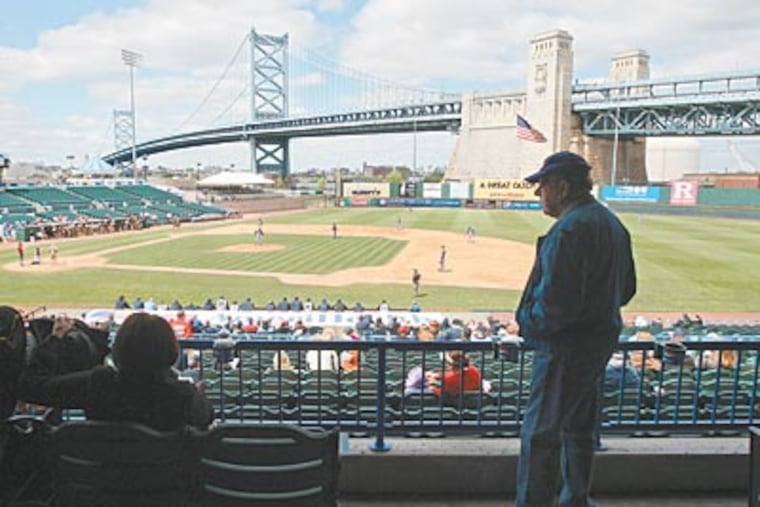
There will be bottomless popcorn, fireworks, and, as always, that stunning view of the Philadelphia skyline. The Riversharks have a lot to celebrate Friday at Campbell's Field, when they hold their 10th-season home opener, with former Phillies outfielder Von Hayes as team manager.
The minor-league club has helped raise hundreds of thousands of dollars for local charities and provided up to 100 jobs a season. The park is a boon to families, beautiful and inexpensive to attend.
"To me, it looks as good today as it did 10 years ago," said Tom Corcoran, who was president of the Cooper's Ferry Development Association, a partner in the project, when Campbell's Field was built.
As an economic engine, however, the Riversharks have underperformed. When selling the stadium to Camden, backers predicted attendance of close to 5,000 a game, $7 million in gross annual revenue, and up to $210,000 a year directed to the city through a 50-cent ticket surcharge.
Partners in the project hoped the stadium would leverage millions of dollars in waterfront redevelopment. Camden residents would embrace the team as their own, they promised.
Instead, income to the city last year from the surcharge, paid in lieu of taxes, was about a third of the early projection. Published attendance averaged 3,700 a game, but the Sharks paid the surcharge on just 58 percent of tickets because many were distributed through sponsorship deals.
The stadium has changed people's impression of Camden, says Riversharks general manager Adam Lorber. In its first years, families never would have attended the outfield sleepovers popular today, he said.
"You're out in the open, in the middle of Camden, and nobody's worried about anything," Lorber said.
But it is debatable whether fostering a sense of the stadium as an oasis in one of the nation's most dangerous cities has helped the surrounding area.
The team is "an excellent neighbor and business partner," according to Mayor Dana Redd, yet few businesses have grown up in the ballpark's shadow.
Plans to build an adjacent retail-and-recreation complex were canceled before Campbell's Field was completed. Construction of a Delaware River tram that could have given sports-crazed Philadelphia easy access to the games is stalled indefinitely. Plans for a nearby hotel folded.
From his office in Philadelphia, where he is executive director of the Delaware River Waterfront Corp., Corcoran can see the stadium. He says he is optimistic that the retail development many hoped for could come through when the economy improves.
The situation is familiar to Rick Eckstein, a Villanova University sociology professor who has studied the community impact of more than three dozen stadiums and cowrote the book Public Dollars, Private Stadiums: The Battle Over Building Sports Stadiums.
The letdown in Camden is part of a national pattern, Eckstein said. He said he had expected developers to realize five years ago that stadiums make poor economic-development tools.
"The schools that were supposed to be saved weren't," he said. "All the residential and commercial development that [is] supposed to spring up around the ballpark doesn't."
The same thing could play out in Chester, where a $115 million soccer stadium is being built in hopes it will provide a much-needed local stimulus, Eckstein said.
Campbell's Field changed the face of the waterfront, and that's worth something, says Anthony Perno, who holds Corcoran's former seat at Cooper's Ferry. The makeover was key to the transformation of Camden's historic Nipper Tower into condominium units by developer Carl Dranoff.
"Now, when [Dranoff] looked out his windows on the waterfront, instead of looking at a brownfield just off the Ben Franklin Bridge," Perno said, "he was looking at Campbell's Field."
The stadium project cost $21.25 million, including $8.5 million in public money the Riversharks won't begin paying off until 2020.
When Stephen R. Shilling, a Voorhees developer and former banker, brought the idea of locating a team from the independent Atlantic League - focused more on offering family outings than thrilling baseball, and not affiliated with Major League Baseball - he knew it would take several years and debt refinancing to become profitable, Corcoran said.
Shilling had a long-term plan, and he was committed to being part of change on the waterfront.
When he died of brain cancer in 2003, his estate could not carry the money-losing Riversharks. A group of owners led by Opening Day Partners, which has developed ballparks and owns three more teams, bought the club in 2004, just in time to save it from forfeiting its season.
For the last few years the team has operated at about break even, plus or minus $50,000, said Opening Day chairman Peter Kirk, who would not give details.
That is despite what Kirk calls the worst rental agreement in minor-league ball. Though Rutgers-Camden owns the stadium, the team maintains it through a complicated lease agreement. It also pays the debt: about $800,000 yearly, according to Kirk.
He is negotiating with primary debtholder Sovereign Bank and other stadium partners to change that, he said.
He is unlikely to get much enthusiasm from Rutgers, whose Scarlet Raptors play at the facility. As a state entity - and with New Jersey's budget troubles looming large - it would be unwise for the school to "support somebody's bottom line at the expense of either the students or taxpayers," said Larry Gaines, the school's vice chancellor for administration.
The New Jersey Economic Development Authority and Delaware River Port Authority already extended the terms of their loans, for $2 million and $6.54 million.
If he succeeds in negotiations with Sovereign, Kirk said, "the Riversharks will have a very bright future."
He has plans for a skate park and a year-round "life skills" center named for Opening Day partner Brooks Robinson, the famed Baltimore Orioles third baseman. Kirk is looking for "anybody with a checkbook" to join in.
Through the center, he said, Camden children could get homework help, job training, and team internships. And they could learn baseball.
Attendance by Camden residents is relatively low. About 13 percent of advance tickets are purchased by locals. There is little baseball culture in the city and limited opportunity for children to play.
Just two neighborhoods have youth leagues. A T-ball field a few blocks from the stadium on York Street has been unused for years, and baseball diamonds at Pyne Point Park in North Camden are overrun by dirt bikes.
The Sharks help support Cramer Hill's Little League, providing tickets, visits by mascot Finley and players, and the occasional chance to play at the stadium.
Some have asked why the Sharks don't work more with neighborhood groups instead of creating their own life-skills facility. But Bryan Morton, a community activist who can see the stadium from the house he grew up in, finds the idea for such a center "applaudable."
Until this season, no local vendors sold concessions at the park, despite early promises that Camden eateries would be hired.
Fifteen cooks trained with Respond Inc. will supply the stadium with the North Camden nonprofit's signature fried chicken, work in kitchens there, and provide a dessert cart. Respond's executive director, Wilbert Mitchell, said that if the pilot program succeeded, he hoped to do more.
Assemblyman Angel Fuentes (D., Camden), City Council president when the stadium was built, said that the waterfront had developed sluggishly but that he remained hopeful. He has coordinated a meeting with Redd and investors from New York, Philadelphia, and China next month about options, including a possible hotel, he said.
Guard towers at Riverfront State Prison, formerly visible from the stands, are gone. The prison was demolished last year, opening the property for development north of the Ben Franklin Bridge.
And Campbell Soup has renewed its stadium naming rights agreement for another 10 years - a $3.2 million bet that baseball will be in Camden for a while.