Lockheed shows off F-35 fighter amid budget concerns
Tucked into a tight cockpit simulator of the U.S. military's newest fighter jet, Gina Diorio seemed a little overwhelmed by the high-tech gadgetry around her.
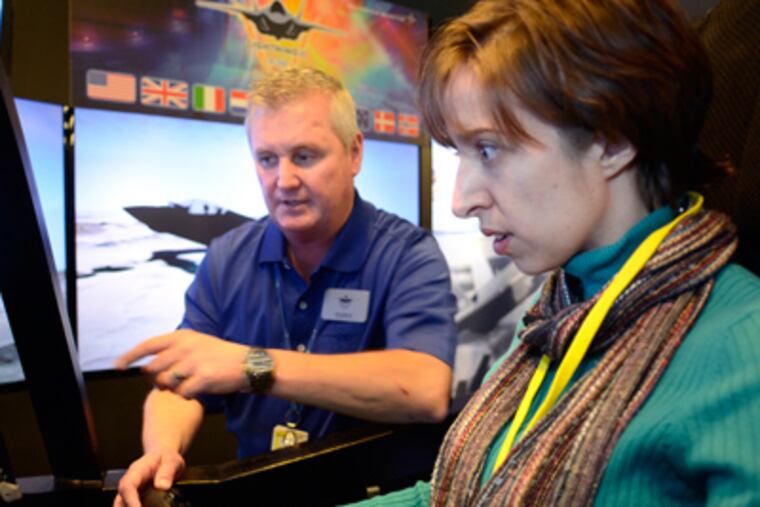
Tucked into a tight cockpit simulator of the U.S. military's newest fighter jet, Gina Diorio seemed a little overwhelmed by the high-tech gadgetry around her.
She caught on fast, taking off, retracting landing gear, then climbing to engage "enemy" aircraft. Two missiles, seen on big screens, cut through the sky to their targets.
"It was fun and informative," said Diorio, district office director for U.S. Rep. Scott Garrett (D., N.J.). She polished off her flight with two victory rolls.
The demonstration of the controversial F-35 Lightning II fighter and an update on its development and production Thursday at Lockheed Martin in Mount Laurel had a celebratory tone to it.
Officials at the company - which plans to construct more than 2,443 of the fighters for the Marines, Navy, and Air Force - highlighted the $382 billion project's local economic impact, the crafts' stealth and vertical-landing capabilities, and the need to replace the nation's aging fighters.
What didn't come up were the project's massive cost overruns, delays, and future prospects, considering the economic downturn and the mandate to reduce federal spending.
If Congress' bipartisan Joint Select Committee on Deficit Reduction can't agree on budget-cutting recommendations by Nov. 23 or Congress fails to enact them by Dec. 23, the result would be $1.2 trillion in automatic spending cuts in January 2013. Half would come from Pentagon programs.
"It would be inappropriate for Lockheed Martin to comment on the specific budget negotiations concerning budget cuts currently taking place," Sam Grizzle, spokesman for the company's aviation programs, said Thursday.
"We remain focused on delivering value to our customers by supporting their global security missions including the F-35 program," he said. " . . . We continue to make progress towards meeting the expectations of our U.S. and Allied forces."
The F-35 project is the military's largest weapons procurement program in history. U.S. allies including Britain, Australia, Canada, Israel, Italy, Denmark, Norway, the Netherlands, and Turkey have expressed interest in buying the aircraft, which cost an estimated $65 million each.
Defense Department officials said this month that India's military also could use a jet like the F-35, which has a top speed of up to 1,200 miles an hour.
Delivery of the aircraft, originally set for 2010, is expected in 2016.
"For more than a decade, the U.S. and our allies have invested in the development of the F-35, which will serve as a cornerstone of global security for many years," said Stephen Callaghan, director of Lockheed Martin's F-35 Programs in Washington.
The program will impact the U.S. economy directly and indirectly, generating over 127,000 jobs, he added.
With 51 suppliers in New Jersey - including Camden's L-3 Communications, which manufactures defense systems and equipment - company officials said the program has provided 950 jobs in the state and pumped more than $63 million into the economy.
In Pennsylvania, it supports 260 jobs through 47 suppliers and has added $31 million to the economy.
Lockheed Martin has been part of the Delaware Valley economy for almost 60 years, said Dale Bennett, president of the Mission Systems and Sensors business unit in Mount Laurel.
It employs more than 9,000 people in the region, Bennett said, and pays New Jersey-based suppliers approximately $770 million annually.
"The F-35 program is a critical element to our success in this region," he said.
The Joint Strike Fighter has been undergoing tests at Joint Base McGuire-Dix-Lakehurst to assess its capability to take off and land on an aircraft carrier deck.
Barring any reduction in federal spending, the Air Force expects to purchase 1,763 F-35s, while the Navy and Marines will buy a total of 680. More than 500 will go to allies.
Air Force and Navy versions are designed for conventional takeoff and landing on fixed runways and aircraft carriers. The Marines' F-35, the most complex model, is designed for short takeoffs and vertical landing.
"We are developing and testing," said Callaghan, a retired Navy aviator, who gave his update Thursday to New Jersey suppliers, elected officials, and Lockheed Martin executives.
"We are 9 to 10 percent ahead of plan on flights tests. We're making very good strides," he said.
The various F-35 versions share common parts, helping to keep costs down, officials said. The cost also is affected by the number of aircraft put into production. Lockheed Martin eventually hopes to turn out about 17 planes a month.
"As our [current fighter] planes get older, they become more expensive to maintain and operate," Callaghan said. "The threats in the world continue to advance, and the older ones won't survive. . . . We need the next generation" of fighters.
Watch a video of the F35 Lightning at www.philly.com
/lockheed EndText