Deconstructing Corzine, the liberal capitalist
Jon S. Corzine the politician was a relentless cheerleader for liberal causes. As a senator in George W. Bush's Washington, he advocated not just for universal health care but for free day care, too. As a governor in blue New Jersey, he limited gun purchases and enacted paid family leave so workers could care for ailing relatives.
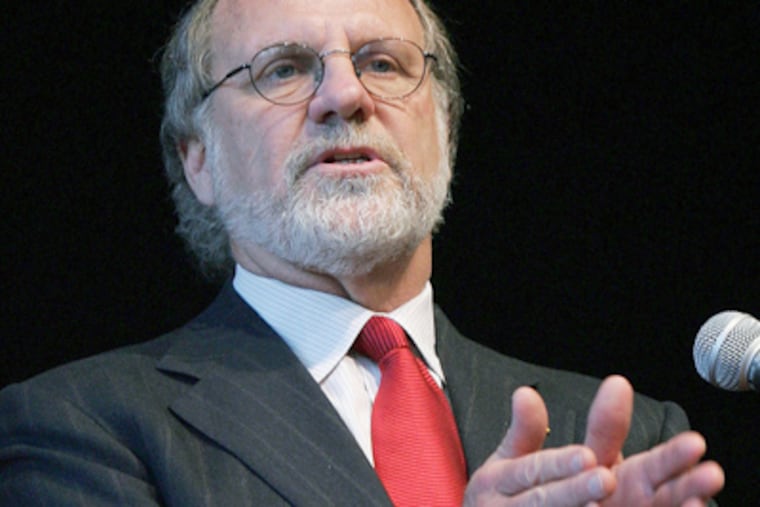
Jon S. Corzine the politician was a relentless cheerleader for liberal causes.
As a senator in George W. Bush's Washington, he advocated not just for universal health care but for free day care, too. As a governor in blue New Jersey, he limited gun purchases and enacted paid family leave so workers could care for ailing relatives.
But on Wall Street, where Corzine is now embroiled in the bankruptcy and investigation of his brokerage firm, MF Global, capitalist instincts appeared to trump liberalism.
Details are emerging about how the 64-year-old Democrat avoided governmental intervention over the last few months and pressed on with risky bets. He reportedly lobbied against a rule proposed by a federal regulatory agency that would have curbed the kind of transactions that eventually left MF Global in the hole.
"These are the kinds of risks in the marketplace that obviously have created a public-policy concern," said former New Jersey Sen. Robert Torricelli, who served with Corzine.
"If Jon had not had both a financial and political career of such a high profile, it might not have had so much scrutiny," Torricelli said. "Unfortunately, Jon is in the middle of what would amount to a public policy perfect storm."
Corzine's behavior on Wall Street, where he returned after losing reelection to Gov. Christie, suggests that he is either a political hypocrite or an unlucky businessman.
"He's a man of great integrity," said Bill Castner, who served as Corzine's chief counsel during his one term as governor. "It seems like he was a victim of the volatility of Wall Street and markets outside of his control, but that shouldn't take way from one of the most honest and authentic individuals I've ever worked for."
Yet from today's nerve center of progressive politics - namely the Occupy protests that have popped up across the country this fall - the perspective is different.
While the values Corzine pushed as a politician reflect those of many of the protesters, his risky trading of other people's money symbolizes the "greed" of the mega-rich that the protesters are railing against.
Protesters also disdain the incestuous relationship they perceive between business and politics. The federal regulator in charge of monitoring MF Global, for example, once worked for Corzine at his former bank, Goldman Sachs.
Several protesters at Occupy Philadelphia weren't familiar with Corzine's professional collapse. But they weren't surprised by it, either.
"People here have come to the conclusion that there's only one party," said Michael Pierce, 50, of Mount Holly, who has slept in a tent outside City Hall since the Occupy protests began last month. "The corporate and economic Wall Street structure is frankly running both [party's] campaigns."
Corzine, however, didn't rely on donations to fund his campaigns, as most politicians do; he used more than $100 million from the fortune he amassed at the helm of Goldman Sachs to self-finance his Senate run in 2000 and his gubernatorial campaigns in 2005 and 2009. He literally bought support from the state's political fiefdoms and then played hardball campaign politics to make sure he won.
As governor, Corzine took a Clintonian approach, with progressive-minded social views buttressed by corporate-minded economic policies, said Deborah Howlett, Corzine's former communications director. Corzine expanded corporate subsidies, and he tried, but failed, to sell up to $38 billion in bonds to pay down state debt and fix roadways while simultaneously hiking tolls.
"He understands business and he takes risks, and that's what we're seeing here," Howlett said. "I really think he thought MF Global was a challenge and a chance for him to make a success after losing the election. He came close - he likes to walk that edge. He's willing to take the risk to get the big reward."
One of his most notable risks: Not wearing a seat belt while his state trooper sped down the Garden State Parkway in 2007, nearly killing him midterm.
"He realized that he was fortunate enough to have been elected governor; he was fortunate enough to have survived a life-threatening accident, and he wanted to make the most of his opportunities while he was governor," Castner said. "That led him to talk about big ideas, big policies, big solutions, and I think that was a hallmark of his tenure as governor."
Castner described Corzine's record as progressive and strong. During his term, the state rewrote the public school funding formula and abolished a practice that allowed wealthier towns to shift their state-mandated affordable housing obligations onto poorer towns.
Often described as single-minded in his desire to to win, Corzine shut down state government to get his proposed budget passed.
But he doesn't have much to show for his quest to improve the lives of the poor. Camden, which he ran through a state takeover, remains one of the poorest and most dangerous cities in the country.
And a damning report released last week by the left-leaning New Jersey Policy Perspective found that the state bled jobs from 2000 to 2010, the "lost decade." Corzine was in charge for four of those years, during which he reduced the state workforce.
Corzine, bearded and clad in sweater vests unusual for a politician, also failed to connect with citizens and, often, other politicians.
Inside, though, former associates and observers say there really is a bleeding heart for the poor.
"Since he entered the public realm you'd be hard to find someone who so consistently advocated liberal position on the issues without qualification, without any kind of regard for the popularity of his views," said Brigid Harrison, political scientist at Montclair State University.
"We saw him traditionally advocating for more government and more government regulation. And I guess he thought it didn't apply" with MF Global, she said.
The political fallout from Corzine's corporate collapse has begun, with Republicans calling for Corzine to return the money he has raised for President Obama's reelection campaign.
In a statement Friday, Corzine expressed remorse: Resigning "was a difficult decision, but one that I believe is best for the firm and its stakeholders. I feel great sadness for what has transpired at MF Global and the impact it has had on the firm's clients, employees and many others."
Corzine's future is far murkier than when he was rumored as a potential Treasury secretary under Obama.
Still considerably wealthy - he reportedly earned more than $4 million for his short tenure at the firm - he notably is not taking up to $12 million in severance.
While he was still governor, Corzine told Bond Buyer newspaper about the need to restructure massive short-term bonuses paid to Wall Street executives. And he seemed to bemoan the significance of the very line of work he would find himself in just a year later:
"The overemphasis on financial services in the broader spectrum of the economy relative to real production is probably a bigger problem than bonuses . . . And you wonder - you're always going to need bankers and remediation, but is this the best allocation of the bright minds, and are relative compensation levels in other parts of our economy properly represented in that competitive marketplace?"
It's unclear how Corzine reconciles the left part of his political soul, which made him question the pull of Wall Street money and feel sympathy for those who don't have it - and the other part, which made him compete at all costs for many pieces of the American pie.
"There's not a simple answer to any of these questions about Corzine," Howlett said. "It's very complicated."
Staff writer Maya Rao contributed to this article.